Zlatanova Ivana, Pinto Cristina, Silvestre Jean-Sébastien
UMRS-970, Paris Centre de Recherche Cardiovasculaire, Institut National de la Santé et de la Recherche Médicale (INSERM), Sorbonne Paris Cité, Université Paris Descartes , Paris , France.
Front Cardiovasc Med. 2016 Oct 14;3:40. doi: 10.3389/fcvm.2016.00040. eCollection 2016.
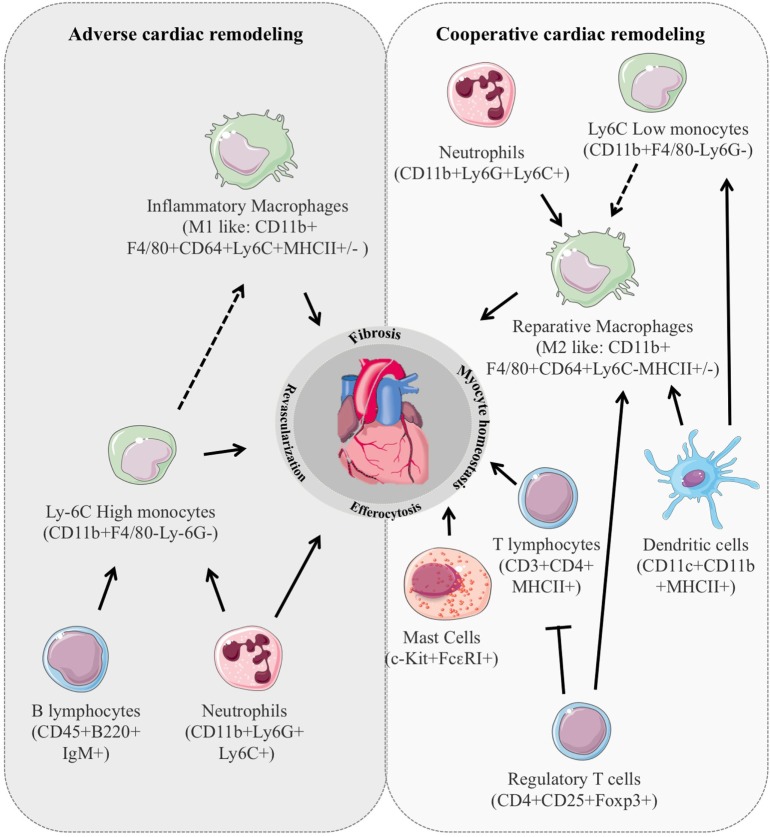
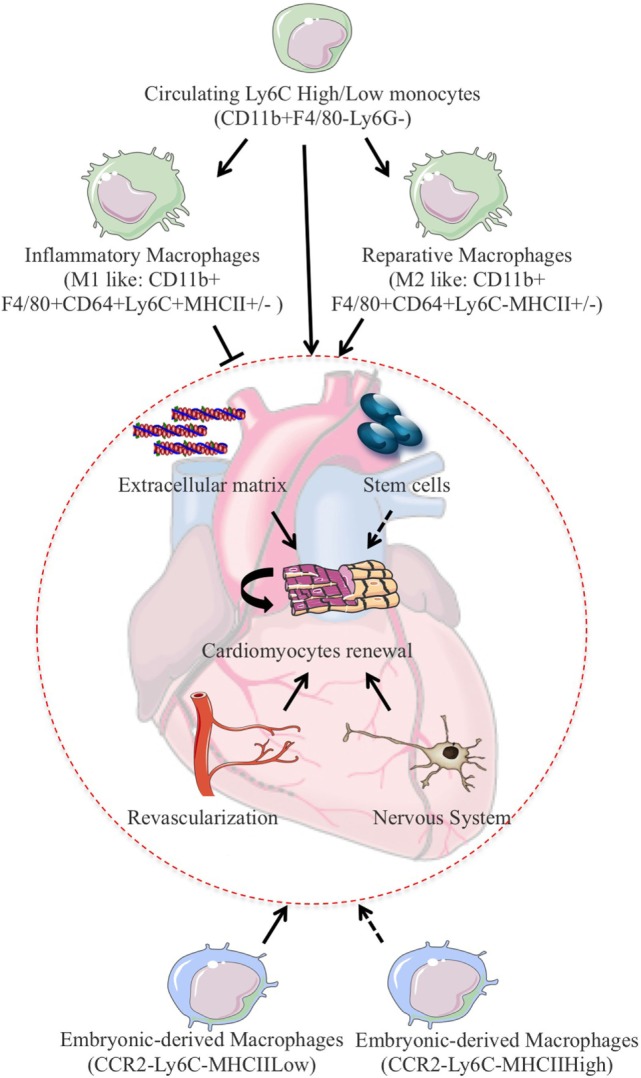
The accumulation of immune cells is among the earliest responses that manifest in the cardiac tissue after injury. Both innate and adaptive immunity coordinate distinct and mutually non-exclusive events governing cardiac repair, including elimination of the cellular debris, compensatory growth of the remaining cardiac tissue, activation of resident or circulating precursor cells, quantitative and qualitative modifications of the vascular network, and formation of a fibrotic scar. The present review summarizes the mounting evidence suggesting that the inflammatory response also guides the regenerative process following cardiac damage. In particular, recent literature has reinforced the central role of monocytes/macrophages in poising the refreshment of cardiomyocytes in myocardial infarction- or apical resection-induced cardiac insult. Macrophages dictate cardiac myocyte renewal through stimulation of preexisting cardiomyocyte proliferation and/or neovascularization. Nevertheless, substantial efforts are required to identify the nature of these macrophage-derived factors as well as the molecular mechanisms engendered by the distinct subsets of macrophages pertaining in the cardiac tissue. Among the growing inflammatory intermediaries that have been recognized as essential player in heart regeneration, we will focus on the role of interleukin (IL)-6 and IL-13. Finally, it is likely that within the mayhem of the injured cardiac tissue, additional types of inflammatory cells, such as neutrophils, will enter the dance to ignite and refresh the broken heart. However, the protective and detrimental inflammatory pathways have been mainly deciphered in animal models. Future research should be focused on understanding the cellular effectors and molecular signals regulating inflammation in human heart to pave the way for the development of factual therapies targeting the inflammatory compartment in cardiac diseases.
免疫细胞的聚集是心脏组织损伤后最早出现的反应之一。先天性免疫和适应性免疫共同协调心脏修复过程中不同且并非相互排斥的事件,包括清除细胞碎片、剩余心脏组织的代偿性生长、驻留或循环前体细胞的激活、血管网络的数量和质量改变以及纤维化瘢痕的形成。本综述总结了越来越多的证据,表明炎症反应也指导心脏损伤后的再生过程。特别是,最近的文献强化了单核细胞/巨噬细胞在心肌梗死或心尖切除引起的心脏损伤中对心肌细胞更新的关键作用。巨噬细胞通过刺激已有的心肌细胞增殖和/或新生血管形成来决定心肌细胞的更新。然而,需要付出巨大努力来确定这些巨噬细胞衍生因子的性质以及心脏组织中不同巨噬细胞亚群所产生的分子机制。在已被确认为心脏再生重要参与者的不断增加的炎症介质中,我们将重点关注白细胞介素(IL)-6和IL-13的作用。最后,在受损心脏组织的混乱局面中,可能会有其他类型的炎症细胞,如中性粒细胞,加入进来,为破碎的心点燃希望并使其恢复生机。然而,保护和有害的炎症途径主要是在动物模型中得到阐释的。未来的研究应聚焦于了解调节人类心脏炎症的细胞效应器和分子信号,为开发针对心脏病炎症部分的实际疗法铺平道路。