Department of Medicine, Memorial Sloan Kettering Cancer Center, New York, NY, USA.
Medical Oncology, Beatson West of Scotland Cancer Center, Glasgow, UK.
Br J Cancer. 2021 Jan;124(1):237-246. doi: 10.1038/s41416-020-01092-0. Epub 2020 Oct 7.
No biomarkers have been established to predict treatment efficacy in renal cell carcinoma (RCC). In an exploratory retrospective analysis of a Phase 2 study, we constructed composite biomarker scores (CBSs) to predict progression-free survival (PFS) and overall survival (OS) in patients with metastatic RCC randomised to receive lenvatinib-plus-everolimus.
Of 40 biomarkers tested, the 5 most strongly associated with PFS (HGF, MIG, IL-18BP, IL-18, ANG-2) or OS (TIMP-1, M-CSF, IL-18BP, ANG-2, VEGF) were used to make a 5-factor PFS-CBS or OS-CBS, respectively. A 2-factor CBS was generated with biomarkers common to PFS-CBS and OS-CBS. Patients were divided into groups accordingly (5-factor-CBS high: 3-5, CBS-low: 0-2; 2-factor-CBS high: 1-2, CBS-low: 0).
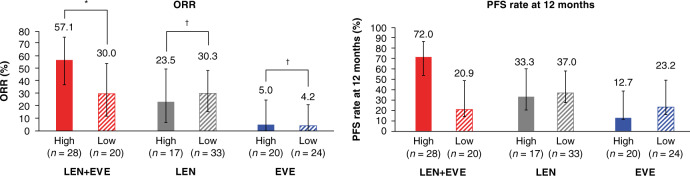
PFS/OS with lenvatinib-plus-everolimus were significantly longer in the 5-factor CBS-high group versus the CBS-low group (P = 0.0022/P < 0.0001, respectively). In the CBS-high group, PFS/OS were significantly longer with lenvatinib-plus-everolimus versus everolimus (P < 0.001/P = 0.0079, respectively); PFS was also significantly longer with lenvatinib-plus-everolimus versus lenvatinib (P = 0.0046). The 5-factor-CBS had a predictive role in PFS and OS after multivariate analysis. Similar trends were observed with the 2-factor-CBS for PFS (i.e., lenvatinib-plus-everolimus versus everolimus).
The 5-factor CBS may identify patients with metastatic RCC who would benefit from lenvatinib-plus-everolimus versus everolimus; additional validation is required.
The clinical trial registration number is NCT01136733.
目前尚无生物标志物可预测肾细胞癌(RCC)的治疗效果。在一项 2 期研究的探索性回顾性分析中,我们构建了复合生物标志物评分(CBS),以预测接受仑伐替尼联合依维莫司治疗的转移性 RCC 患者的无进展生存期(PFS)和总生存期(OS)。
在 40 个测试的生物标志物中,与 PFS(HGF、MIG、IL-18BP、IL-18、ANG-2)或 OS(TIMP-1、M-CSF、IL-18BP、ANG-2、VEGF)相关性最强的 5 个生物标志物分别用于构建 5 因素 PFS-CBS 或 OS-CBS。与 PFS-CBS 和 OS-CBS 共有的生物标志物生成 2 因素 CBS。患者据此分为相应的组(5 因素-CBS 高:3-5,CBS-低:0-2;2 因素-CBS 高:1-2,CBS-低:0)。
与 CBS 低组相比,仑伐替尼联合依维莫司治疗的 PFS/OS 在 5 因素 CBS 高组中显著延长(P=0.0022/P<0.0001)。在 CBS 高组中,与依维莫司相比,仑伐替尼联合依维莫司的 PFS/OS 显著延长(P<0.001/P=0.0079);与仑伐替尼相比,PFS 也显著延长(P=0.0046)。多变量分析显示,5 因素 CBS 对 PFS 和 OS 具有预测作用。对于 PFS,也观察到 2 因素 CBS 的类似趋势(即仑伐替尼联合依维莫司与依维莫司相比)。
5 因素 CBS 可能可以识别出转移性 RCC 患者,他们可能从仑伐替尼联合依维莫司治疗中获益,需要进一步验证。
临床试验注册号为 NCT01136733。