Department of Orthopaedic Surgery, Hirosaki University Graduate School of Medicine, 5 Zaifu-cho, Hirosaki, Aomori, 036-8562, Japan.
Department of Rehabilitation Medicine, Hirosaki University Graduate School of Medicine, 5 Zaifu-cho, Hirosaki, Aomori, 036-8562, Japan.
J Orthop Traumatol. 2020 Oct 7;21(1):18. doi: 10.1186/s10195-020-00557-5.
The purpose of this study is to compare the outcomes of acute primary repair of extraarticular ligaments with staged surgery for acute knee dislocations (KDs) and multiligament knee injuries (MLKIs).
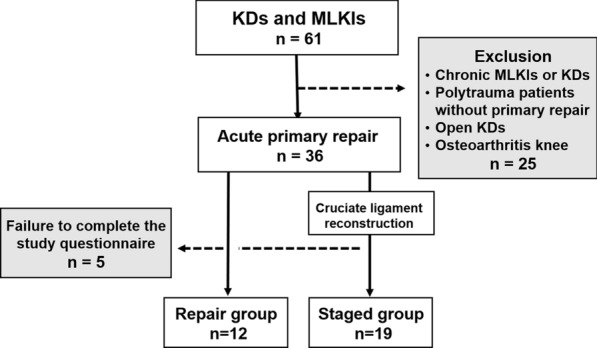
Between January 2005 and May 2018, 61 consecutive patients diagnosed with MLKI or KD were referred to or visited our institution. Of these, 31 patients who underwent acute repair of extraarticular ligaments within 3 weeks of injury were included in this study. These patients were retrospectively classified into two groups: those who underwent only primary repair (repair group) and those who underwent staged reconstructive surgery (staged group). Follow-up examination included range of motion (ROM), knee joint stability (Lachman test, posterior drawer test, and varus and valgus stress test), Lysholm knee score, Tegner activity scale, and Knee Injury and Osteoarthritis and Outcome Score (KOOS).
Twelve of the 31 patients did not need or desire further surgery and were included in the repair group. No significant difference was observed in demographic data between the repair and staged groups. Although staged surgery decreased positive posterior drawer test results, no significant difference was observed between the two groups regarding ROM, other knee joint stability tests, Lysholm scores, Tegner scale, or KOOS.
In this series, all patients returned to their activities of daily living and preinjury occupation levels. Acute primary repair of extraarticular ligaments provides essential knee stability without varus/valgus instability and may reduce the need for subsequent cruciate ligament reconstruction.
Level IV, retrospective observational study.
本研究旨在比较关节外韧带急性一期修复与分期手术治疗急性膝关节脱位(KD)和多韧带膝关节损伤(MLKI)的疗效。
2005 年 1 月至 2018 年 5 月,连续 61 例 MLKI 或 KD 患者就诊于我院,其中 31 例患者在受伤后 3 周内行关节外韧带急性修复术。回顾性分析这些患者,根据手术方式不同分为两组:仅行一期修复(修复组)和分期重建手术(分期组)。随访检查包括关节活动度(ROM)、膝关节稳定性(Lachman 试验、后抽屉试验、内外翻应力试验)、Lysholm 膝关节评分、Tegner 活动量表和膝关节损伤与骨关节炎评分(KOOS)。
31 例患者中,12 例患者不需要或不希望进一步手术,纳入修复组。修复组和分期组患者的人口统计学数据无显著差异。尽管分期手术降低了后抽屉试验阳性率,但两组间 ROM、其他膝关节稳定性试验、Lysholm 评分、Tegner 量表或 KOOS 无显著差异。
本研究中,所有患者均恢复了日常生活和术前职业活动水平。关节外韧带的急性一期修复提供了基本的膝关节稳定性,没有内外翻不稳定,可能减少后续交叉韧带重建的需要。
IV 级,回顾性观察研究。