Forouz Farzaneh, Dabbaghi Maryam, Namjoshi Sarika, Mohammed Yousuf, Roberts Michael S, Grice Jeffrey E
Therapeutics Research Group, University of Queensland Diamantina Institute, The University of Queensland, Woolloongabba, QLD 4102, Australia.
School of Pharmacy and Medical Sciences, University of South Australia, Adelaide, SA 5000, Australia.
Pharmaceutics. 2020 Oct 5;12(10):947. doi: 10.3390/pharmaceutics12100947.
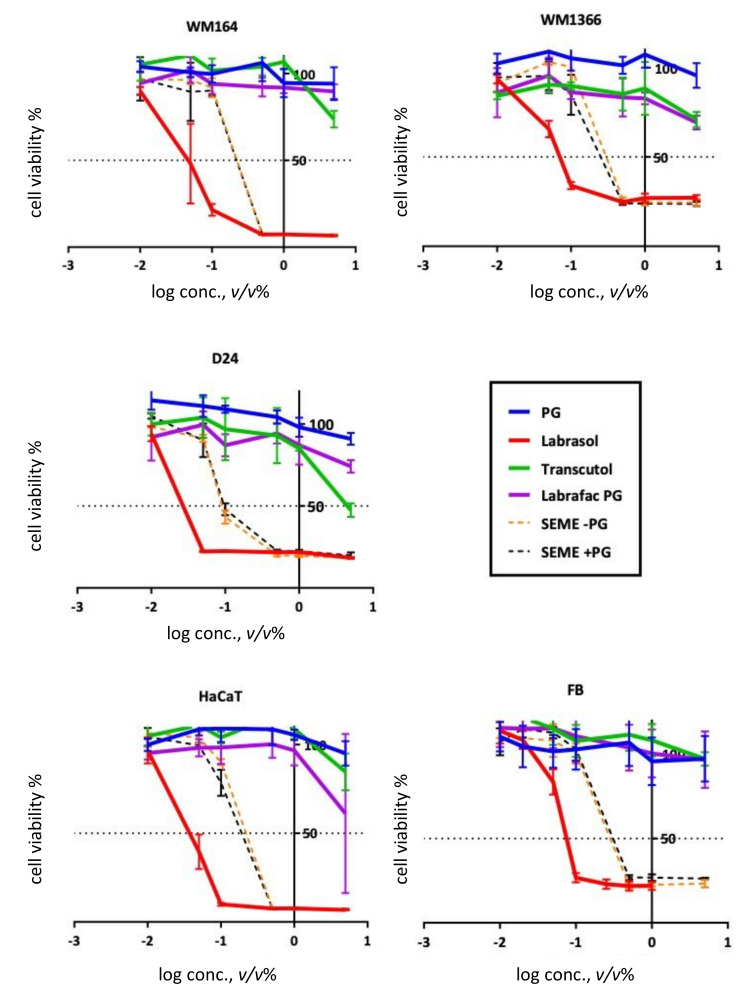
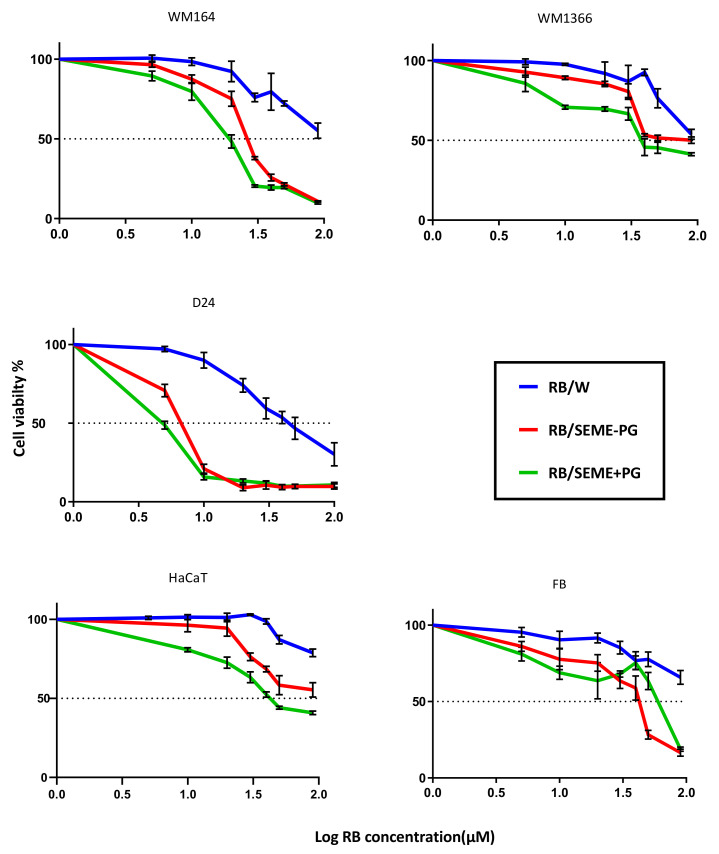
The topical delivery route is proposed as an alternative or adjunctive approach to melanoma treatment, since the target site for melanoma treatment-the epidermal basal layer-is potentially accessible by this route. Microemulsion systems are effective delivery vehicles for enhanced, targeted skin delivery. This work investigated the effect of Rose Bengal (RB) and RB-loaded self-emulsifying microemulsions (SEMEs) on growth inhibition of human melanoma and normal skin cell monolayers, the safety of the excipients incorporated in SEMEs on human cell lines, and the in-vitro human skin penetration of RB delivered in SEMEs and control solution. Cellular toxicity was assessed by the 3-(4,5-dimethylthiazol-2-yl)-2,5-diphenyltetrazolium bromide (MTT) assay, and the growth inhibitory mechanism of RB was investigated by flow cytometry using PI staining. Unloaded SEMEs caused reduced cellular toxicity compared to the surfactant excipient, Labrasol. RB-loaded SEMEs increased cell growth inhibition compared to the RB aqueous solution. Flow cytometry revealed apoptotic cells after treatment with RB-loaded SEMEs, indicating that apoptosis may be one of the mechanisms of cell death. Preliminary results of multiphoton microscopy with fluorescence lifetime imaging (MPM-FLIM) analysis showed deeper penetration with greater skin concentrations of RB delivered from SEMEs compared to the RB aqueous solution. This study highlights the enhanced skin penetration and antimelanoma effects of RB loaded in a SEME system.
由于黑色素瘤治疗的靶部位——表皮基底层——可通过该途径到达,因此局部给药途径被提议作为黑色素瘤治疗的替代或辅助方法。微乳系统是用于增强靶向皮肤给药的有效载体。本研究考察了孟加拉玫瑰红(RB)及载药自乳化微乳(SEME)对人黑色素瘤细胞和正常皮肤细胞单层生长抑制的影响、SEME中辅料对人细胞系的安全性以及SEME和对照溶液中RB的体外人皮肤渗透情况。通过3-(4,5-二甲基噻唑-2-基)-2,5-二苯基四氮唑溴盐(MTT)法评估细胞毒性,并使用碘化丙啶(PI)染色通过流式细胞术研究RB的生长抑制机制。与表面活性剂辅料Labrasol相比,未载药的SEME细胞毒性降低。与RB水溶液相比,载药SEME增强了细胞生长抑制作用。流式细胞术显示,载药SEME处理后出现凋亡细胞,表明凋亡可能是细胞死亡的机制之一。多光子显微镜荧光寿命成像(MPM-FLIM)分析的初步结果表明,与RB水溶液相比,SEME递送的RB在皮肤中的浓度更高且渗透更深。本研究突出了载于SEME系统中的RB增强的皮肤渗透和抗黑色素瘤作用。