Centre for Child Development and Education, Menzies School of Health Research, Charles Darwin University, Darwin, Australia.
Child Health Division, Menzies School of Health Research, Charles Darwin University, Darwin, Australia.
BMC Public Health. 2020 Oct 7;20(1):1521. doi: 10.1186/s12889-020-09620-6.
The prevalence of otitis media (OM) and related hearing loss has remained persistently high among some groups of Australian Aboriginal children who are also reported to have poor academic outcomes. The general literature remains inconclusive about the association between OM-related hearing loss and academic performance in primary school. This study aimed to investigate this association in Aboriginal children living in the Northern Territory (NT) of Australia.
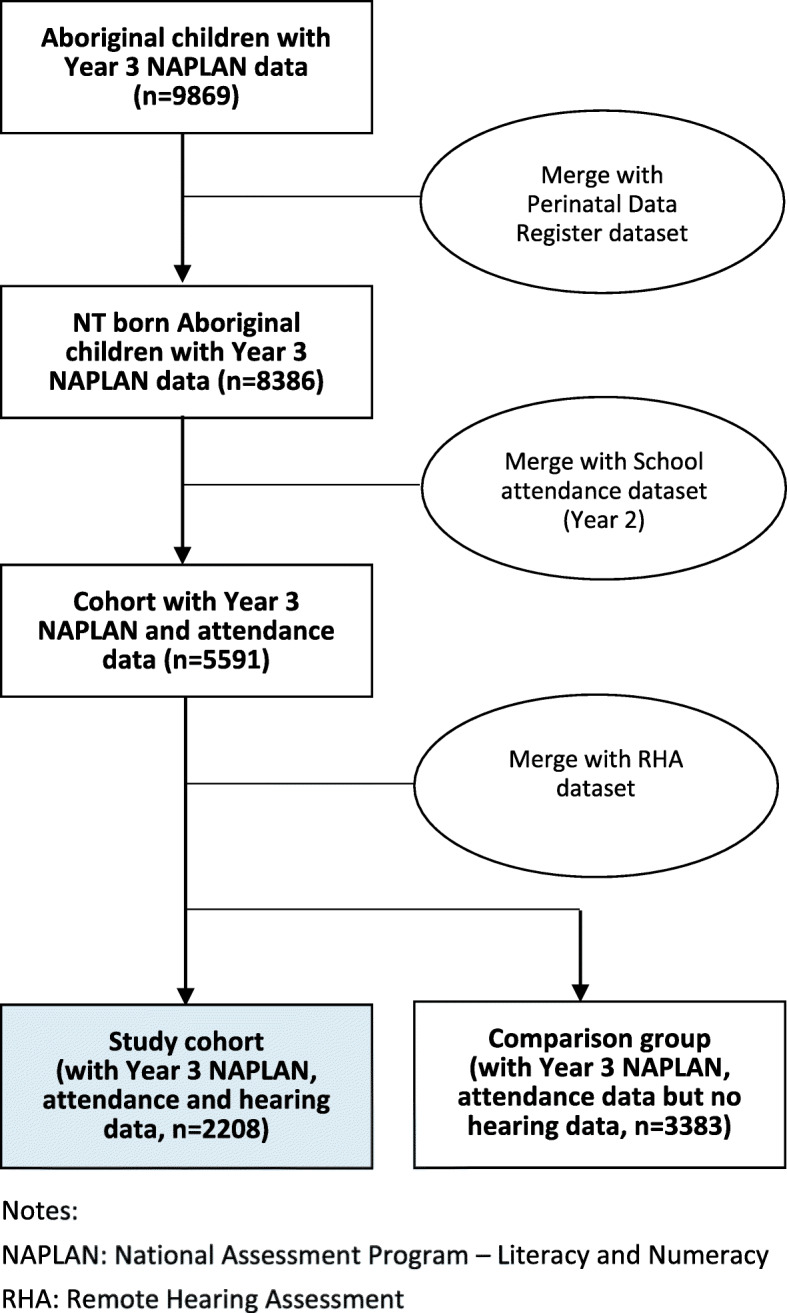
A retrospective, observational cohort study was conducted for 2208 NT Aboriginal children, aged about 8 years, living in remote and very remote communities. The explanatory variable was audiometrically determined hearing level as recorded in the Remote Hearing Assessment dataset. The outcome variable consisted of scale scores in the five domains of the National Assessment Program - Literacy and Numeracy (NAPLAN) for Year 3. Other linked datasets used in the study included school attendance records, perinatal records and community level information on relative remoteness, socioeconomic disadvantage and housing crowdedness. Fixed effects linear regression models were used for statistical analyses.
Compared with children with normal hearing and after controlling for a range of covariates, children with mild hearing impairment (HI) scored lower in Writing and Spelling by 15.0 points (95% CI: - 22.4 to - 7.6, p < 0.0005) and 5.0 points (95% CI: - 9.6 to - 0.3, p = 0.037), equivalent to 7.3 and 2.1% of the mean score, respectively. Children with moderate or worse HI scored lower in Writing and Numeracy by 13.4 points (95% CI, - 24.8 to - 1.9, p = 0.022) and 15.2 points (95% CI, - 27.6 to - 2.7, p = 0.017), both equivalent to 6.3% of the mean score the respective domain. Other factors associated with poorer NAPLAN results included being male, lower Year 2 school attendance, low birthweight, average household size> 5 persons, living in a very remote community and speaking English as a second language.
OM-related HI was independently associated with poorer early year academic achievement in Aboriginal children living in remote NT communities. Interventions to improve academic outcomes for Aboriginal children must incorporate actions to address the negative impact associated with HI through early detection, effective treatment and ongoing support for affected children.
在一些澳大利亚原住民儿童群体中,中耳炎(OM)和相关听力损失的患病率仍然居高不下,据报道,这些儿童的学业成绩也较差。一般文献对于 OM 相关听力损失与小学学业成绩之间的关联仍没有定论。本研究旨在调查澳大利亚北领地(NT)原住民儿童中这种关联。
对 2208 名居住在偏远和极偏远社区的 8 岁左右的 NT 原住民儿童进行了回顾性、观察性队列研究。解释变量为远程听力评估数据集记录的听力水平。结果变量由全国评估计划-读写和算术(NAPLAN)中三个年级的五个领域的量表评分组成。本研究中使用的其他相关数据集包括学校出勤率记录、围产期记录以及社区相对偏远程度、社会经济劣势和住房拥挤程度的社区水平信息。采用固定效应线性回归模型进行统计分析。
与听力正常的儿童相比,在控制了一系列混杂因素后,轻度听力障碍(HI)儿童在写作和拼写方面的得分分别低 15.0 分(95%CI:-22.4 至-7.6,p<0.0005)和 5.0 分(95%CI:-9.6 至-0.3,p=0.037),相当于平均分数的 7.3%和 2.1%。中重度或更重度 HI 儿童在写作和算术方面的得分分别低 13.4 分(95%CI:-24.8 至-1.9,p=0.022)和 15.2 分(95%CI:-27.6 至-2.7,p=0.017),两者均相当于各自领域平均分数的 6.3%。其他与 NAPLAN 成绩较差相关的因素包括男性、二年级学校出勤率较低、低出生体重、平均家庭规模>5 人、居住在非常偏远的社区和英语为第二语言。
OM 相关的 HI 与居住在北领地偏远社区的原住民儿童早期学业成绩较差独立相关。改善原住民儿童学业成绩的干预措施必须包括通过早期发现、有效治疗和对受影响儿童的持续支持来解决与 HI 相关的负面影响。