Department of Emergency Medicine, Chang Gung Memorial Hospital and Chang Gung University College of Medicine, No. 5, Fuxing St., Guishan Dist., Taoyuan City, 333, Taiwan, Republic of China.
The Institute of Health Policy and Management, National Taiwan University, No. 17, Xu-Zhou Road, Taipei, 100, Taiwan.
BMC Med Educ. 2020 Oct 7;20(1):348. doi: 10.1186/s12909-020-02267-2.
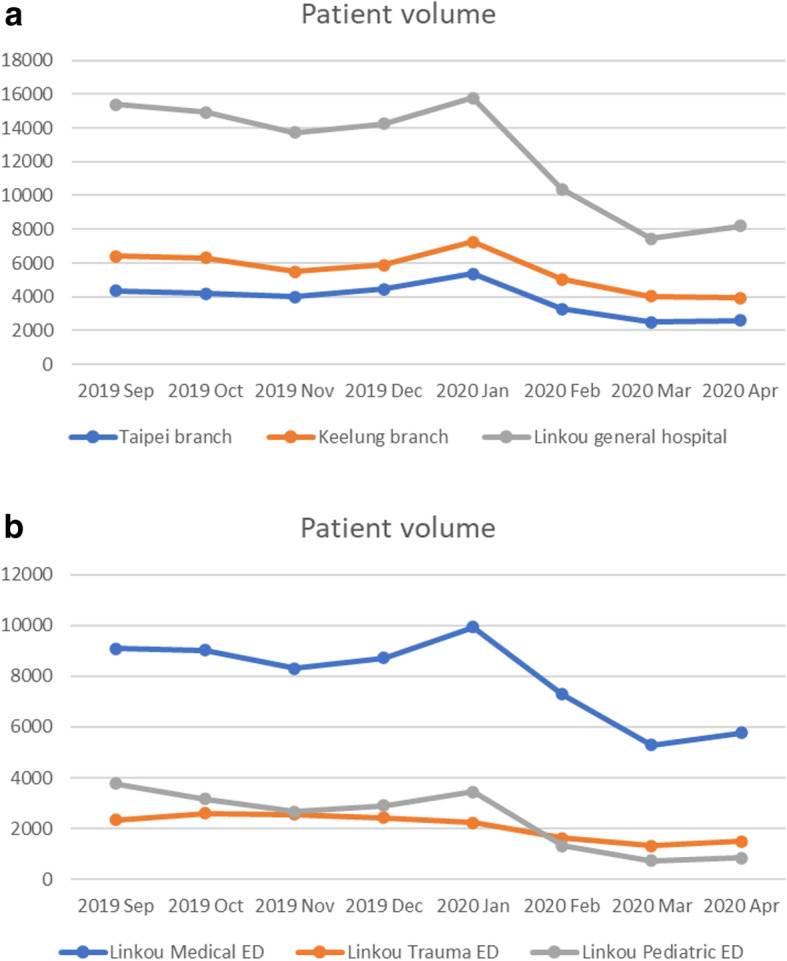
The coronavirus disease 2019 (COVID-19) pandemic has engendered difficulties for health systems globally; however, the effect of the pandemic on emergency medicine (EM) residency training programs is unknown. The pandemic has caused reduced volumes of emergency department (ED) patients, except for those with COVID-19 infections, and this may reduce the case exposure of EM residents. The primary objective of this study was to compare the clinical exposure of EM residents between the prepandemic and pandemic periods.
This was a retrospective study of EM resident physicians' training in a tertiary teaching hospital with two branch regional hospitals in Taiwan. We retrieved data regarding patients seen by EM residents in the ED between September 1, 2019, and April 30, 2020. The first confirmed COVID-19 case in Taiwan was reported on January 11, so the pandemic period in our study was defined as spanning from February 1, 2020, to April 30, 2020. The number and characteristics of patients seen by residents were recorded. We compared the data between the prepandemic and pandemic periods.
The mean number of patients per hour (PPH) seen by EM residents in the adult ED decreased in all three hospitals during the pandemic. The average PPH of critical area of medical ED was 1.68 in the pre-epidemic period and decreased to 1.33 in the epidemic period (p value < 0.001). The average number of patients managed by residents decreased from 1.24 to 0.82 in the trauma ED (p value = 0.01) and 1.56 to 0.51 in the pediatric ED (p value = 0.003) during the pandemic, respectively. The severity of patient illness did not change significantly between the periods.
The COVID-19 pandemic engendered a reduced ED volume and decreased EM residents' clinical exposure. All portion of EM residency training were affected by the pandemic, with pediatric EM being the most affected. The patient volume reduction may persist and in turn reduce patients' case exposure until the pandemic subsides. Adjustment of the training programs may be necessary and ancillary methods of learning should be used to ensure adequate EM residency training.
2019 年冠状病毒病(COVID-19)大流行给全球卫生系统带来了困难;然而,大流行对急诊医学(EM)住院医师培训计划的影响尚不清楚。大流行导致急诊部(ED)患者数量减少,除了 COVID-19 感染者外,这可能会减少 EM 住院医师的病例接触。这项研究的主要目的是比较大流行前和大流行期间 EM 住院医师的临床暴露情况。
这是一项在台湾一家三级教学医院及其两个分院区进行的 EM 住院医师培训的回顾性研究。我们检索了 2019 年 9 月 1 日至 2020 年 4 月 30 日期间 EM 住院医师在 ED 就诊的患者数据。台湾首例确诊的 COVID-19 病例报告于 1 月 11 日,因此本研究中的大流行期定义为 2020 年 2 月 1 日至 2020 年 4 月 30 日。记录了居民就诊的患者数量和特征。我们比较了大流行前和大流行期间的数据。
在所有三所医院,EM 住院医师在成人 ED 中每小时就诊患者的平均人数(PPH)在大流行期间均下降。急诊医学重症监护区的平均 PPH 在大流行前为 1.68,降至大流行期间的 1.33(p 值<0.001)。在创伤 ED 中,居民管理的患者人数从 1.24 人减少到 0.82 人(p 值=0.01),在儿科 ED 中,从 1.56 人减少到 0.51 人(p 值=0.003),分别。期间患者病情严重程度无明显变化。
COVID-19 大流行导致 ED 量减少,EM 住院医师的临床暴露减少。EM 住院医师培训的所有部分都受到大流行的影响,儿科 EM 受影响最大。患者数量的减少可能会持续下去,并反过来减少患者的病例接触,直到大流行消退。可能需要调整培训计划,并应使用辅助学习方法来确保充分的 EM 住院医师培训。