State Key Laboratory of Agricultural Microbiology and College of Life Science and Technology, Huazhong Agricultural University, Wuhan, 430070, China.
Institute of Agricultural Resources and Regional Planning, CAAS, Beijing, 100081, China.
Microb Cell Fact. 2020 Oct 7;19(1):191. doi: 10.1186/s12934-020-01448-4.
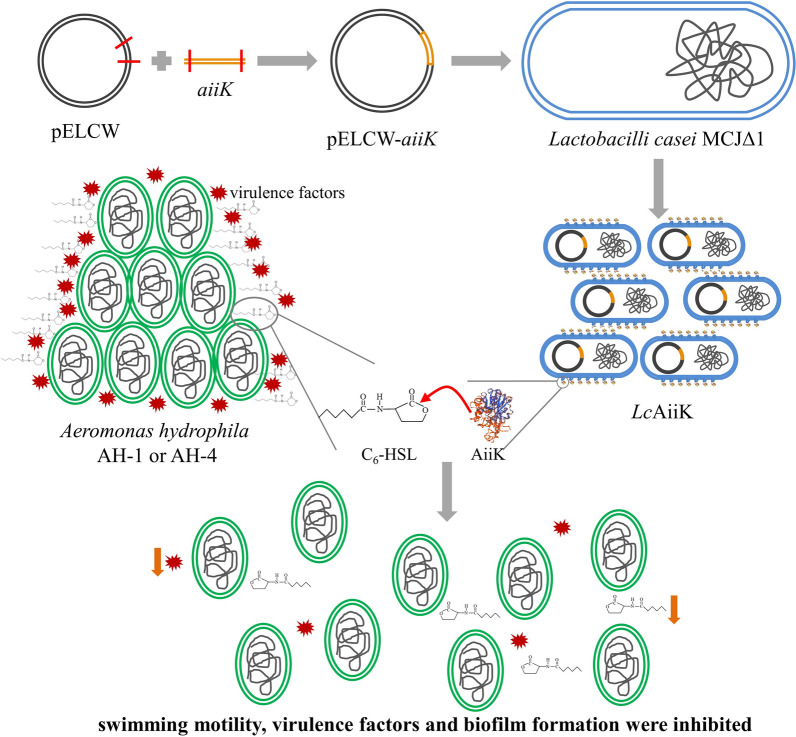
Nowadays, microbial infections have caused increasing economic losses in aquaculture industry and deteriorated worldwide environments. Many of these infections are caused by opportunistic pathogens through cell-density mediated quorum sensing (QS). The disruption of QS, known as quorum quenching (QQ), is an effective and promising way to prevent and control pathogens, driving it be the potential bio-control agents. In our previous studies, AHL lactonase AiiK was identified with many characteristics, and constitutive expression vector pELX1 was constructed to express heterologous proteins in Lactobacillus casei MCJΔ1 (L. casei MCJΔ1). In this study, recombinant strain pELCW-aiiK/L. casei MCJΔ1 (LcAiiK) and wild-type Aeromonas hydrophila (A. hydrophila) were co-cultured to test the QQ ability of LcAiiK against A. hydrophila.
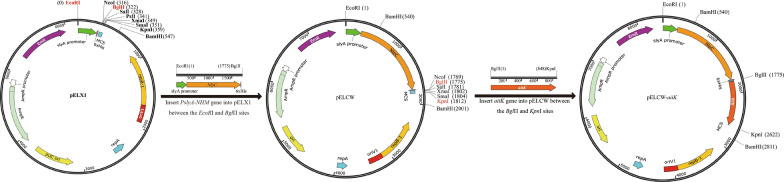
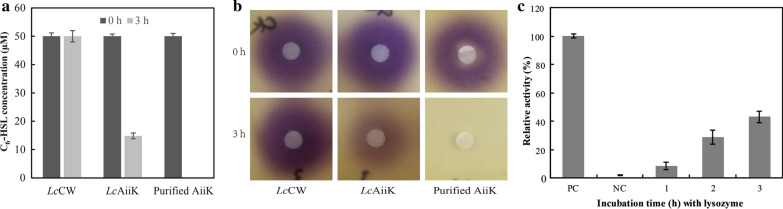
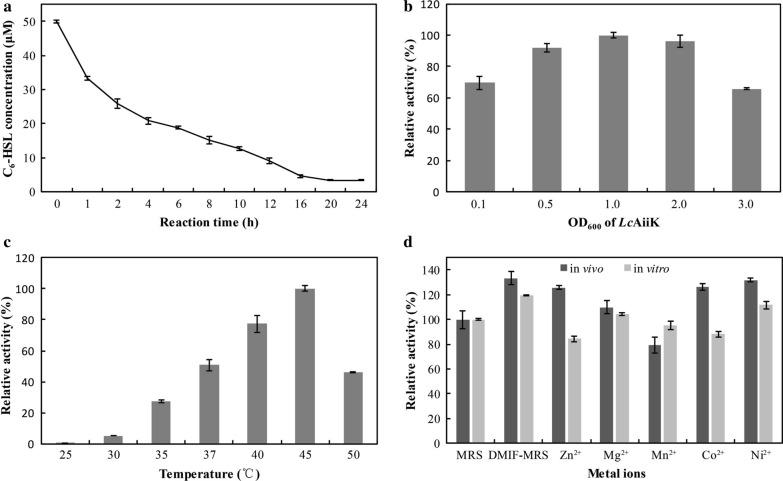
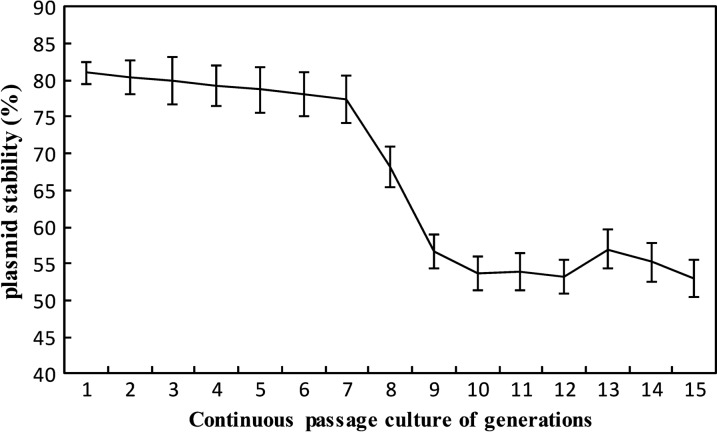
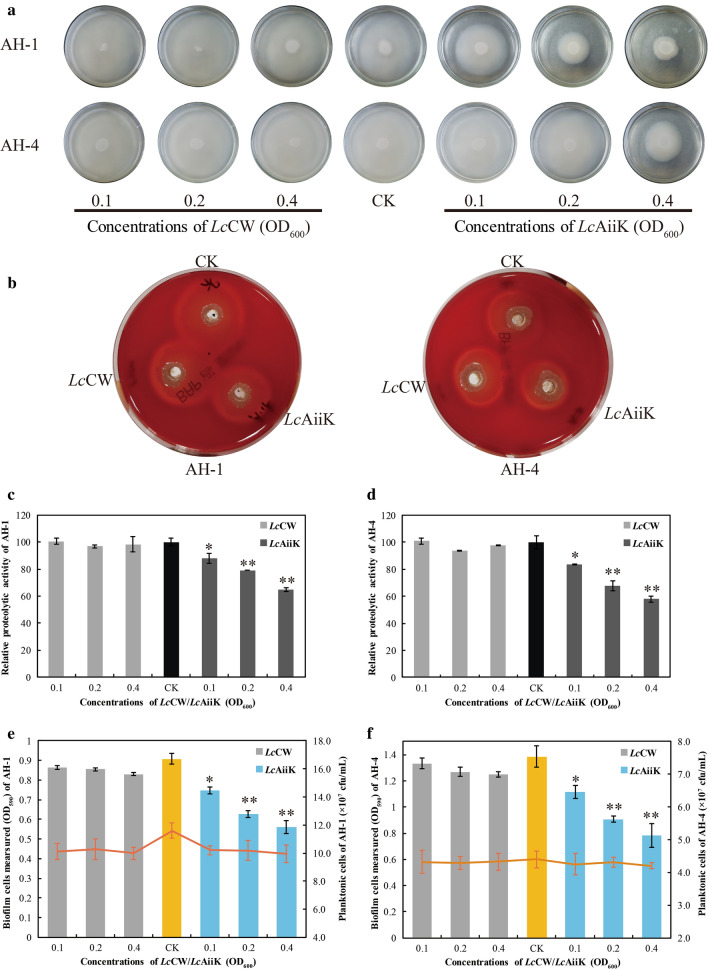
A cell wall-associated expression vector pELCW for L. casei MCJΔ1 was constructed. Localization assays revealed that the expressed AiiK was anchored at the surface layer of LcAiiK via vector pELCW-aiiK. LcAiiK (OD = 0.5) degraded 24.13 μM of C-HSL at 2 h, 40.99 μM of C-HSL at 12 h, and 46.63 μM of C-HSL at 24 h. Over 50% LcAiiK cells maintained the pELCW-aiiK plasmid after 15 generations of cultivation without erythromycin. Furthermore, LcAiiK inhibited the swimming motility, extracellular proteolytic activity, haemolytic activity and biofilm formation of A. hydrophila AH-1 and AH-4.
The AHL lactonase AiiK is firstly and constitutively expressed at the surface layer of L. casei MCJΔ1. LcAiiK displayed considerable AHL lactonase activity and great QQ abilities against A. hydrophila AH-1 and AH-4 by attenuating their QS processes instead of killing them. Therefore, the LcAiiK can be exploited as an anti-pathogenic drug or a bio-control agent to control the AHL-mediated QS of pathogenic bacteria.
如今,微生物感染导致水产养殖业的经济损失不断增加,并恶化了全球环境。其中许多感染是由机会性病原体通过细胞密度介导的群体感应(QS)引起的。QS 的中断,称为群体感应淬灭(QQ),是一种预防和控制病原体的有效且有前途的方法,使其成为潜在的生物控制剂。在我们之前的研究中,鉴定了具有许多特性的 AHL 内酯酶 AiiK,并构建了组成型表达载体 pELX1 以在干酪乳杆菌 MCJΔ1(Lactobacillus casei MCJΔ1)中表达异源蛋白。在这项研究中,重组菌株 pELCW-aiiK/L. casei MCJΔ1(LcAiiK)和野生型嗜水气单胞菌(Aeromonas hydrophila)被共同培养,以测试 LcAiiK 对嗜水气单胞菌的 QQ 能力。
构建了用于干酪乳杆菌 MCJΔ1 的细胞外膜相关表达载体 pELCW。定位分析表明,表达的 AiiK 通过载体 pELCW-aiiK 锚定在 LcAiiK 的表面层。LcAiiK(OD=0.5)在 2 小时时降解了 24.13 μM 的 C-HSL,在 12 小时时降解了 40.99 μM 的 C-HSL,在 24 小时时降解了 46.63 μM 的 C-HSL。在没有红霉素的情况下,经过 15 代培养,超过 50%的 LcAiiK 细胞仍保持 pELCW-aiiK 质粒。此外,LcAiiK 抑制了嗜水气单胞菌 AH-1 和 AH-4 的泳动运动、细胞外蛋白酶活性、溶血活性和生物膜形成。
AHL 内酯酶 AiiK 首次在干酪乳杆菌 MCJΔ1 的表面层组成型表达。LcAiiK 通过削弱其 QS 过程而不是杀死它们,对嗜水气单胞菌 AH-1 和 AH-4 表现出相当的 AHL 内酯酶活性和强大的 QQ 能力。因此,LcAiiK 可以作为一种抗病原药物或生物控制剂来控制 AHL 介导的病原菌的 QS。