Department of Mental Health and Public Medicine - Infectious Diseases Unit, University of Campania Luigi Vanvitelli, L. Armanni 5, 80131, Naples, Italy.
Infect Dis Poverty. 2020 Oct 7;9(1):139. doi: 10.1186/s40249-020-00756-6.
Health workers (HWs) are at increased risk for severe acute respiratory syndrome-coronavirus-2 (SARS-CoV-2) infection and a possible source of nosocomial transmission clusters. Despite the increased risk, the best surveillance strategy and management of exposed HWs are not yet well known. The aim of this review was to summarize and critically analyze the existing evidence related to this topic in order to support public health strategies aimed at protecting HWs in the hospital setting.
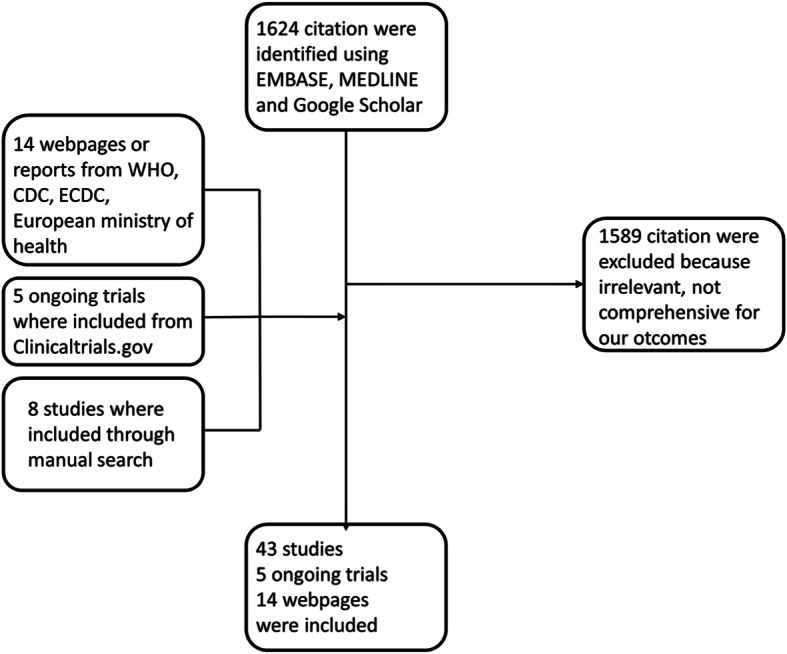
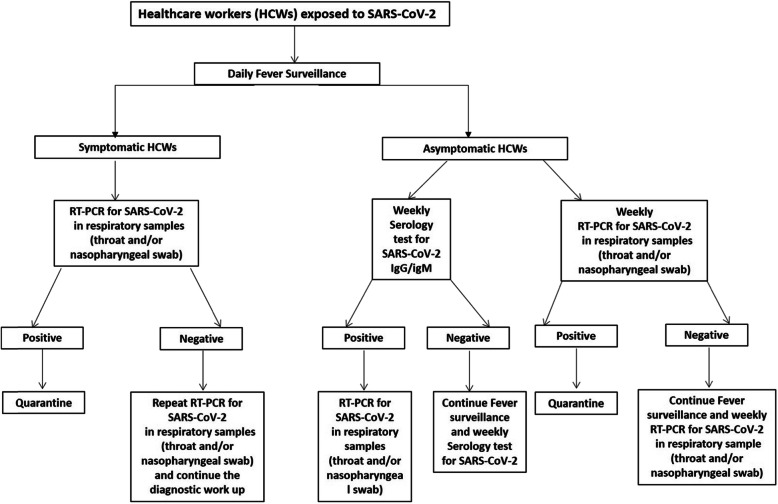
A comprehensive computerized literature research from 1 January 2020 up to 22 May 2020 was made to identify studies analyzing the burden of infection, risk assessment, surveillance and management of HWs exposed to SARS-CoV-2. Among 1623 citation identified using MEDLINE, Embase, Google Scholar and manual search, we included 43 studies, 14 webpages and 5 ongoing trials. Health workers have a high risk of acquiring infection while caring for coronavirus disease 2019 (COVID-19) patients. In particular, some types exposures and their duration, as well as the inadequate or non-use of personal protective equipment (PPE) are associated with increased infection risk. Strict infection prevention and control procedures (IPC), adequate training programs on the appropriate use of PPE and close monitoring of HWs with symptom surveillance and testing are essential to significantly reduce the risk. At the moment there is not enough evidence to provide precise indications regarding pre-exposure prophylaxis (PrEP) and post-exposure prophylaxis (PEP).
During the spread of COVID-19 outbreak, numerous published papers investigated the epidemiology, risk assessment and prevention and control of SARS-CoV-2. However, more high-quality studies are needed to provide valid recommendations for better management and for the clinical and microbiological surveillance of healthcare personnel.
卫生工作者(HWs)感染严重急性呼吸综合征冠状病毒 2 型(SARS-CoV-2)的风险增加,并且可能成为医院内传播集群的源头。尽管风险增加,但最佳监测策略和暴露于 SARS-CoV-2 的 HWs 的管理尚不清楚。本综述的目的是总结和批判性分析与该主题相关的现有证据,以支持旨在保护医院环境中 HWs 的公共卫生策略。
从 2020 年 1 月 1 日至 2020 年 5 月 22 日,进行了全面的计算机文献检索,以确定分析感染负担、风险评估、HWs 监测和管理的研究。在使用 MEDLINE、Embase、Google Scholar 和手动搜索识别的 1623 条引文,我们纳入了 43 项研究、14 个网页和 5 项正在进行的试验。HWs 在照顾 2019 年冠状病毒病(COVID-19)患者时感染的风险很高。特别是,某些类型的暴露及其持续时间,以及个人防护设备(PPE)的使用不当或未使用,与感染风险增加相关。严格的感染预防和控制程序(IPC)、适当的 PPE 使用培训计划以及对有症状监测和检测的 HWs 的密切监测,对于显著降低风险至关重要。目前,没有足够的证据提供关于暴露前预防(PrEP)和暴露后预防(PEP)的精确建议。
在 COVID-19 爆发期间,发表了许多研究调查 SARS-CoV-2 的流行病学、风险评估和预防控制。然而,需要更多高质量的研究为更好的管理以及为医疗保健人员的临床和微生物学监测提供有效的建议。