Division of Anti-aging Medicine, Center for Molecular Medicine, Jichi Medical University.
J Atheroscler Thromb. 2021 Mar 1;28(3):203-213. doi: 10.5551/jat.RV17045. Epub 2020 Oct 8.
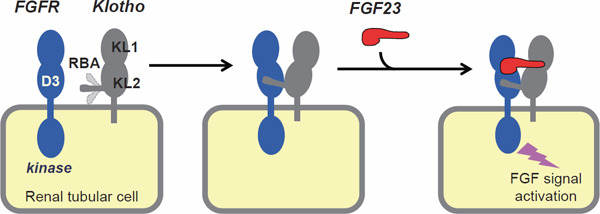
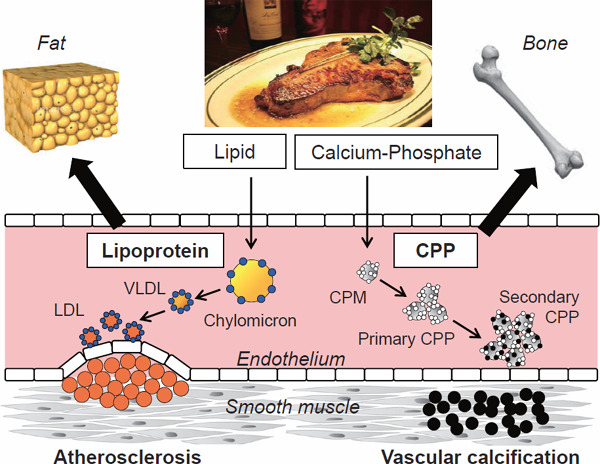
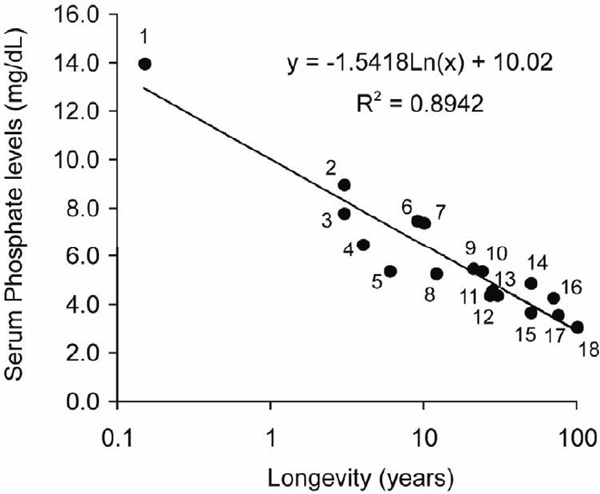
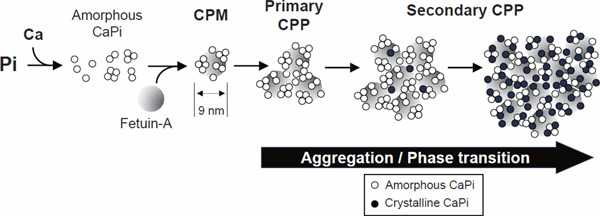
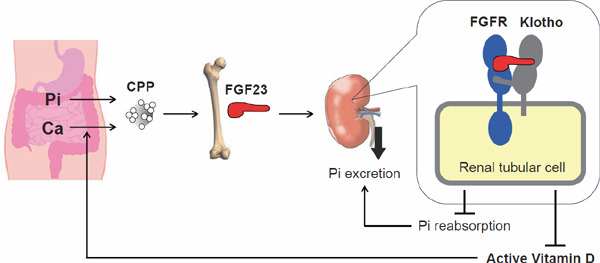
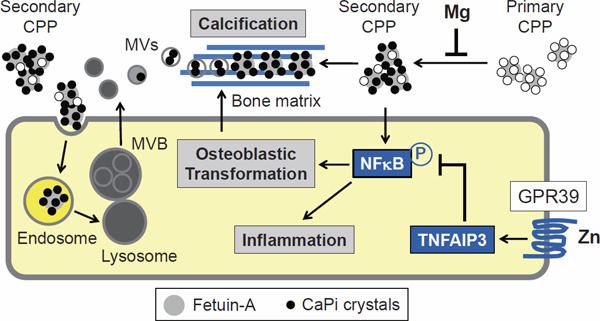
During the evolution of skeletons, terrestrial vertebrates acquired strong bones made of calcium-phosphate. By keeping the extracellular fluid in a supersaturated condition regarding calcium and phosphate ions, they created the bone when and where they wanted simply by providing a cue for precipitation. To secure this strategy, they acquired a novel endocrine system to strictly control the extracellular phosphate concentration. In response to phosphate intake, fibroblast growth factor-23 (FGF23) is secreted from the bone and acts on the kidney through binding to its receptor Klotho to increase urinary phosphate excretion, thereby maintaining phosphate homeostasis. The FGF23-Klotho endocrine system, when disrupted in mice, results in hyperphosphatemia and vascular calcification. Besides, mice lacking Klotho or FGF23 suffer from complex aging-like phenotypes, which are alleviated by placing them on a low- phosphate diet, indicating that phosphate is primarily responsible for the accelerated aging. Phosphate acquires the ability to induce cell damage and inflammation when precipitated with calcium. In the blood, calcium-phosphate crystals are adsorbed by serum protein fetuin-A and prevented from growing into large precipitates. Consequently, nanoparticles that comprised calcium-phosphate crystals and fetuin-A, termed calciprotein particles (CPPs), are generated and dispersed as colloids. CPPs increase in the blood with an increase in serum phosphate and age. Circulating CPP levels correlate positively with vascular stiffness and chronic non-infectious inflammation, raising the possibility that CPPs may be an endogenous pro-aging factor. Terrestrial vertebrates with the bone made of calcium- phosphate may be destined to age due to calcium-phosphate in the blood.
在骨骼进化过程中,陆地脊椎动物获得了由钙磷酸盐组成的强壮骨骼。通过使细胞外液中钙离子和磷酸盐离子处于过饱和状态,它们只需提供沉淀的信号,就可以在需要的时间和地点生成骨骼。为了确保这一策略的成功,它们获得了一种新的内分泌系统,以严格控制细胞外磷酸盐浓度。当磷酸盐摄入时,成纤维细胞生长因子 23(FGF23)从骨骼中分泌出来,并通过与受体 Klotho 结合作用于肾脏,增加尿磷酸盐排泄,从而维持磷酸盐的体内平衡。在小鼠中,FGF23-Klotho 内分泌系统发生紊乱,导致高磷酸盐血症和血管钙化。此外,缺乏 Klotho 或 FGF23 的小鼠会出现复杂的衰老样表型,通过让它们摄入低磷酸盐饮食可以得到缓解,这表明磷酸盐主要负责加速衰老。当与钙结合时,磷酸盐获得了诱导细胞损伤和炎症的能力。在血液中,钙磷酸盐晶体被血清蛋白胎球蛋白 A 吸附,防止其生长成大的沉淀物。因此,由钙磷酸盐晶体和胎球蛋白 A 组成的纳米颗粒,即钙磷蛋白颗粒(CPP)生成并分散为胶体。随着血清磷酸盐和年龄的增加,血液中的 CPP 增加。循环 CPP 水平与血管僵硬和慢性非传染性炎症呈正相关,这表明 CPP 可能是一种内源性促衰老因子。由于血液中的钙磷酸盐,具有钙磷酸盐骨骼的陆地脊椎动物可能注定会衰老。