Division of Anti-aging Medicine, Center for Molecular Medicine, Jichi Medical University, 3311-1 Yakushiji, Shimotsuke, Tochigi 329-0498, Japan.
Clin Sci (Lond). 2021 Aug 13;135(15):1915-1927. doi: 10.1042/CS20201453.
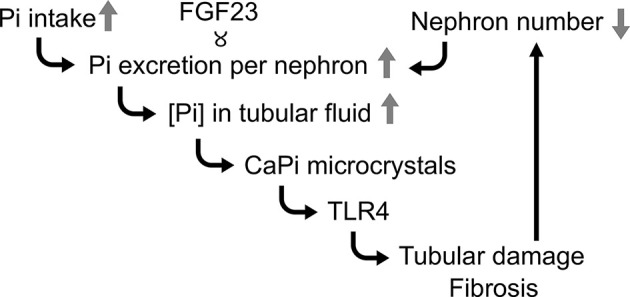
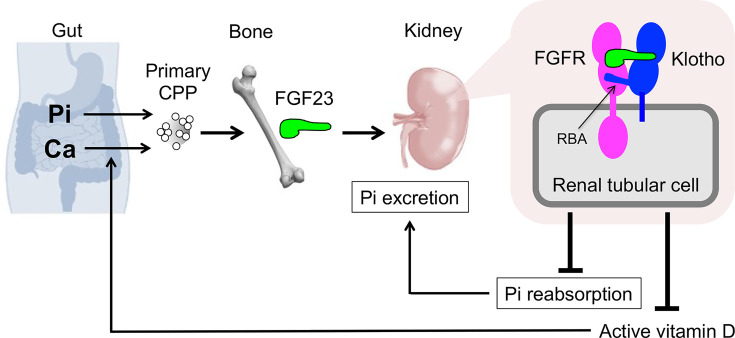
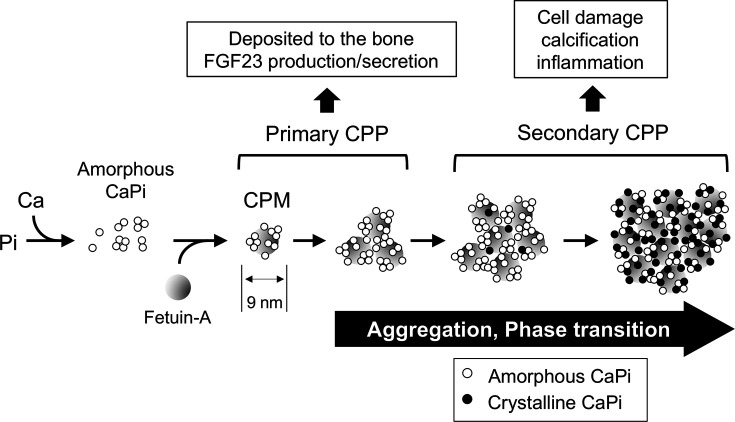
The klotho gene, named after a Greek goddess who spins the thread of life, was identified as a putative 'ageing-suppressor' gene. Klotho-deficient mice exhibit complex ageing-like phenotypes including hypogonadism, arteriosclerosis (vascular calcification), cardiac hypertrophy, osteopenia, sarcopenia, frailty, and premature death. Klotho protein functions as the obligate co-receptor for fibroblast growth factor-23 (FGF23), a bone-derived hormone that promotes urinary phosphate excretion in response to phosphate intake. Thus, Klotho-deficient mice suffer not only from accelerated ageing but also from phosphate retention due to impaired phosphate excretion. Importantly, restoration of the phosphate balance by placing Klotho-deficient mice on low phosphate diet rescued them from premature ageing, leading us to the notion that phosphate accelerates ageing. Because the extracellular fluid is super-saturated in terms of phosphate and calcium ions, an increase in the phosphate concentration can trigger precipitation of calcium-phosphate. In the blood, calcium-phosphate precipitated upon increase in the blood phosphate concentration is adsorbed by serum protein fetuin-A to form colloidal nanoparticles called calciprotein particles (CPPs). In the urine, CPPs appear in the renal tubular fluid when FGF23 increases phosphate load excreted per nephron. CPPs can induce cell damage, ectopic calcification, and inflammatory responses. CPPs in the blood can induce arteriosclerosis and non-infectious chronic inflammation, whereas CPPs in the urine can induce renal tubular damage and interstitial inflammation/fibrosis. Thus, we propose that CPPs behave like a pathogen that accelerates ageing and should be regarded as a novel therapeutic target against age-related disorders including chronic kidney disease.
klotho 基因以希腊神话中编织生命之线的女神命名,被鉴定为一种假定的“衰老抑制”基因。klotho 缺陷小鼠表现出复杂的衰老样表型,包括性腺功能减退、动脉硬化(血管钙化)、心脏肥大、骨质疏松、肌肉减少症、虚弱和过早死亡。klotho 蛋白作为成纤维细胞生长因子 23(FGF23)的必需共受体发挥作用,FGF23 是一种源自骨骼的激素,可促进磷酸盐摄入后的尿磷酸盐排泄。因此,klotho 缺陷小鼠不仅遭受加速衰老,而且由于磷酸盐排泄受损而遭受磷酸盐潴留。重要的是,通过将 klotho 缺陷小鼠置于低磷酸盐饮食上来恢复磷酸盐平衡,可使它们免于过早衰老,从而使我们认为磷酸盐会加速衰老。由于细胞外液在磷酸盐和钙离子方面是过饱和的,磷酸盐浓度的增加可以触发钙磷酸盐的沉淀。在血液中,随着血液磷酸盐浓度的增加而沉淀的钙磷酸盐被血清蛋白 fetuin-A 吸附形成称为钙磷蛋白颗粒(CPPs)的胶体纳米颗粒。在尿液中,当 FGF23 增加每个肾单位排泄的磷酸盐负荷时,CPPs 出现在肾小管液中。CPPs 可诱导细胞损伤、异位钙化和炎症反应。血液中的 CPPs 可诱导动脉粥样硬化和非传染性慢性炎症,而尿液中的 CPPs 可诱导肾小管损伤和间质炎症/纤维化。因此,我们提出 CPPs 表现得像一种加速衰老的病原体,应被视为针对包括慢性肾脏病在内的与年龄相关的疾病的新型治疗靶点。