Department of Neonatology, Children's Hospital of Philadelphia, University of Pennsylvania, Philadelphia, PA, USA.
Department of Obstetrics and Gynecology, Northwestern University, Chicago, IL, USA.
J Perinatol. 2021 Feb;41(2):196-203. doi: 10.1038/s41372-020-00837-2. Epub 2020 Oct 7.
Evaluate racial/ethnic differences in maternal resilience and its associations with low birthweight (LBW).
Retrospective cohort study of 3244 women surveyed in the Longitudinal Study of Adolescent to Adult Health. The Add Health Resilience Instrument assessed resilience. Logistic regression models explored associations between women's resilience and risk of LBW.
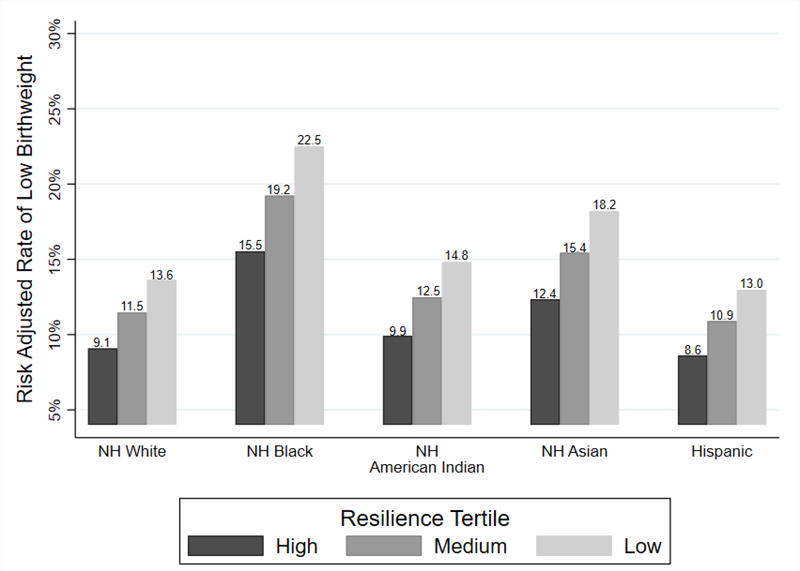
Resilience scores were lowest in American Indian women. Women with the lowest resilience scores were more likely to deliver a LBW infant than highly resilient women, after adjusting for demographic and health-related factors (aOR 1.58 95% CI 1.05-2.38). The risk-adjusted rate of LBW among highly resilient Black women (15.6%) was significantly higher than the risk-adjusted rate of LBW among highly resilient white women (9.1%, p = 0.01) and highly resilient Hispanic women (8.6%, p = 0.04).
Resilience scores differ significantly among women of different race and ethnicity but do not appear to entirely account for racial/ethnic disparities in LBW.
评估产妇韧性的种族/民族差异及其与低出生体重(LBW)的关联。
对青少年至成年健康纵向研究中接受调查的 3244 名女性进行回顾性队列研究。Add Health 韧性工具评估了韧性。逻辑回归模型探讨了女性韧性与 LBW 风险之间的关联。
美国印第安女性的韧性评分最低。在调整人口统计学和健康相关因素后,韧性评分最低的女性比高度韧性的女性更有可能分娩 LBW 婴儿(调整后的优势比 1.58,95%置信区间 1.05-2.38)。高度韧性的黑人女性(15.6%)的 LBW 风险调整率明显高于高度韧性的白人女性(9.1%,p=0.01)和高度韧性的西班牙裔女性(8.6%,p=0.04)。
不同种族和民族的女性的韧性评分存在显著差异,但似乎并不能完全解释 LBW 中的种族/民族差异。