Lin Chaohui, Chen Yifan, Chen Bin, Zheng Ke, Luo Xiongbiao, Lin Fengfei
Department of Orthopedic Surgery, Fuzhou Second Hospital Affiliated to Xiamen University, The Teaching Hospital of Fujian Medical University, Fuzhou, Fujian, China.
Fujian University of Traditional Chinese Medicine, Fuzhou, Fujian, China.
Emerg Med Int. 2020 Sep 23;2020:1930405. doi: 10.1155/2020/1930405. eCollection 2020.
While D-dimer can successfully diagnose venous thrombosis due to its excellent negative predictive value (NPV), it cannot be used to detect venous thromboembolism (VTE) because of its low positive predictive value (PPV). This study aims to investigate if a combination of using D-dimer and fibrinogen can improve PPV in the VTE diagnosis.
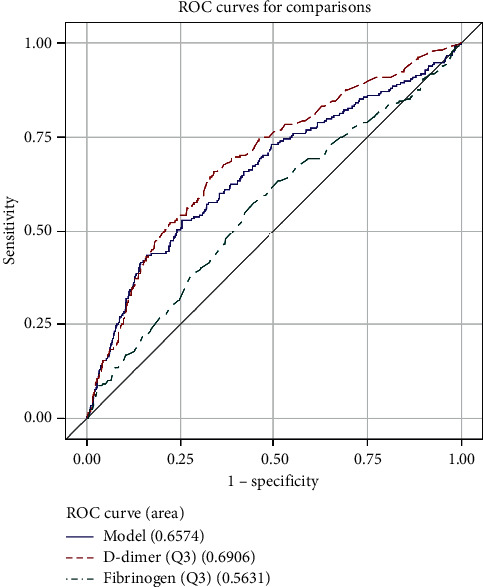
We retrospectively analyzed various data including D-dimer, fibrinogen, C-reactive protein, ultrasound, and others collected from 10775 traumatic fracture patients and categorized them into two groups of VTE and non-VTE. By comparing the difference between the two groups, we employ multiple logistic regression to find risk factors that are useful to detect VTE. The receiver operating characteristic (ROC) curve was used to evaluate the diagnostic yield of using fibrinogen, D-dimer, and their combination, respectively. Also, these data were classified into quartiles by patient age. We perform the same analysis on the quartiles and find if the patient's age has an impact on diagnosing VTE.
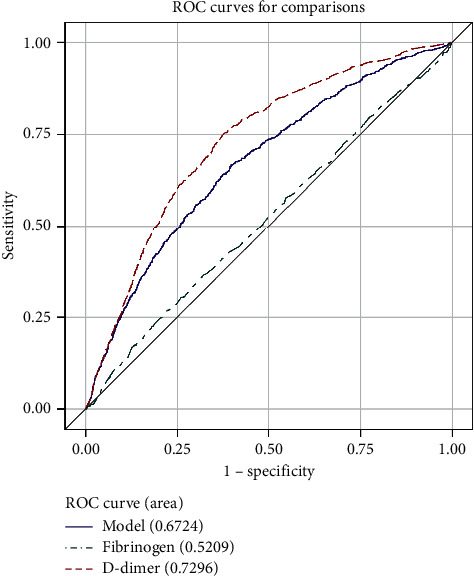
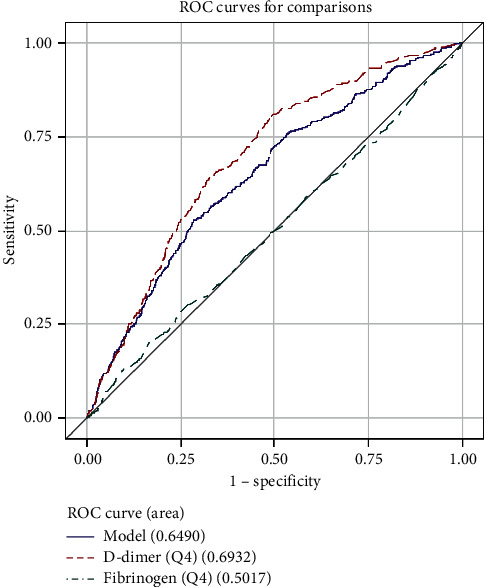
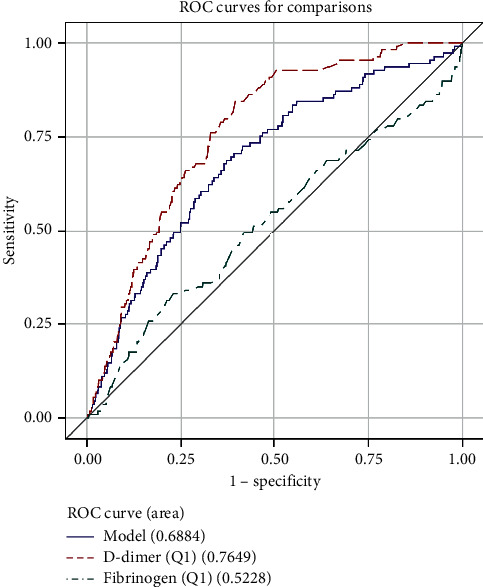
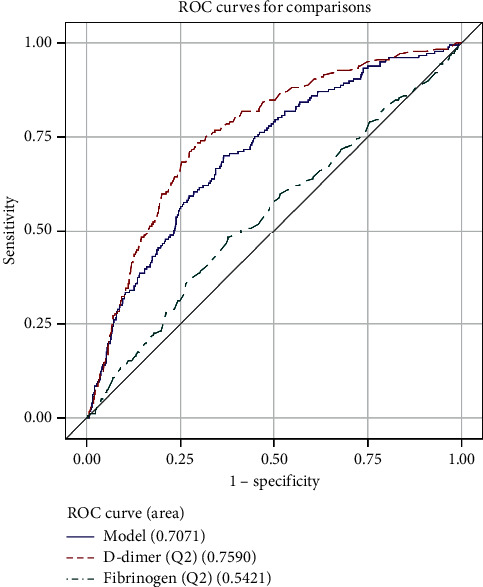
The univariate analysis demonstrated that five factors of age, D-dimer, fibrinogen, C-reactive protein, and high-density lipoprotein cholesterol were significant to predict VTE. ROC showed that D-dimer was more useful than fibrinogen for the diagnosis of VTE, while the area under the curve (AUC) was 0.7296 for D-dimer and 0.5209 for fibrinogen. The cutoff point of D-dimer and fibrinogen was 424.89 ng/ml and 3.543 g/L, respectively. The specificity of fibrinogen was 0.777 which was better than D-dimer, while the sensitivity of fibrinogen was lower than that of D-dimer. Both PPV and NPV were similar in D-dimer and fibrinogen. The PPV of combining D-dimer and fibrinogen in ages Q3 (60 < age ≤ 70) and Q4 (age > 70) was better than using either D-dimer or fibrinogen.
Fibrinogen is a promising strategy for the diagnosis of subclinical VTE and postoperative VTE. In particular, a combination of D-dimer and fibrinogen can improve the PPV to successfully diagnose VTE in traumatic fracture patients who are more than 60 years old. . This assay is a diagnostic test at level II.
尽管D - 二聚体因其出色的阴性预测值(NPV)能够成功诊断静脉血栓形成,但由于其阳性预测值(PPV)较低,不能用于检测静脉血栓栓塞症(VTE)。本研究旨在探讨联合使用D - 二聚体和纤维蛋白原是否能提高VTE诊断中的PPV。
我们回顾性分析了从10775例创伤性骨折患者收集的包括D - 二聚体、纤维蛋白原、C反应蛋白、超声等各种数据,并将他们分为VTE组和非VTE组。通过比较两组之间的差异,我们采用多元逻辑回归来寻找有助于检测VTE的危险因素。采用受试者工作特征(ROC)曲线分别评估使用纤维蛋白原、D - 二聚体及其组合的诊断效能。此外,这些数据按患者年龄分为四分位数。我们对四分位数进行相同的分析,以确定患者年龄对VTE诊断是否有影响。
单因素分析表明,年龄、D - 二聚体、纤维蛋白原、C反应蛋白和高密度脂蛋白胆固醇这五个因素对预测VTE具有显著性。ROC显示,D - 二聚体在VTE诊断中比纤维蛋白原更有用,D - 二聚体的曲线下面积(AUC)为0.7296,纤维蛋白原为0.5209。D - 二聚体和纤维蛋白原的截断点分别为424.89 ng/ml和3.543 g/L。纤维蛋白原的特异性为0.777,优于D - 二聚体,而纤维蛋白原的敏感性低于D - 二聚体。D - 二聚体和纤维蛋白原的PPV和NPV相似。在年龄四分位数Q3(60<年龄≤70)和Q4(年龄>70)中,联合使用D - 二聚体和纤维蛋白原的PPV优于单独使用D - 二聚体或纤维蛋白原。
纤维蛋白原是诊断亚临床VTE和术后VTE的一种有前景的策略。特别是,联合使用D - 二聚体和纤维蛋白原可以提高PPV,从而成功诊断60岁以上创伤性骨折患者的VTE。 本检测为二级诊断试验。