Sabraoui Talal, Khider Taleb, Nasser Boubker, Eddoha Rabiaa, Moujahid Abderrahman, Benbachir Maryam, Essamadi Abdelkhalid
Faculty of Sciences and Technology Laboratory of Biochemistry & Neurosciences, Applied Biochemistry and Toxicology Team, Hassan First University, 26000 Settat, Morocco.
Food Chemistry, Department of Chemistry and Pharmacy, Emil Fischer Center, Friedrich-Alexander Universitât Erlangen-Nürnberg (FAU), Nikolaus-Fiebiger-Straße 10, 91058, Germany.
Int J Food Sci. 2020 Sep 17;2020:8885889. doi: 10.1155/2020/8885889. eCollection 2020.
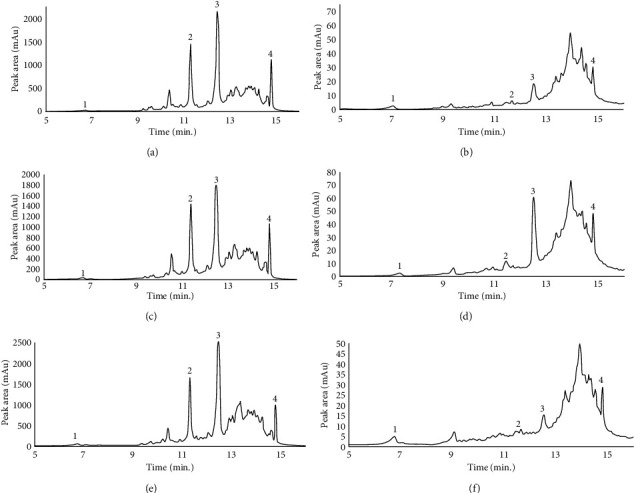
Pomegranate () is widely cultivated in the Mediterranean countries especially in Morocco. Pomegranate peel and seed contain considerable amounts of phenolic compounds with antioxidant activity. The aim of the present study was to phytochemically characterize the pomegranate peels and seeds obtained from three Moroccan provinces, using UHPLC-DAD. In addition, total phenolic content (TPC), total flavonoid contents (TFC), and metal chelating of pomegranate peel were also evaluated. The results showed that pomegranate peel possesses the highest phenolic (TPC: 224.39 mg GAE/g dw) and flavonoid (TFC: 62.64 mg rutin/g dw) contents. Punicalagin- and punicalagin-, are the abundant compounds found in peel: 216.36 ± 9.94 mg/g, 154.94 ± 5.21 mg/g, respectively. Pomegranate peels showed significantly ( < 0.05) high antioxidant activity 1-diphenyl-2-picrylhydrazyl (DPPH) EC: 42.71 ± 0.04 g/mL, 2.2'-Azino-bis(3-Ethylbenzothiazoline-6-Sulfonic Acid) (ABTS) EC: 62.15 ± 0.01 g/mL), and chelating activity (FRAP 1.85 ± 0.00 mg ascorbic acid equivalents/100 g, Fe: 2.52 ± 0.01 mol EDTA equivalents/g dw) compared to seeds. A positive correlation between antioxidant activity and total phenolic was found. According to achieved results, high antioxidant capacity of pomegranate extracts, especially peel, shed light to further use as natural food preservatives. Pomegranate peel could be used for the fortification of food with fiber by introducing it in dietary, as well as in health applications due to its higher antioxidant capacity.
石榴()在地中海国家广泛种植,尤其是在摩洛哥。石榴皮和籽含有大量具有抗氧化活性的酚类化合物。本研究的目的是利用超高效液相色谱 - 二极管阵列检测法(UHPLC - DAD)对从摩洛哥三个省份获得的石榴皮和籽进行植物化学特征分析。此外,还评估了石榴皮的总酚含量(TPC)、总黄酮含量(TFC)和金属螯合能力。结果表明,石榴皮的酚类(TPC:224.39毫克没食子酸当量/克干重)和黄酮类(TFC:62.64毫克芦丁/克干重)含量最高。石榴皮素 - 和石榴皮素 - 是皮中含量丰富的化合物:分别为216.36±9.94毫克/克、154.94±5.21毫克/克。与籽相比,石榴皮表现出显著(<0.05)高的抗氧化活性(1,1 - 二苯基 - 2 - 苦基肼(DPPH)EC:42.71±0.04微克/毫升,2,2'- 联氮 - 双 -(3 - 乙基苯并噻唑啉 - 6 - 磺酸)(ABTS)EC:62.15±0.01微克/毫升)和螯合活性(铁还原抗氧化能力(FRAP)1.85±0.00毫克抗坏血酸当量/100克,铁:2.52±0.01毫摩尔乙二胺四乙酸当量/克干重)。发现抗氧化活性与总酚之间存在正相关。根据所得结果,石榴提取物,尤其是石榴皮的高抗氧化能力,为其进一步用作天然食品防腐剂提供了依据。由于石榴皮具有较高的抗氧化能力,它可通过添加到饮食中用于食品纤维强化,以及在健康应用中使用。