Szekely Brian, Alphonsa Sushma, Grimes Katelyn, Munkasy Barry, Buckley Thomas, Murray Nicholas G
Department of Psychology.
Department of School of Community Health Sciences, Division of Kinesiology, University of Nevada, Reno, 89557, Nevada.
J Clin Transl Res. 2020 Apr 16;5(4):197-203. eCollection 2020 May 26.
Repetitive head impacts (RHIs) have received more notice over the past decade. More sensitive measures, such as postural control, have been used to evaluate if there are biomechanical changes after RHI exposure. Similar to the clinical findings, most of the studies have failed to find any significant changes across an athletic season. However, these studies included those with a concussion history and only assessed postural control in the eyes open (EO) condition, rather than in both the EO and eyes closed (EC) conditions.
The purpose of this study was to investigate postural control changes during quiet stance following a season of RHI in Division I football athletes who did not have a prior diagnosed signet ring cell compared to a group of non-RHI athletes with no history of a diagnosed sport-related concussion.
Eighteen male Division I athletes were recruited and met the inclusion criteria: Nine football athletes (RHI group) and nine baseball athletes (CON group). All athletes performed three 30 s trials while standing with feet together on a force platform during EC and EO conditions. Center of pressure data was analyzed with sample entropy (SampEn) in the anteroposterior (AP) and mediolateral (ML) directions. SampEn data were analyzed with a three-level linear mixed effects model or the multilevel model, with the three levels being condition, time, and group.
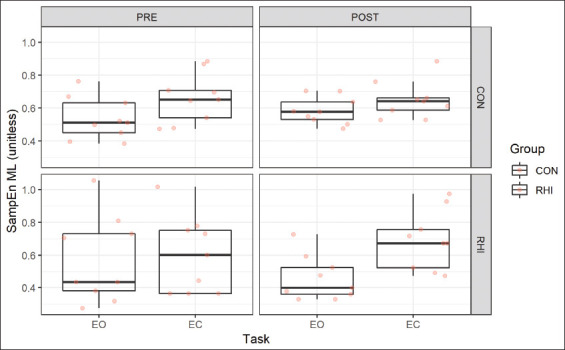
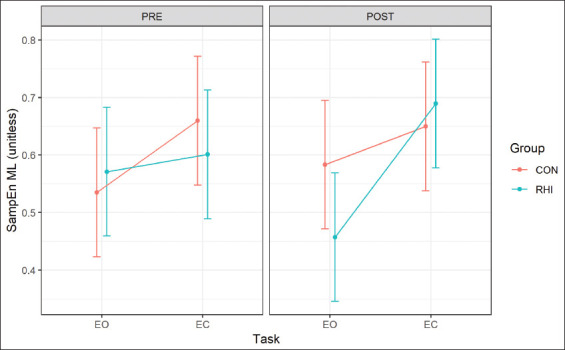
The analysis reported no significant effect for SampEn AP, but reported a significant three-way interaction (Group by Task by Time) for SampEn ML. Specifically, SampEn ML was significantly higher for EC than EO for both groups.
There are postural control changes from pre- to post-season, with the main contributor being EC postural control. Thus, there could be a change in the sensory reweighting dynamics due to RHI and the effect of sport.
RHI may be better assessed in the clinical setting with EC, rather than with EO. Furthermore, clinicians should include tasks that deprive sensory inputs to examine the effects of RHI.
在过去十年中,重复性头部撞击(RHIs)受到了更多关注。人们采用了更敏感的测量方法,如姿势控制,来评估暴露于重复性头部撞击后是否存在生物力学变化。与临床研究结果类似,大多数研究未能在一个运动赛季中发现任何显著变化。然而,这些研究包括了有脑震荡病史的人,并且仅在睁眼(EO)条件下评估姿势控制,而非在睁眼和闭眼(EC)两种条件下进行评估。
本研究的目的是调查与一组无诊断出的与运动相关脑震荡病史的非重复性头部撞击运动员相比,在没有先前诊断出印戒细胞的一级橄榄球运动员经历一个赛季的重复性头部撞击后,安静站立时的姿势控制变化。
招募了18名男性一级运动员,他们符合纳入标准:9名橄榄球运动员(重复性头部撞击组)和9名棒球运动员(对照组)。所有运动员在闭眼和睁眼条件下双脚并拢站在测力平台上时进行三次30秒的试验。使用样本熵(SampEn)分析前后(AP)和内外侧(ML)方向的压力中心数据。SampEn数据采用三级线性混合效应模型或多水平模型进行分析,三个水平分别为条件、时间和组。
分析报告显示,样本熵AP无显著影响,但样本熵ML报告了显著的三向交互作用(组×任务×时间)。具体而言,两组在闭眼时的样本熵ML均显著高于睁眼时。
从赛季前到赛季后存在姿势控制变化,主要因素是闭眼姿势控制。因此,由于重复性头部撞击和运动的影响,感觉重加权动态可能会发生变化。
在临床环境中,使用闭眼而非睁眼可能能更好地评估重复性头部撞击。此外,临床医生应纳入剥夺感觉输入的任务,以检查重复性头部撞击的影响。