Lee Sun Uk, Lee Jungyeun, Yoon Jee Eun, Kim Hyo Jung, Choi Jeong Yoon, Yun Chang Ho, Kim Ji Soo
Department of Neurology, Korea University Medical Center, Seoul, Korea.
Department of Neurology, Seoul National University College of Medicine, Seoul, Korea.
J Clin Neurol. 2020 Oct;16(4):599-604. doi: 10.3988/jcn.2020.16.4.599.
Nonketotic hyperglycemia often causes transient visual field defects, but only scattered anecdotes are available in the literature.
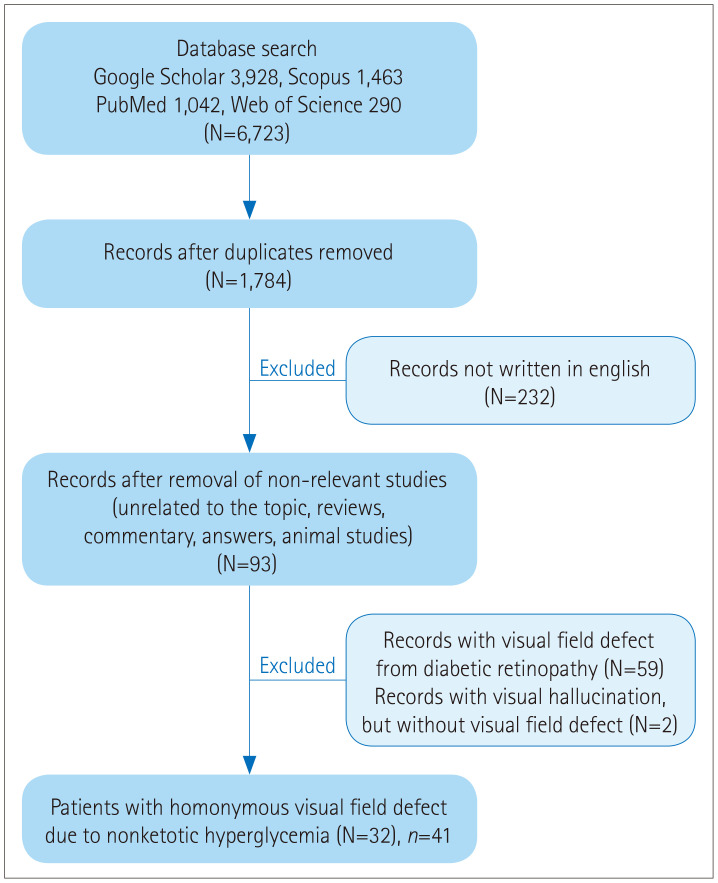
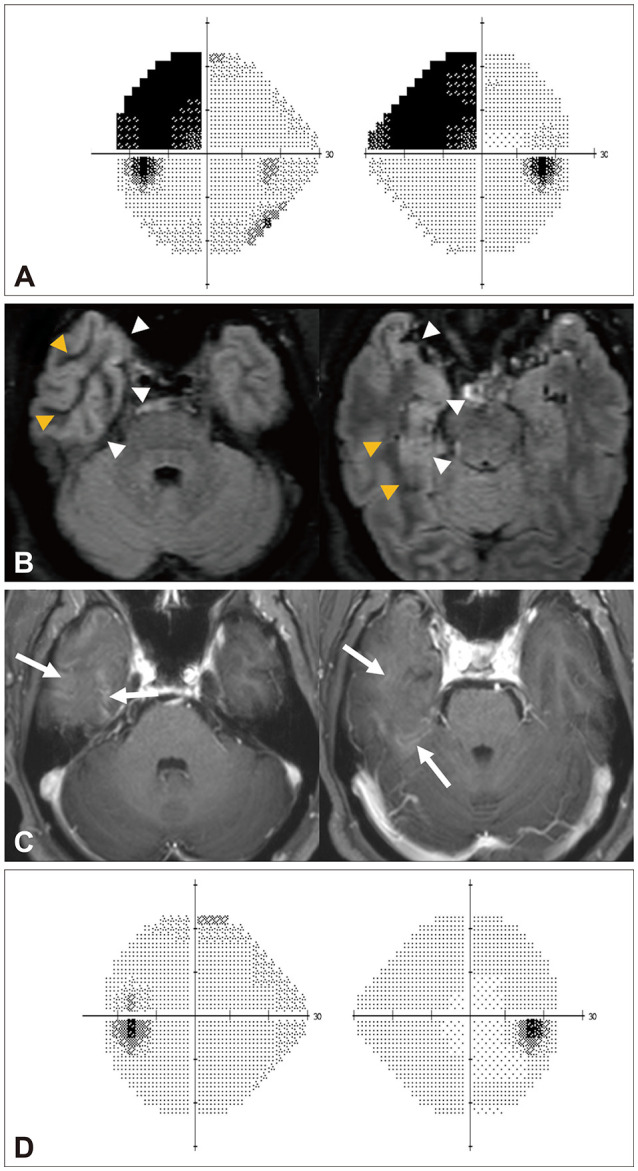
We report a patient with homonymous superior quadrantanopsia due to nonketotic hyperglycemia and provide a systematic literature review of the clinical features of 40 previously reported patients (41 in total, including our case) with homonymous visual field defects in association with nonketotic hyperglycemia.
The typical visual field defect was congruous (84.6%), homonymous hemianopsia (87.8%) with macular splitting (61.5%) or sparing (38.5%). It was transient and repetitive in 54.5% of the patients, but it developed as a persistent form in the remainder. Positive visual symptoms such as hallucinations and phosphenes developed in 73.2% of patients. Brain MRI revealed corresponding abnormalities in most patients (84.8%), characterized by a low-intensity white-matter signal or a high-intensity gray-matter signal on T2-weighted or fluid-attenuated inversion recovery images with diffusion restriction or gadolinium enhancement. Most (97.0%) patients recovered completely, with 48.5% treated by glycemic control alone and the remainder also receiving antiepileptic agents.
Nonketotic hyperglycemia should be considered a possible cause of transient visual field defects, especially when it is associated with repetitive positive visual symptoms and typical MRI findings in hyperglycemic patients.
非酮症高血糖常导致短暂性视野缺损,但文献中仅有零散的病例报道。
我们报告1例因非酮症高血糖导致同侧上象限偏盲的患者,并对先前报道的40例(共41例,包括我们的病例)伴有非酮症高血糖的同侧视野缺损患者的临床特征进行系统的文献回顾。
典型的视野缺损为一致性(84.6%),同侧偏盲(87.8%),伴有黄斑分裂(61.5%)或黄斑回避(38.5%)。54.5%的患者视野缺损为短暂性且反复出现,其余患者则表现为持续性。73.2%的患者出现幻觉和光幻视等阳性视觉症状。多数患者(84.8%)的脑部MRI显示相应异常,特征为T2加权像或液体衰减反转恢复序列图像上的白质低信号或灰质高信号,伴有扩散受限或钆增强。多数患者(97.0%)完全康复,48.5%的患者仅通过血糖控制治疗,其余患者还接受了抗癫痫药物治疗。
非酮症高血糖应被视为短暂性视野缺损的可能病因,尤其是当高血糖患者伴有反复的阳性视觉症状和典型的MRI表现时。