Department of Civil and Environmental Engineering, University of Alberta, Edmonton, AB, Canada, T6G 1H9.
Department of Civil and Environmental Engineering, University of Alberta, Edmonton, AB, Canada, T6G 1H9.
Environ Pollut. 2021 Jan 1;268(Pt A):115642. doi: 10.1016/j.envpol.2020.115642. Epub 2020 Sep 14.
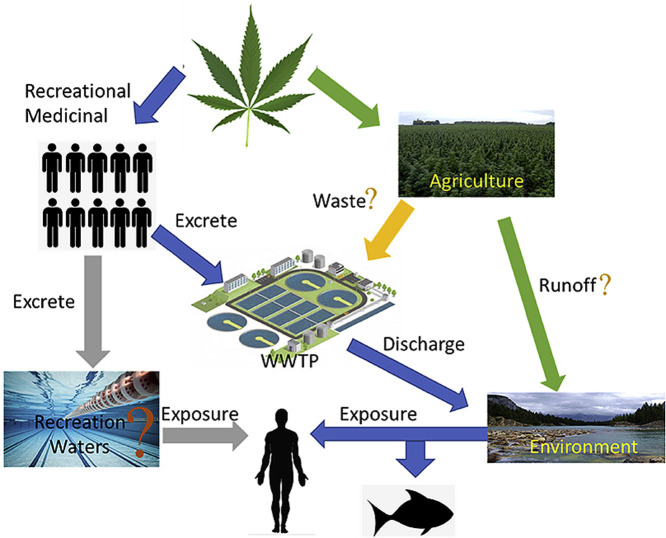
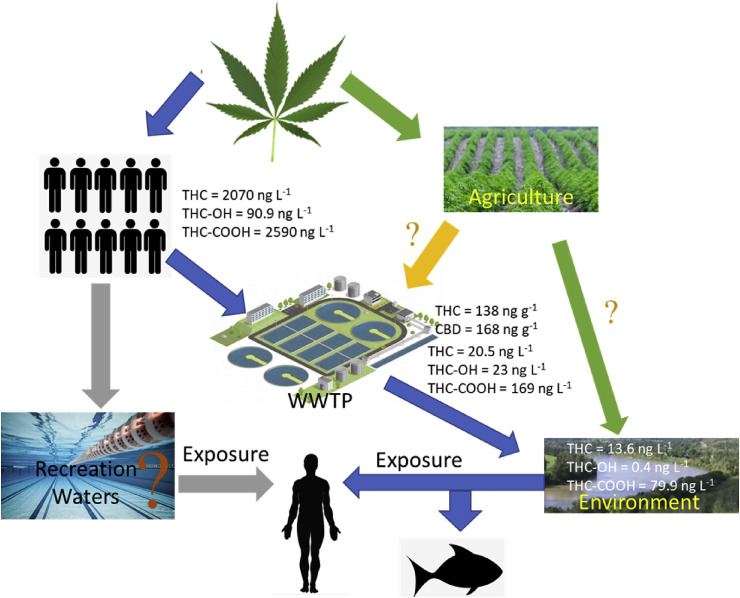
Cannabinoids are a group of organic compounds found in cannabis. Δ-tetrahydrocannabinol (THC) and cannabidiol (CBD), the two major constituents of cannabinoids, and their metabolites are contaminants of emerging concern due to the limited information on their environmental impacts. As well, their releases to the water systems and environment are expected to increase due to recent legalization. Solid-phase extraction is the most common technique for the extraction and pre-concentration of cannabinoids in water samples as well as a clean-up step after the extraction of cannabinoids from solid samples. Liquid chromatography coupled with mass spectrometry is the most common technique used for the analysis of cannabinoids. THC and its metabolites have been detected in wastewater, surface water, and drinking water. In particular, 11-nor-9-carboxy-Δ-tetrahydrocannabinol (THC-COOH) has been detected at concentrations up to 2590 and 169 ng L in untreated and treated wastewater, respectively, 79.9 ng L in surface water, and 1 ng L in drinking water. High removal of cannabinoids has been observed in wastewater treatment plants; this is likely a result of adsorption due to the low aqueous solubility of cannabinoids. Based on the estrogenicity and cytotoxicity studies and modelling, it has been predicted that THC and THC-COOH pose moderate risk for adverse impact on the environment. While chlorination and photo-oxidation have been shown to be effective in the removal of THC-COOH, they also produce by-products that are potentially more toxic than regulated disinfection by-products. The potential of indirect exposure to cannabinoids and their metabolites through recreational water is of great interest. As cannabinoids and especially their by-products may have adverse impacts on the environment and public health, more studies on their occurrence in various types of water and environmental systems, as well as on their environmental toxicity, would be required to accurately assess their impact on the environment and public health.
大麻素是在大麻中发现的一组有机化合物。Δ-四氢大麻酚(THC)和大麻二酚(CBD)是大麻素的两种主要成分,及其代谢物是由于其对环境影响的信息有限而成为关注的新兴污染物。此外,由于最近的合法化,预计它们向水系统和环境中的释放将会增加。固相萃取是从水样中提取和浓缩大麻素的最常用技术,也是从固体样品中提取大麻素后的净化步骤。液相色谱与质谱联用是分析大麻素最常用的技术。在废水、地表水和饮用水中都检测到了 THC 和其代谢物。特别是,在未经处理和处理的废水中,11-去甲-9-羧基-Δ-四氢大麻酚(THC-COOH)的浓度分别高达 2590 和 169ng/L,在地表水中的浓度为 79.9ng/L,在饮用水中的浓度为 1ng/L。在废水处理厂中观察到大麻素的去除率很高;这可能是由于大麻素的低水溶解度导致的吸附所致。基于雌激素和细胞毒性研究和建模,预测 THC 和 THC-COOH 对环境产生不利影响的风险适中。尽管氯化和光氧化已被证明可有效去除 THC-COOH,但它们也会产生潜在毒性比受管制的消毒副产物更毒的副产物。通过娱乐用水间接接触大麻素及其代谢物的潜力引起了极大的关注。由于大麻素及其副产物可能对环境和公共健康产生不利影响,因此需要对其在各种类型的水和环境系统中的存在情况以及环境毒性进行更多的研究,以便准确评估其对环境和公共健康的影响。