Scheeres D J, French A S, Tricarico P, Chesley S R, Takahashi Y, Farnocchia D, McMahon J W, Brack D N, Davis A B, Ballouz R-L, Jawin E R, Rozitis B, Emery J P, Ryan A J, Park R S, Rush B P, Mastrodemos N, Kennedy B M, Bellerose J, Lubey D P, Velez D, Vaughan A T, Leonard J M, Geeraert J, Page B, Antreasian P, Mazarico E, Getzandanner K, Rowlands D, Moreau M C, Small J, Highsmith D E, Goossens S, Palmer E E, Weirich J R, Gaskell R W, Barnouin O S, Daly M G, Seabrook J A, Al Asad M M, Philpott L C, Johnson C L, Hartzell C M, Hamilton V E, Michel P, Walsh K J, Nolan M C, Lauretta D S
Smead Department of Aerospace Engineering Sciences, University of Colorado, Boulder, CO, USA.
Planetary Science Institute, Tucson, AZ, USA.
Sci Adv. 2020 Oct 8;6(41). doi: 10.1126/sciadv.abc3350. Print 2020 Oct.
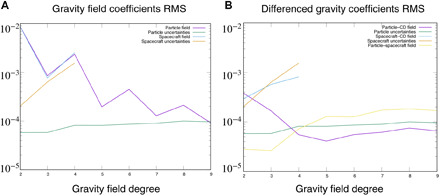
The gravity field of a small body provides insight into its internal mass distribution. We used two approaches to measure the gravity field of the rubble-pile asteroid (101955) Bennu: (i) tracking and modeling the spacecraft in orbit about the asteroid and (ii) tracking and modeling pebble-sized particles naturally ejected from Bennu's surface into sustained orbits. These approaches yield statistically consistent results up to degree and order 3, with the particle-based field being statistically significant up to degree and order 9. Comparisons with a constant-density shape model show that Bennu has a heterogeneous mass distribution. These deviations can be modeled with lower densities at Bennu's equatorial bulge and center. The lower-density equator is consistent with recent migration and redistribution of material. The lower-density center is consistent with a past period of rapid rotation, either from a previous Yarkovsky-O'Keefe-Radzievskii-Paddack cycle or arising during Bennu's accretion following the disruption of its parent body.
小天体的引力场有助于深入了解其内部质量分布。我们采用了两种方法来测量碎石堆小行星(101955)本努的引力场:(i)跟踪并模拟绕该小行星运行的航天器;(ii)跟踪并模拟从小行星本努表面自然喷出并进入持续轨道的卵石大小的粒子。这些方法在3阶及以下阶次上产生了统计上一致的结果,基于粒子的引力场在9阶及以下阶次上具有统计显著性。与常密度形状模型的比较表明,本努具有非均匀的质量分布。这些偏差可以通过本努赤道隆起和中心处较低的密度来建模。较低密度的赤道与近期物质的迁移和重新分布一致。较低密度的中心与过去的快速旋转时期一致,这一时期要么源于之前的雅科夫斯基-奥基夫-拉季耶夫斯基-帕达克周期,要么是在本努的母体解体后的吸积过程中出现的。