Department of Obstetrics and Gynecology, Medical University of Innsbruck, Innsbruck, Tyrol, Austria.
Department of Obstetrics and Gynecology, Paracelsus Medical University Salzburg, Salzburg, Austria.
Int J Gynecol Cancer. 2020 Nov;30(11):1667-1671. doi: 10.1136/ijgc-2020-001975. Epub 2020 Oct 8.
On March 16, 2020, the federal government of Austria declared a nationwide lockdown due to the COVID-19 pandemic. Since the lockdown, screening examinations and routine checkups have been restricted to prevent the spread of the virus and to increase the hospitals' bed capacity across the country. This resulted in a severe decline of patient referrals to the hospitals.
To assess the impact of the COVID-19 pandemic on the rate of newly diagnosed gynecological and breast cancers in Austria.
Data of 2077 patients from 18 centers in Austria with newly diagnosed gynecological or breast cancer between January and May 2019 and January and May 2020 were collected. Clinical parameters, including symptoms, performance status, co-morbidities, and referral status, were compared between the time before and after the COVID-19 outbreak.
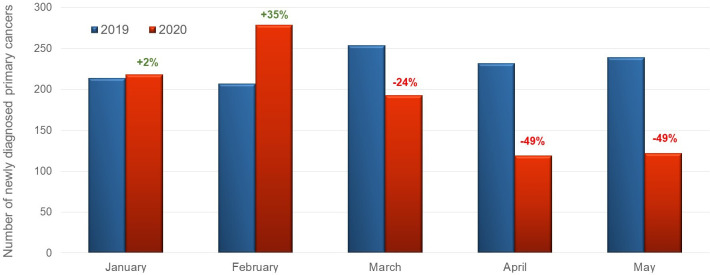
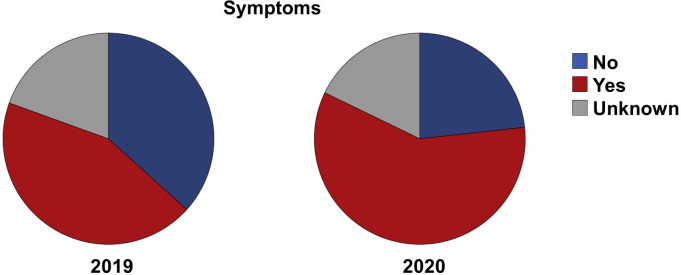
Our results showed a slight increase of newly diagnosed cancers in January and February 2020 as compared with 2019 (+2 and +35%, respectively) and a strong decline in newly diagnosed tumors since the lockdown: -24% in March 2020 versus March 2019, -49% in April 2020 versus April 2019, -49% in May 2020 versus May 2019. Two-thirds of patients diagnosed during the pandemic presented with tumor-specific symptoms compared with less than 50% before the pandemic (p<0.001). Moreover, almost 50% of patients in 2020 had no co-morbidities compared with 35% in 2019 (p<0.001). Patients, who already had a malignant disease, were rarely diagnosed with a new cancer in 2020 as compared with 2019 (11% vs 6%; p<0.001).
The lockdown led to a decreased number of newly diagnosed gynecological and breast cancers. The decreased accessibility of the medical services and postponed diagnosis of potentially curable cancers during the COVID-19 pandemic may be a step backwards in our healthcare system and might impair cancer treatment outcomes. Therefore, new strategies to manage early cancer detection are needed to optimize cancer care in a time of pandemic in the future.
2020 年 3 月 16 日,由于 COVID-19 大流行,奥地利联邦政府宣布全国封锁。自封锁以来,为了防止病毒传播和增加全国医院的床位容量,筛查检查和常规检查受到限制。这导致患者向医院转诊的人数严重下降。
评估 COVID-19 大流行对奥地利新诊断妇科和乳腺癌发病率的影响。
收集了 2019 年 1 月至 5 月和 2020 年 1 月至 5 月期间奥地利 18 个中心的 2077 例新诊断妇科或乳腺癌患者的数据。比较了 COVID-19 爆发前后的临床参数,包括症状、表现状态、合并症和转诊状态。
我们的结果显示,与 2019 年相比,2020 年 1 月和 2 月新诊断的癌症略有增加(分别增加 2%和 35%),自封锁以来新诊断的肿瘤数量大幅下降:2020 年 3 月与 2019 年 3 月相比下降 24%,2020 年 4 月与 2019 年 4 月相比下降 49%,2020 年 5 月与 2019 年 5 月相比下降 49%。与大流行前相比,有肿瘤特异性症状的患者占三分之二,而不到 50%(p<0.001)。此外,与 2019 年相比,2020 年几乎有 50%的患者没有合并症(p<0.001)。与 2019 年相比,患有恶性疾病的患者在 2020 年很少被诊断出患有新癌症(11%比 6%;p<0.001)。
封锁导致新诊断的妇科和乳腺癌数量减少。在 COVID-19 大流行期间,医疗服务的可及性降低,潜在可治愈癌症的诊断推迟,这可能是我们医疗保健系统的倒退,并可能影响癌症治疗结果。因此,需要制定新的策略来管理早期癌症检测,以优化未来大流行期间的癌症护理。