Department of Gynecology, Centro Hospitalar e Universitário de Coimbra, Praceta Prof. Mota Pinto, 3004-561 Coimbra, Portugal.
Faculty of Medicine, University of Coimbra, Azinhaga de Santa Comba, Celas, 3000-548 Coimbra, Portugal.
Medicina (Kaunas). 2022 Dec 16;58(12):1862. doi: 10.3390/medicina58121862.
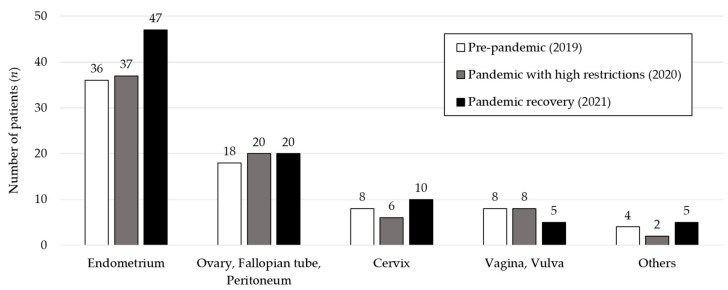
Background and Objectives: The COVID-19 pandemic impacted health systems worldwide, particularly cancer care. Because the actual implications of these changes on gynecological oncology healthcare are still unclear, we aim to evaluate the impact of this pandemic on the diagnosis and management of gynecological cancer. Materials and Methods: This is a single-center retrospective observational study, including patients diagnosed with gynecological malignancies between January 2019 and December 2021. Patients were included into three groups based on the timing of cancer diagnosis: pre-pandemic (2019), pandemic with high restrictions (2020) and pandemic recovery (2021). Results: Overall, 234 patients were diagnosed with gynecological cancer during the period of study. A decrease in the number of newly diagnosed cervical cancers and other rare tumors (leiomyosarcoma, invasive hydatidiform mole) was apparent in 2020. Some aggressive histological types of endometrial and ovarian cancer were more commonly diagnosed in the pandemic recovery group (p < 0.05), although no differences were demonstrated concerning tumor staging in all gynecological cancers. The median time between the first multidisciplinary team meeting and the treatment initiation was higher after the COVID-19 pandemic in endometrial cancer (23.0 vs. 34.0 vs. 36.0 days, p < 0.05). Patients with ovarian cancer were more frequently proposed for neoadjuvant therapy in 2020 compared to the other periods (33.3% vs. 55.0% vs. 10.0% p < 0.05). A significant reduction in the laparoscopic approach was observed during 2020 in endometrial cancer (32.1% vs. 14.3% vs. 36.4%, p < 0.05). No significant differences were registered regarding median hospitalization days or intra- and post-operative complications between these periods. Conclusions: The COVID-19 pandemic had a significant impact on the diagnosis and management of most gynecological malignancies, namely, on time to first treatment, chosen oncological therapies and surgical approaches. These results suggest important clinical and healthcare implications that should be addressed in future prospective studies.
COVID-19 大流行对全球卫生系统产生了影响,尤其是癌症治疗。由于这些变化对妇科肿瘤学医疗保健的实际影响尚不清楚,我们旨在评估这场大流行对妇科癌症诊断和管理的影响。
这是一项单中心回顾性观察性研究,纳入了 2019 年 1 月至 2021 年 12 月期间诊断为妇科恶性肿瘤的患者。患者根据癌症诊断时间分为三组:大流行前(2019 年)、大流行高限制期(2020 年)和大流行恢复期(2021 年)。
总体而言,研究期间共有 234 例患者被诊断为妇科癌症。2020 年新诊断的宫颈癌和其他罕见肿瘤(平滑肌肉瘤、侵袭性葡萄胎)数量明显减少。在大流行恢复期,一些侵袭性组织学类型的子宫内膜癌和卵巢癌更为常见(p < 0.05),尽管所有妇科癌症的肿瘤分期均无差异。COVID-19 大流行后,子宫内膜癌首次多学科团队会议与治疗开始之间的中位时间延长(23.0 天 vs. 34.0 天 vs. 36.0 天,p < 0.05)。与其他时期相比,2020 年卵巢癌患者更常接受新辅助治疗(33.3% vs. 55.0% vs. 10.0%,p < 0.05)。2020 年,子宫内膜癌腹腔镜手术明显减少(32.1% vs. 14.3% vs. 36.4%,p < 0.05)。这些时期的中位住院天数或围手术期并发症无显著差异。
COVID-19 大流行对大多数妇科恶性肿瘤的诊断和管理产生了重大影响,即首次治疗时间、选择的肿瘤治疗方法和手术方式。这些结果表明,未来的前瞻性研究应解决这些重要的临床和医疗保健问题。