Oliveira Juliana S, Sherrington Catherine, Lord Stephen, Sesto Romina, Youkhana Sabrina, Camara Giane C, Grunseit Anne C, Bauman Adrian, Anstey Kaarin J, Shepherd Roberta B, Tiedemann Anne
Institute for Musculoskeletal Health, Faculty of Medicine and Health, The University of Sydney, Camperdown, Australia.
Neuroscience Research Australia, University of New South Wales, Sydney, Australia.
BMJ Open Sport Exerc Med. 2020 Sep 29;6(1):e000878. doi: 10.1136/bmjsem-2020-000878. eCollection 2020.
Falls significantly reduce independence and quality of life in older age. Balance-specific exercise prevents falls in people aged 60+ years. Yoga is growing in popularity and can provide a high challenge to balance; however, the effect of yoga on falls has not been evaluated. This trial aims to establish the effect on falls of a yoga exercise programme compared with a yoga relaxation programme in community-dwellers aged 60+ years.
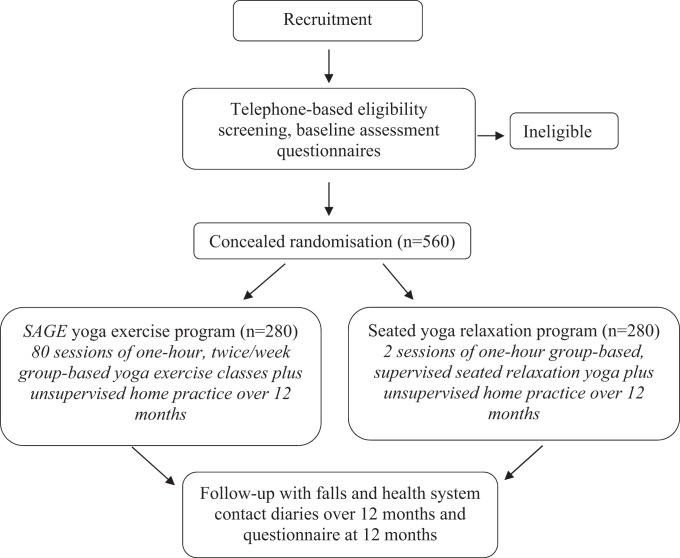
This randomised controlled trial will involve 560 community-dwelling people aged 60+ years. Participants will be randomised to either: (1) the Successful AGEing () yoga exercise programme or (2) a yoga relaxation programme. Primary outcome is rate of falls in the 12 months post randomisation. Secondary outcomes include mental well-being, physical activity, health-related quality of life, balance self-confidence, physical function, pain, goal attainment and sleep quality at 12 months after randomisation. The number of falls per person-year will be analysed using negative binomial regression models to estimate between-group difference in fall rates. Generalised linear models will assess the effect of group allocation on the continuously scored secondary outcomes, adjusting for baseline scores. An economic analysis will compare the cost-effectiveness and cost-utility of the two yoga programmes.
Protocol was approved by the Human Research Ethics Committee at The University of Sydney, Australia (approval 2019/604). Trial results will be disseminated via peer-reviewed articles, conference presentations, lay summaries.
The protocol for this trial is registered with the Australian New Zealand Clinical Trials Registry (ACTRN12619001183178).
跌倒会显著降低老年人的独立性和生活质量。针对平衡能力的锻炼可预防60岁及以上人群跌倒。瑜伽越来越受欢迎,且对平衡能力具有较高挑战性;然而,瑜伽对跌倒的影响尚未得到评估。本试验旨在确定与瑜伽放松计划相比,瑜伽锻炼计划对60岁及以上社区居民跌倒情况的影响。
这项随机对照试验将纳入560名60岁及以上的社区居民。参与者将被随机分为:(1)成功老龄化(SA)瑜伽锻炼计划组或(2)瑜伽放松计划组。主要结局是随机分组后12个月内的跌倒发生率。次要结局包括随机分组后12个月时的心理健康、身体活动、健康相关生活质量、平衡自信心、身体功能、疼痛、目标达成情况和睡眠质量。将使用负二项回归模型分析每人年的跌倒次数,以估计两组跌倒率之间的差异。广义线性模型将评估分组对连续评分的次要结局的影响,并对基线评分进行调整。一项经济学分析将比较两种瑜伽计划的成本效益和成本效用。
该方案已获得澳大利亚悉尼大学人类研究伦理委员会的批准(批准号2019/604)。试验结果将通过同行评审文章、会议报告、通俗摘要进行传播。
本试验方案已在澳大利亚新西兰临床试验注册中心注册(ACTRN12619001183178)。