Rissardo Jamir Pitton, Caprara Ana Letícia Fornari
Department of Medicine, Federal University of Santa Maria, Santa Maria, RS, Brazil.
Brain Circ. 2020 Jun 26;6(2):96-106. doi: 10.4103/bc.bc_57_19. eCollection 2020 Apr-Jun.
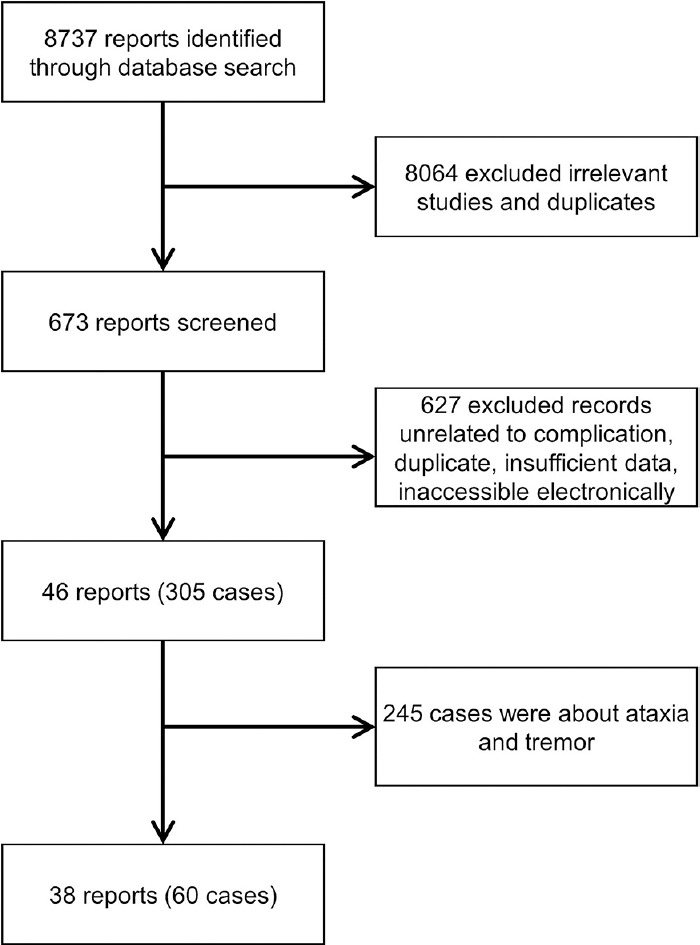
Central nervous system adverse effects are commonly reported with pregabalin (PGB). On the other hand, movement disorders (MDs) associated with this drug were rarely described. However, their occurrence could significantly affect the quality of life of PGB users. This literature review aims to evaluate the clinical epidemiological profile, pathological mechanisms, and management of PGB-associated MDs. Relevant reports in six databases were identified and assessed by two reviewers without language restriction. A total of 46 reports containing 305 cases from 17 countries were assessed. The MDs encountered were as follows: 184 individuals with ataxia, 61 with tremors, 39 with myoclonus, 8 with parkinsonism, 1 with restless legs syndrome, 1 with dystonia, 1 with dyskinesia, and 1 with akathisia. The mean age was 62 years (range: 23-94). The male sex was slightly predominant with 54.34%. The mean PGB dose when the MD occurred was 238 mg, and neuropathic pain was the most common indication of PGB. The time from PGB start to MD was < 1 month at 75%. The time from PGB withdrawal to recovery was < 1 week at 77%. All the individuals where the follow-up was reported had a full recovery. The most common management was PGB withdrawal. In the literature, the majority of the cases did not report information about timeline events, neurological examination details, or electrodiagnostic studies. The best management for all MDs is probably PGB withdrawal. If the patient is on dialysis program, perhaps an increased number of sessions will decrease recovery time. Furthermore, the addition of a benzodiazepine could accelerate recovery.
普瑞巴林(PGB)常被报道有中枢神经系统不良反应。另一方面,与该药物相关的运动障碍(MDs)很少被描述。然而,它们的出现会显著影响使用PGB患者的生活质量。这篇文献综述旨在评估与PGB相关的MDs的临床流行病学特征、病理机制及管理。两名审阅者对六个数据库中的相关报告进行了识别和评估,无语言限制。共评估了来自17个国家的46篇报告,包含305例病例。所遇到的MDs如下:184例共济失调、61例震颤、39例肌阵挛、8例帕金森综合征、1例不宁腿综合征、1例肌张力障碍、1例运动障碍和1例静坐不能。平均年龄为62岁(范围:23 - 94岁)。男性略占优势,为54.34%。MD出现时PGB的平均剂量为238mg,神经病理性疼痛是PGB最常见的适应证。从开始使用PGB到出现MD的时间<1个月的占75%。从停用PGB到恢复的时间<1周的占77%。所有报告了随访情况的个体均完全康复。最常见的处理方法是停用PGB。在文献中,大多数病例未报告时间线事件、神经学检查细节或电诊断研究的信息。对所有MDs的最佳处理方法可能是停用PGB。如果患者正在接受透析治疗,增加透析次数或许会缩短恢复时间。此外,加用苯二氮䓬类药物可加速恢复。