Challenge TB Project, Management Sciences for Health, Kabul, Afghanistan.
National TB Program, Ministry of Public Health, Kabul, Afghanistan.
PLoS One. 2020 Oct 9;15(10):e0240031. doi: 10.1371/journal.pone.0240031. eCollection 2020.
This observational study analyzed the performance of the National TB Control Program (NTP) in Afghanistan in household contact screening from 2011 to 2018 and its use as an entry point for isoniazid preventive therapy (IPT), as well as the IPT completion rates for children under age five.
From 2011 to 2018, the Afghanistan NTP released guidelines for passive and active contact screening of bacteriologically confirmed TB cases. Health workers were trained in contact screening. Presumptive TB cases gave sputum for AFB smear microscopy; other diagnostics were used if patients could not produce sputum. Children under five (excluding those with active TB) were treated for latent TB infection. We calculated the yield and the number needed to screen and number needed to test to find a case of TB, as well as the rates of IPT initiation and completion.
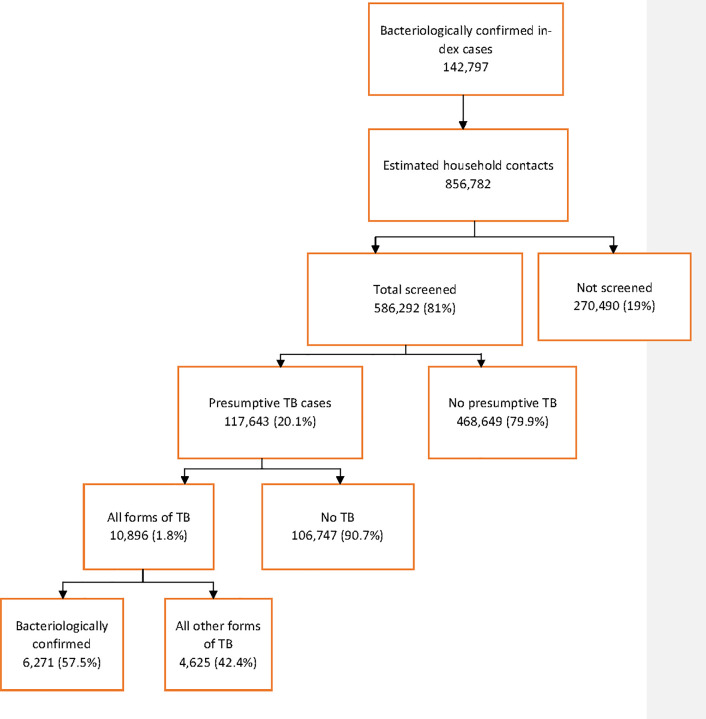
From 2011 to 2018, 142,797 bacteriologically confirmed TB cases were diagnosed in Afghanistan. The number of household members eligible for screening was estimated to be 856,782, of whom 586,292 (81%) were screened for TB and 117,643 (20.1%) were found to be presumptive TB cases. Among the cases screened, 10,896 TB cases (all forms) were diagnosed (1.85%, 95% CI 1.82-1.89), 54.4% in females. The number needed to screen to diagnose a single case of TB (all forms) was 53.8; the number needed to test was 10.7. Out of all children under five, 101,084 (85.9%) were initiated on IPT, and 69,273 (68.5%) completed treatment.
Program performance in contact screening in Afghanistan is high, at 81%, and the yield of TB is also high-close to 10 times higher than the national TB incidence rate. IPT initiation and completion rates are also high as compared to those of many other countries but need further improvement, especially for completion.
本观察性研究分析了 2011 年至 2018 年期间阿富汗国家结核病控制规划(NTP)在家庭接触者筛查方面的表现及其作为异烟肼预防性治疗(IPT)切入点的作用,以及 5 岁以下儿童 IPT 的完成率。
从 2011 年到 2018 年,阿富汗 NTP 发布了针对确诊结核病病例的被动和主动接触筛查指南。卫生工作者接受了接触筛查培训。疑似结核病患者提供 AFB 涂片显微镜检查的痰液;如果患者无法产生痰液,则使用其他诊断方法。五岁以下(不包括活动性结核病患者)的儿童接受潜伏性结核病感染治疗。我们计算了产量、筛查人数和需要检测人数以发现结核病病例,以及 IPT 的起始和完成率。
从 2011 年到 2018 年,阿富汗诊断出 142797 例确诊结核病病例。估计有 856782 名家庭接触者符合筛查条件,其中 586292 人(81%)接受了结核病筛查,117643 人(20.1%)被发现为疑似结核病病例。在接受筛查的病例中,诊断出 10896 例结核病病例(所有类型)(1.85%,95%CI 1.82-1.89),其中 54.4%为女性。诊断出单个结核病病例(所有类型)所需的筛查人数为 53.8 人,所需的检测人数为 10.7 人。在所有五岁以下儿童中,有 101084 人(85.9%)开始接受 IPT,有 69273 人(68.5%)完成了治疗。
阿富汗在接触筛查方面的项目表现率很高,达到 81%,结核病的检出率也很高,接近全国结核病发病率的 10 倍。IPT 的起始和完成率也很高,与许多其他国家相比,但仍需要进一步改进,特别是完成率。