Sanaie A, Mergenthaler C, Nasrat A, Seddiq M K, Mahmoodi S D, Stevens R H, Creswell J
Anti-TB Association Afghanistan, Kabul, Afghanistan.
Stop TB Partnership, Geneva, Switzerland.
PLoS One. 2016 Oct 4;11(10):e0163813. doi: 10.1371/journal.pone.0163813. eCollection 2016.
In Afghanistan, improving TB case detection remains challenging. In 2014, only half of the estimated incident TB cases were notified, and notifications have decreased since peaking in 2007. Active case finding has been increasingly considered to improve TB case notifications. While access to health services has improved in Afghanistan, it remains poor and many people seeking health services won't receive proper care.
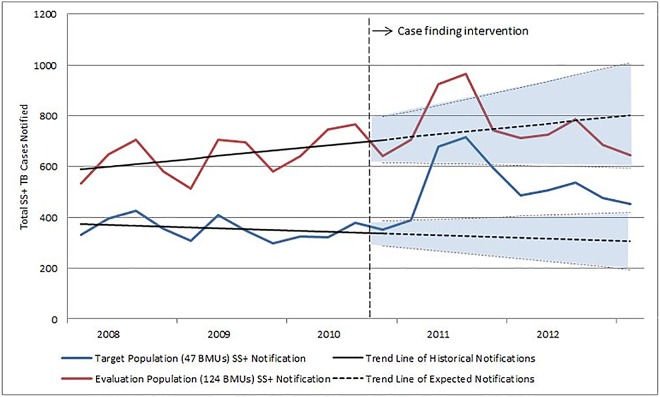
From October 2011 through December 2012 we conducted three separate case finding strategies in six provinces of Afghanistan and measured impact on TB case notification. Systematically screening cough among attendees at 47 health facilities, active household contact investigation of smear-positive index TB patients, and active screening at 15 camps for internally displaced people were conducted. We collected both intervention yield and official quarterly notification data. Additional TB notifications were calculated by comparing numbers of cases notified during the intervention with those notified before the intervention, then adjusting for secular trends in notification.
We screened 2,022,127 people for TB symptoms during the intervention, tested 59,838 with smear microscopy and detected 5,046 people with smear-positive TB. Most cases (81.7%, 4,125) were identified in health facilities while nearly 20% were found through active case finding. A 56% increase in smear-positive TB notifications was observed between the baseline and intervention periods among the 47 health facilities, where cases detected by all three strategies were notified.
While most people with TB are likely to be identified through health facility screening, there are many people who remain without a proper diagnosis if outreach is not attempted. This is especially true in places like Afghanistan where access to general services is poor. Targeted active case finding can improve the number of people who are detected and treated for TB and can push towards the targets of the Stop TB Global Plan and End TB Strategy.
在阿富汗,提高结核病病例发现率仍然具有挑战性。2014年,估计的结核病新发病例中仅有一半得到通报,自2007年达到峰值以来通报数量一直在下降。主动病例发现越来越被认为是提高结核病病例通报的方法。虽然阿富汗的医疗服务可及性有所改善,但仍然很差,许多寻求医疗服务的人无法获得适当的治疗。
从2011年10月至2012年12月,我们在阿富汗的六个省份开展了三种不同的病例发现策略,并评估了对结核病病例通报的影响。对47家医疗机构的就诊者进行咳嗽症状的系统筛查,对涂片阳性的结核病索引患者进行家庭主动接触者调查,并在15个境内流离失所者营地进行主动筛查。我们收集了干预产出和官方季度通报数据。通过比较干预期间通报的病例数与干预前通报的病例数,然后根据通报的长期趋势进行调整,计算出额外的结核病通报数。
在干预期间,我们对2,022,127人进行了结核病症状筛查,对59,838人进行了涂片显微镜检查,发现了5,046例涂片阳性结核病患者。大多数病例(81.7%,4,125例)在医疗机构中被发现,而近20%是通过主动病例发现发现的。在47家医疗机构中,基线期和干预期之间涂片阳性结核病通报增加了56%,所有三种策略发现的病例均在此通报。
虽然大多数结核病患者可能通过医疗机构筛查被发现,但如果不尝试进行外展服务,仍有许多人无法得到正确诊断。在阿富汗这样的地方尤其如此,那里的一般服务可及性很差。有针对性的主动病例发现可以增加被发现并接受结核病治疗的人数,并有助于实现《终止结核病全球计划》和《终止结核病战略》的目标。