Imoto Hiroaki, Zhang Suxiang, Okada Mariko
Institute for Protein Research, Osaka University, Suita, Osaka 565-0871, Japan.
Center for Drug Design and Research, National Institutes of Biomedical Innovation, Health and Nutrition, Ibaraki, Osaka 567-0085, Japan.
Cancers (Basel). 2020 Oct 7;12(10):2878. doi: 10.3390/cancers12102878.
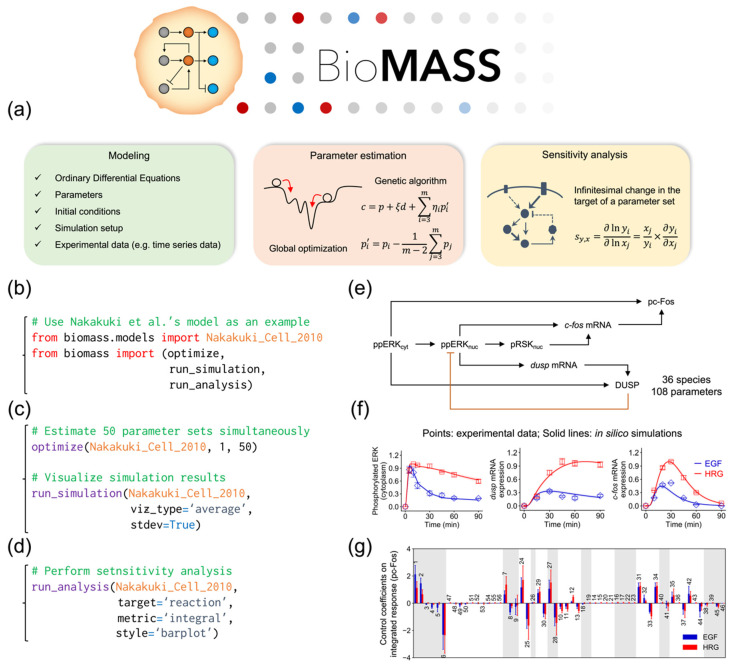
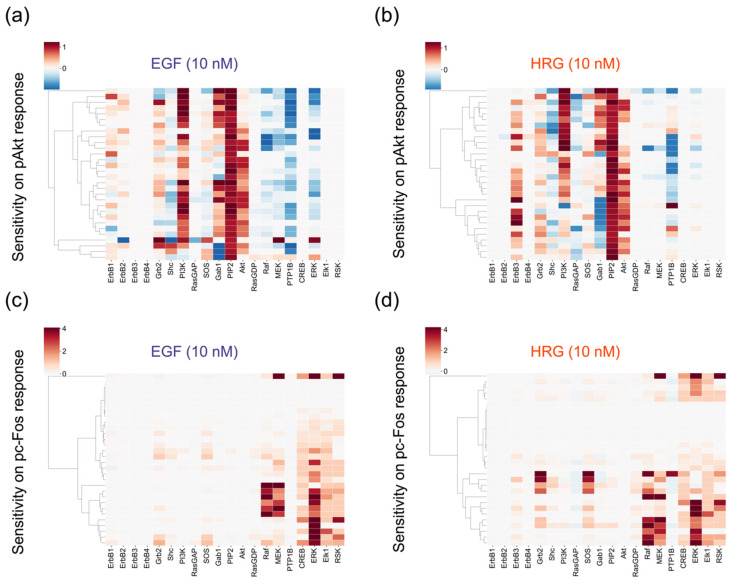
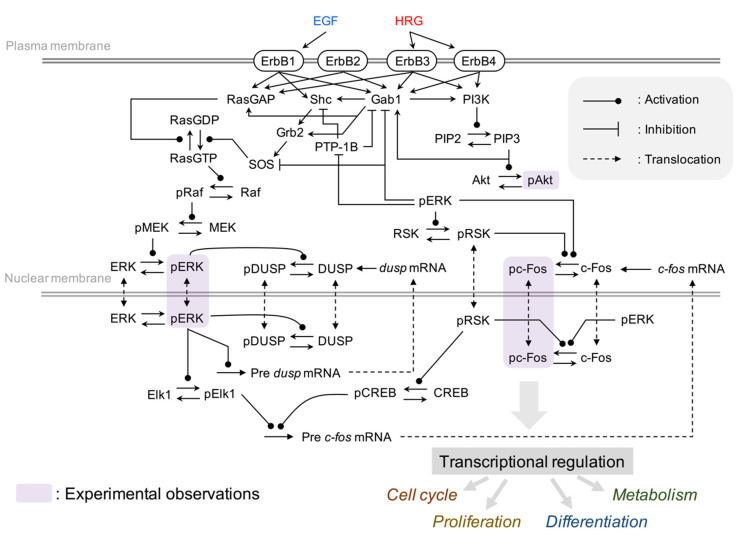
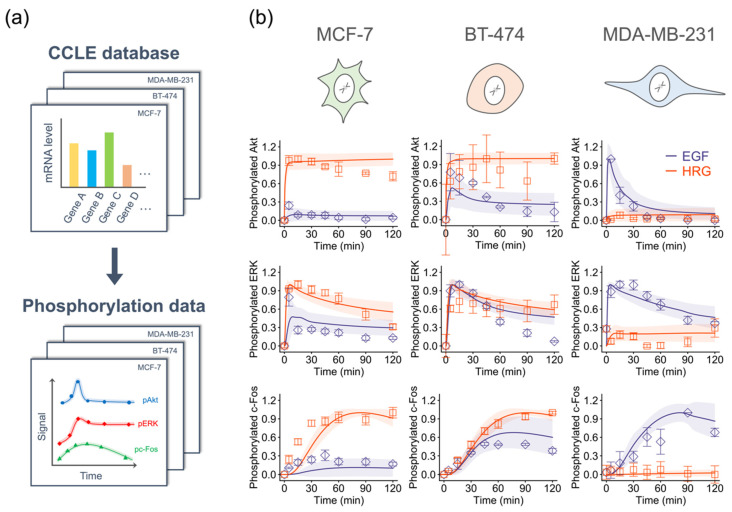
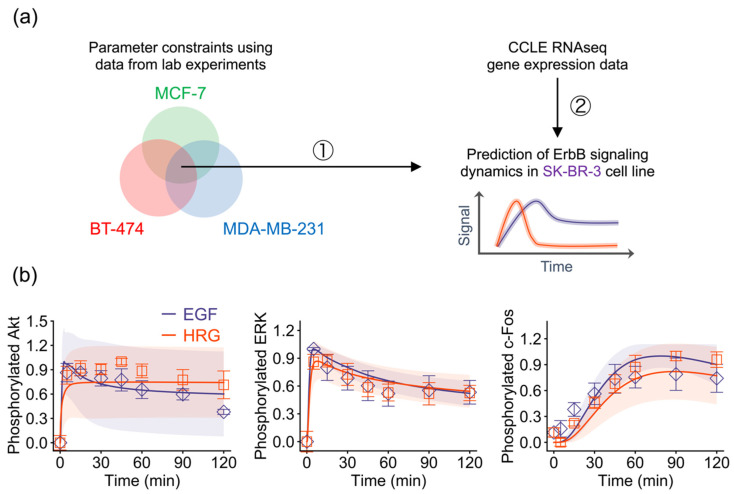
A current challenge in systems biology is to predict dynamic properties of cell behaviors from public information such as gene expression data. The temporal dynamics of signaling molecules is critical for mammalian cell commitment. We hypothesized that gene expression levels are tightly linked with and quantitatively control the dynamics of signaling networks regardless of the cell type. Based on this idea, we developed a computational method to predict the signaling dynamics from RNA sequencing (RNA-seq) gene expression data. We first constructed an ordinary differential equation model of ErbB receptor → c-Fos induction using a newly developed modeling platform BioMASS. The model was trained with kinetic parameters against multiple breast cancer cell lines using autologous RNA-seq data obtained from the Cancer Cell Line Encyclopedia (CCLE) as the initial values of the model components. After parameter optimization, the model proceeded to prediction in another untrained breast cancer cell line. As a result, the model learned the parameters from other cells and was able to accurately predict the dynamics of the untrained cells using only the gene expression data. Our study suggests that gene expression levels of components within the ErbB network, rather than rate constants, can explain the cell-specific signaling dynamics, therefore playing an important role in regulating cell fate.
系统生物学当前面临的一个挑战是根据诸如基因表达数据等公共信息预测细胞行为的动态特性。信号分子的时间动态对于哺乳动物细胞的定向分化至关重要。我们假设,无论细胞类型如何,基因表达水平都与信号网络的动态紧密相关并对其进行定量控制。基于这一想法,我们开发了一种计算方法,用于从RNA测序(RNA-seq)基因表达数据预测信号动态。我们首先使用新开发的建模平台BioMASS构建了一个表皮生长因子受体(ErbB)→c-Fos诱导的常微分方程模型。该模型使用从癌症细胞系百科全书(CCLE)获得的自体RNA-seq数据作为模型组件的初始值,针对多种乳腺癌细胞系用动力学参数进行训练。经过参数优化后,该模型在另一个未训练的乳腺癌细胞系中进行预测。结果,该模型从其他细胞中学习参数,并能够仅使用基因表达数据准确预测未训练细胞的动态。我们的研究表明,ErbB网络内组件的基因表达水平而非速率常数可以解释细胞特异性信号动态,因此在调节细胞命运中发挥重要作用。