Laboratory of Cell Systems, Institute for Protein Research, Osaka University, Osaka, 565-0871, Japan.
Laboratory for Integrated Cellular Systems, RIKEN Center for Integrative Medical Sciences (IMS), Yokohama, 230-0045, Japan.
Sci Rep. 2021 Sep 16;11(1):18511. doi: 10.1038/s41598-021-97887-z.
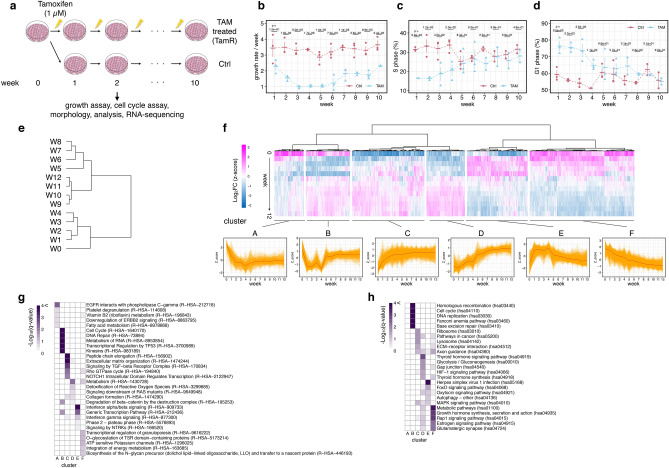
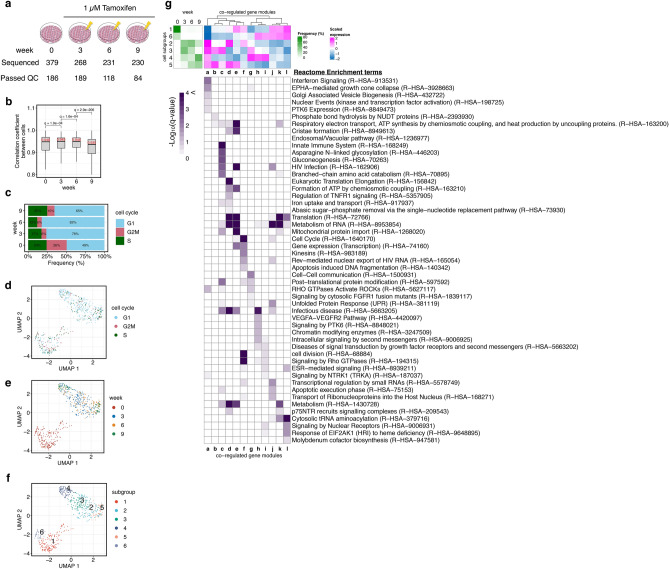
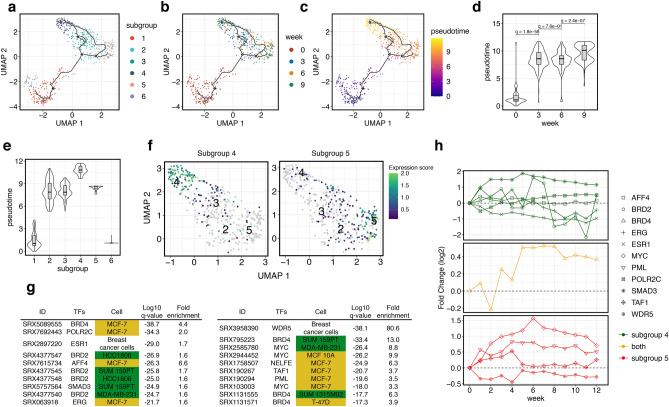
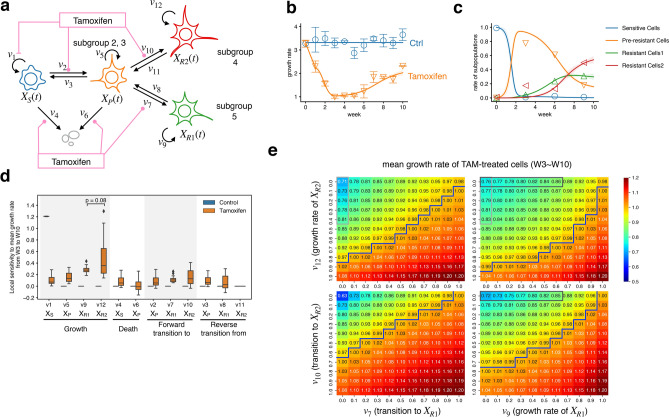
Cancer cells acquire drug resistance through the following stages: nonresistant, pre-resistant, and resistant. Although the molecular mechanism of drug resistance is well investigated, the process of drug resistance acquisition remains largely unknown. Here we elucidate the molecular mechanisms underlying the process of drug resistance acquisition by sequential analysis of gene expression patterns in tamoxifen-treated breast cancer cells. Single-cell RNA-sequencing indicates that tamoxifen-resistant cells can be subgrouped into two, one showing altered gene expression related to metabolic regulation and another showing high expression levels of adhesion-related molecules and histone-modifying enzymes. Pseudotime analysis showed a cell transition trajectory to the two resistant subgroups that stem from a shared pre-resistant state. An ordinary differential equation model based on the trajectory fitted well with the experimental results of cell growth. Based on the established model, it was predicted and experimentally validated that inhibition of transition to both resistant subtypes would prevent the appearance of tamoxifen resistance.
非耐药性、前耐药性和耐药性。尽管耐药性的分子机制已经得到很好的研究,但耐药性获得的过程在很大程度上仍然未知。在这里,我们通过对他莫昔芬处理的乳腺癌细胞的基因表达模式进行序贯分析,阐明了耐药性获得过程的分子机制。单细胞 RNA 测序表明,他莫昔芬耐药细胞可以分为两类,一类表现出与代谢调节相关的基因表达改变,另一类表现出黏附相关分子和组蛋白修饰酶的高表达水平。拟时分析显示,耐药细胞向两个耐药亚群的转变轨迹源自一个共同的前耐药状态。基于轨迹的常微分方程模型与细胞生长的实验结果拟合良好。基于建立的模型,预测并实验验证了抑制向两种耐药亚型的转变可以防止他莫昔芬耐药性的出现。