Cai Yilin, Dai Zheng, Wen Sijin, Bhandari Ruchi
Department of Biostatistics, School of Public Health, West Virginia University, One Medical Center Drive, Morgantown, WV, 26506, USA.
Department of Epidemiology, School of Public Health, West Virginia University, One Medical Center Drive, Morgantown, WV, 26506, USA.
BMC Infect Dis. 2020 Oct 9;20(1):742. doi: 10.1186/s12879-020-05464-y.
The surge of methamphetamine use has been a complicating factor compounding the steeply increasing number of drug overdose deaths in the U.S. Infection from blood-borne viruses including hepatitis B virus (HBV), hepatitis C virus (HCV) and HIV, related to methamphetamine use continue to grow. This study aims to examine the risk factors associated with HBV, HCV and HIV among people who used methamphetamine.
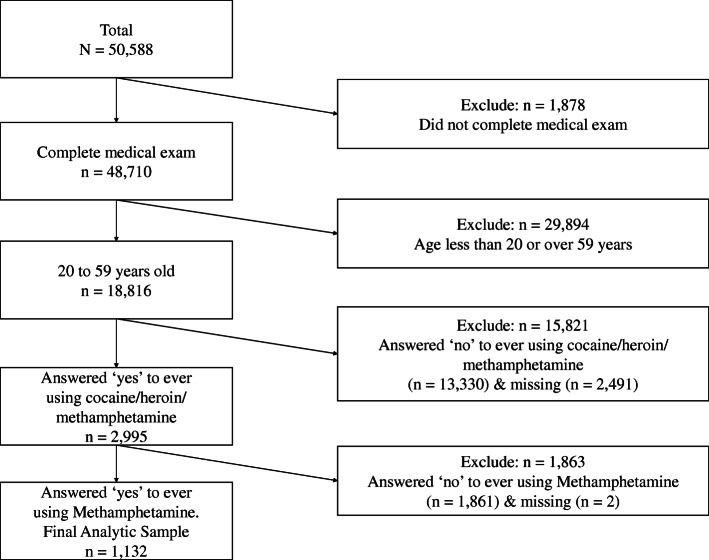
People who ever used methamphetamine were identified from five National Health and Nutrition Examination Survey (NHANES) cohorts, 2007 to 2016. The outcome was either positive or negative for blood-borne viruses as identified from laboratory tests. Weighted statistics for the combined ten years of data were calculated by multiplying the weighted variable for laboratory measurements by 0.2. We examined the association of sexual activities (sexual partners, sexual identity), drug use behaviors (poly-drug use, injection drug use, frequency of drug use, age started using methamphetamine), demographics, and socio-economic status with blood-borne viruses using bivariate and multivariable logistic regression models.
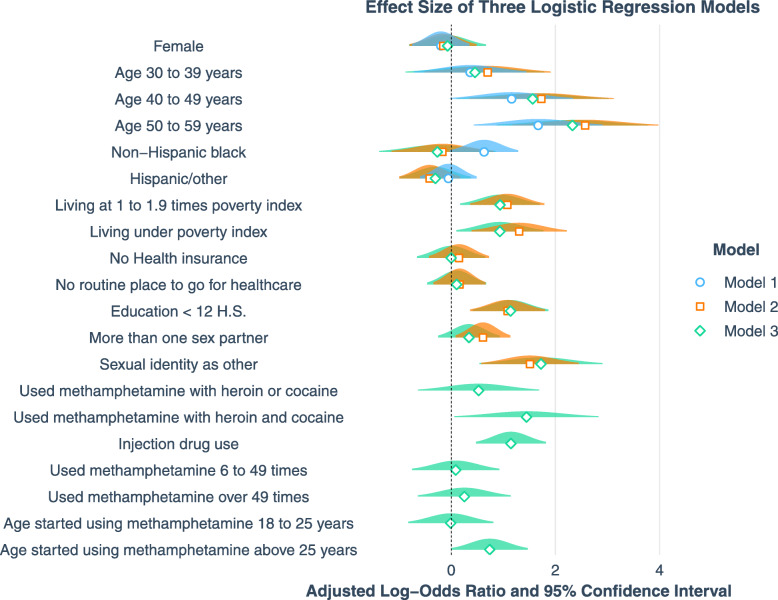
There were 1132 participants representing approximately 11,996,319 persons who ever used methamphetamine in the U.S. Blood-borne viruses' positive rate was 13.0 per 100,000. Multivariable logistic regression analyses showed significant associations of blood-borne infections with age 40-49 years (vs. age 20-29 years, adjusted odds ratio 4.77, 95% CI 1.11-20.55), age 50-59 years (vs. age 20-29 years, 10.25, 2.40-43.82), living within poverty index 1-1.9 (vs. poverty index > = 2, 2.55; 1.19-5.49), living below the poverty threshold (vs. poverty index > = 2, 2.55; 1.11-5.86), having lower than high school education (vs. equal or higher than high school education, 3.13; 1.51-6.46), sexual identity as other than heterosexual (vs. heterosexual, 5.60; 1.72-18.28), using methamphetamine and heroin and cocaine (vs. using methamphetamine alone, 4.24; 1.06-16.92), injection drug use (vs. no injection drug use, 3.15; 1.61-6.16), and started using methamphetamine at age above 25 (vs. started using methamphetamine at age between 10 and 17, 2.09; 1.01-4.35).
Among people who use methamphetamine, those who use polysubstance, or who inject substances, are in urgent need for vaccination and interventions to avoid further harm from blood borne infections.
甲基苯丙胺使用的激增一直是美国药物过量死亡人数急剧增加的一个复杂因素。与甲基苯丙胺使用相关的包括乙型肝炎病毒(HBV)、丙型肝炎病毒(HCV)和艾滋病毒在内的血源性病毒感染持续增加。本研究旨在探讨使用甲基苯丙胺人群中与HBV、HCV和HIV相关的危险因素。
从2007年至2016年的五个国家健康与营养检查调查(NHANES)队列中识别出曾经使用过甲基苯丙胺的人群。结局为实验室检测确定的血源性病毒呈阳性或阴性。通过将实验室测量的加权变量乘以0.2来计算合并十年数据的加权统计量。我们使用双变量和多变量逻辑回归模型研究了性活动(性伴侣、性身份)、药物使用行为(多药使用、注射吸毒、药物使用频率、开始使用甲基苯丙胺的年龄)、人口统计学和社会经济状况与血源性病毒之间的关联。
有1132名参与者,代表美国约11996319名曾经使用过甲基苯丙胺的人。血源性病毒阳性率为每10万人13.0例。多变量逻辑回归分析显示,血源性感染与40 - 49岁(与20 - 29岁相比,调整后的优势比为4.77,95%可信区间为1.11 - 20.55)、50 - 59岁(与20 - 29岁相比,为10.25,2.40 - 43.82)、生活在贫困指数1 - 1.9范围内(与贫困指数≥2相比,为2.55;1.19 - 5.49)、生活在贫困线以下(与贫困指数≥2相比,为2.55;1.11 - 5.86)、高中以下学历(与高中及以上学历相比,为3.13;1.51 - 6.46)、非异性恋性身份(与异性恋相比,为5.60;1.72 - 18.28)、同时使用甲基苯丙胺、海洛因和可卡因(与仅使用甲基苯丙胺相比,为4.24;1.06 - 16.92)、注射吸毒(与不注射吸毒相比,为3.15;1.61 - 6.16)以及25岁以上开始使用甲基苯丙胺(与10 - 17岁开始使用甲基苯丙胺相比,为2.09;1.01 - 4.35)显著相关。
在使用甲基苯丙胺的人群中,那些使用多种物质或注射物质的人迫切需要接种疫苗和进行干预,以避免血源性感染造成进一步伤害。