Karabaev Bakyt B, Beisheeva Nurgul J, Satybaldieva Aiganysh B, Ismailova Aikul D, Pessler Frank, Akmatov Manas K
Republican Blood Centre, Bishkek, Kyrgyzstan, Chingiz Aitmatov Ave 60, 720044, Bishkek, Kyrgyzstan.
Republican AIDS Centre, Bishkek, Kyrgyzstan, Logvinenko Str. 8, 720040, Bishkek, Kyrgyzstan.
Infect Dis Poverty. 2017 Feb 21;6(1):45. doi: 10.1186/s40249-017-0255-9.
Post-Soviet Kyrgyzstan has experienced a major surge in blood-borne infections, but data from adequately powered, up-to-date studies are lacking. We thus examined a) the seroprevalences of hepatitis B virus surface antigen (HBsAg), HIV-1 p24 antigen and antibodies against hepatitis C virus (anti-HCV), human immunodeficiency viruses (anti-HIV-1/2, HIV-1 group O), and Treponema pallidum among blood donors in Kyrgyzstan and assess their distribution according to sex, age, and provinces of residence; b) trends in the respective seroprevalences; and c) co-infection rates among the pathogens studied.
Serological screening was performed on 37 165 blood donors at the Republican Blood Centre in Bishkek, Kyrgyzstan, between January 2013 and December 2015. We applied poststratification weights to control for sampling bias and used logistic regression analyses to examine the association of seropositivity and co-infections with sex, age, provinces of residence, and year of blood donation.
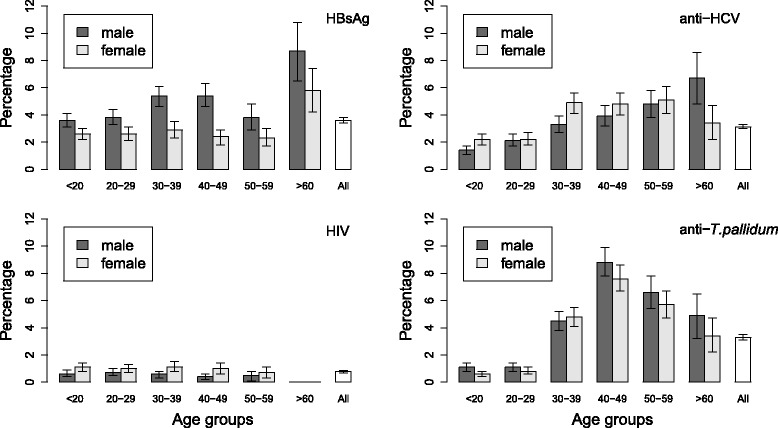
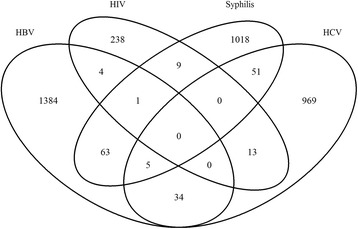
Twenty nine thousand and one hundred forty-five (78%) donors were males and 8 020 (22%) were females. The median age was 27 years (range: 18 - 64). The prevalences of HBsAg, anti-HCV, HIV (p24 Ag and anti-HIV), and anti-T. pallidum were 3.6% (95%CI: 3.4 - 3.8%), 3.1% (3.0 - 3.3%), 0.78% (0.69 - 0.87%), and 3.3% (3.1 - 3.5%), respectively. Males were more likely to be seropositive for HBsAg than females (OR: 1.63; 95%CI: 1.40 - 1.90), but less likely to be seropositive for anti-HCV (0.85; 0.74 - 0.98) and HIV (0.65; 0.49 - 0.85). Prevalences were lower in the capital than in the other provinces. There was a decreasing trend in the seroprevalences of HBsAg, anti-HCV, and anti-T. pallidum from 2012 to 2015 (P-value for trend, P = 0.01, P < 0.0001, P < 0.0001, respectively), while the seroprevalence of HIV increased (P = 0.049). One hundred eighty donors (0.48%) were seropositive for multiple infections. The highest co-infection rate was observed between anti-T. pallidum and HBsAg (6.0%), followed by anti-HCV and anti-T. pallidum (5.2%), and HIV and anti-HCV (4.9%).
The data suggest that Kyrgyzstan can be reclassified from high to lower-intermediate HBsAg endemicity, whereas the high HIV prevalence with a rising trend is an alarming finding that needs to be urgently addressed by public health authorities. The observed co-infections suggest common risk factors but also common preventive interventions.
后苏联时代的吉尔吉斯斯坦血源性感染大幅激增,但缺乏来自充足样本量的最新研究数据。因此,我们调查了:a)吉尔吉斯斯坦献血者中乙型肝炎病毒表面抗原(HBsAg)、HIV-1 p24抗原、丙型肝炎病毒抗体(抗-HCV)、人类免疫缺陷病毒抗体(抗-HIV-1/2、HIV-1 O组)和梅毒螺旋体抗体的血清流行率,并根据性别、年龄和居住省份评估其分布情况;b)各血清流行率的趋势;以及c)所研究病原体之间的合并感染率。
2013年1月至2015年12月期间,对吉尔吉斯斯坦比什凯克共和国血液中心的37165名献血者进行了血清学筛查。我们应用事后分层权重来控制抽样偏差,并使用逻辑回归分析来研究血清阳性和合并感染与性别、年龄、居住省份和献血年份之间的关联。
29145名(78%)献血者为男性,8020名(22%)为女性。年龄中位数为27岁(范围:18 - 64岁)。HBsAg、抗-HCV、HIV(p24抗原和抗-HIV)和抗梅毒螺旋体的流行率分别为3.6%(95%CI:3.4 - 3.8%)、3.1%(3.0 - 3.3%)、0.78%(0.69 - 0.87%)和3.3%(3.1 - 3.5%)。男性HBsAg血清阳性的可能性高于女性(OR:1.63;95%CI:1.40 - 1.90),但抗-HCV(0.85;0.74 - 0.98)和HIV(0.65;0.49 - 0.85)血清阳性的可能性较低。首都的流行率低于其他省份。2012年至2015年期间,HBsAg、抗-HCV和抗梅毒螺旋体的血清流行率呈下降趋势(趋势P值分别为P = 0.01、P < 0.0001、P < 0.0001),而HIV的血清流行率有所上升(P = 0.049)。180名献血者(0.48%)为多重感染血清阳性。观察到的最高合并感染率出现在抗梅毒螺旋体和HBsAg之间(6.0%),其次是抗-HCV和抗梅毒螺旋体(5.2%),以及HIV和抗-HCV(4.9%)。
数据表明,吉尔吉斯斯坦的HBsAg流行程度可从高流行重新分类为中低流行,而HIV高流行且呈上升趋势是一个令人担忧的发现,公共卫生当局需要紧急应对。观察到的合并感染表明存在共同的风险因素,但也存在共同的预防干预措施。