Department of Head and Neck Oncology and Surgery, The Netherlands Cancer Institute/Antoni Van Leeuwenhoek Hospital, Plesmanlaan 121, 1066 CX, Amsterdam, The Netherlands.
Robotics and Mechatronics, Technical Medical Centre, University of Twente, Enschede, The Netherlands.
Dysphagia. 2021 Aug;36(4):736-742. doi: 10.1007/s00455-020-10195-y. Epub 2020 Oct 11.
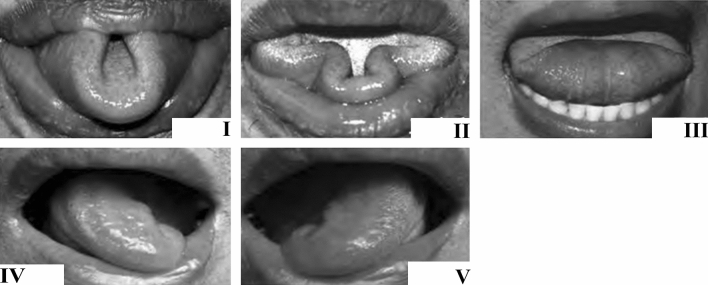
The importance of tongue mobility on speech, oral food transport, and swallowing is well recognized. However, whether the individual tongue mobility influences postoperative function in oral cancer treatment remains to be elucidated. This study assesses the ability to perform five tongue movements as rolling, twisting (two sides), folding, and the 'cloverleaf' in a healthy population. Because a tumor in oral cancer patients often restricts the mobility of the tongue, it might be helpful to know if it is possible to recall any of those movements without demonstrating it. Two observers asked 387 Dutch healthy adults if they could perform one of the five specific tongue movements and were subsequently asked to demonstrate the five movements. The distribution in the Dutch population is: rolling: 83.7%, cloverleaf: 14.7%, folding: 27.5%, twisting left: 36.1% and twisting right: 35.6%. The percentage of people that can fold their tongue is almost ten times higher (3% versus 27.5%) than in previous research, and it was found that the ability to roll the tongue is not a prerequisite for folding of the tongue. A relationship between gender or right-handedness and the ability to perform certain tongue movements could not be found. Of the participants, 9.9% and 13.1% incorrectly assumed that they could demonstrate tongue rolling and cloverleaf. Tongue folding and twisting (left or right) were incorrectly assumed in 36.9%, 24.1%, and 25.4% of the cases. Rolling and cloverleaf are preferred for future prediction models because these movements are easy to recall without demonstrating.
舌运动能力对言语、口腔食物输送和吞咽至关重要。然而,个体舌运动能力是否会影响口腔癌治疗后的功能仍有待阐明。本研究评估了健康人群中进行五种舌运动(滚动、扭转[两侧]、折叠和“三叶形”)的能力。由于口腔癌患者的肿瘤常限制舌的运动能力,因此了解是否有可能在不进行演示的情况下回忆起其中的任何一种运动可能会有所帮助。两名观察者询问了 387 名荷兰健康成年人是否能够进行五种特定的舌运动中的一种,然后要求他们演示这五种运动。在荷兰人群中的分布为:滚动:83.7%,三叶形:14.7%,折叠:27.5%,左旋扭曲:36.1%,右旋扭曲:35.6%。能够折叠舌头的人群比例(3%比 27.5%)几乎是之前研究的十倍,而且发现滚动舌头的能力不是折叠舌头的先决条件。无法发现性别或惯用右手与执行某些舌运动能力之间的关系。在参与者中,有 9.9%和 13.1%错误地认为他们可以演示舌滚动和三叶形。在 36.9%、24.1%和 25.4%的情况下,错误地认为折叠和扭转(左或右)可以演示。滚动和三叶形是未来预测模型的首选,因为这些运动无需演示即可轻松回忆。