University of Arkansas for Medical Sciences, Little Rock, AR, USA.
California Institute of Technology, Pasadena, CA, USA.
Neurorehabil Neural Repair. 2020 Nov;34(11):979-985. doi: 10.1177/1545968320962508. Epub 2020 Oct 10.
Achieving functional repair after peripheral nerve injury (PNI) remains problematic despite considerable advances in surgical technique. Therein, questions lie regarding the variable capacity of peripheral nerves to regenerate based on environmental influence. In-depth analyses of multiple therapeutic strategies have ensued to overcome these natural obstacles. Of these candidate therapies, electrical stimulation has emerged a frontrunner. Extensive animal studies have reported the ability of brief intraoperative electrical stimulation (BES) to enhance functional regeneration after PNI. Despite these reports, the exact mechanisms by which BES enhances regeneration and its effects on long nerve lesions are largely unknown. Indeed, clinical translation of this seemingly simple therapeutic has not been so simple, but a few studies performed in humans have yielded highly encouraging results.
We aimed to help bridge this translational gap by presenting the latest clinical trials on electrical stimulation for PNIs in combination with relevant etiologies, treatments and nonclinical findings.
To do so, a systematic search was performed on PubMed, IEEE, and Web of Science databases up to February 2020 using keywords significant to our study. References of each manuscript were screened for additional manuscripts of relevance to our study.
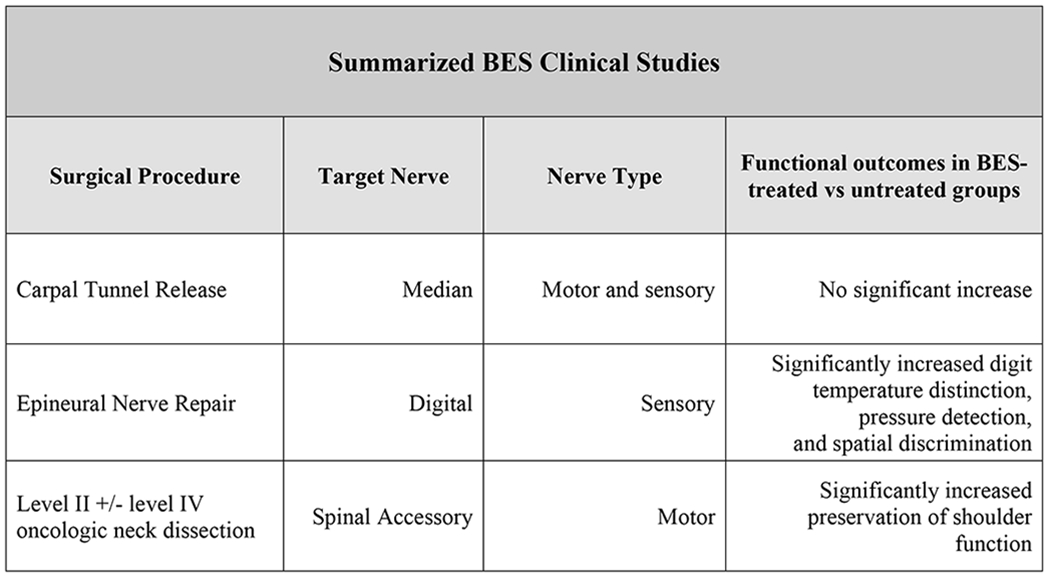
We found multiple BES clinical studies reporting enhanced functional recovery or increased nerve regeneration. Although improved outcomes were reported, high variability after BES is seen between and within species likely due to injury severity, location and timeline along with other factors.
Further clinical studies and introduction of novel delivery platforms are vital to uncover the true regenerative potential of electrical stimulationtherapy.
尽管在手术技术方面取得了相当大的进步,但外周神经损伤(PNI)后的功能修复仍然存在问题。在这方面,存在外周神经根据环境影响再生的能力不同的问题。为了克服这些自然障碍,已经进行了对多种治疗策略的深入分析。在这些候选疗法中,电刺激已成为领先者。大量动物研究报告称,短暂的术中电刺激(BES)能够增强 PNI 后的功能再生。尽管有这些报告,但 BES 增强再生的确切机制及其对长神经损伤的影响在很大程度上仍不清楚。实际上,这种看似简单的治疗方法的临床转化并不那么简单,但是在人类中进行的一些研究已经取得了非常令人鼓舞的结果。
我们旨在通过介绍有关电刺激治疗 PNI 的最新临床试验,结合相关病因,治疗方法和非临床发现,帮助缩小这一转化差距。
为此,我们在 2020 年 2 月之前,在 PubMed,IEEE 和 Web of Science 数据库上使用对我们的研究有重要意义的关键字进行了系统搜索。筛选了每篇手稿的参考文献,以获取与我们的研究相关的其他手稿。
我们发现了多项 BES 临床研究报告称,功能恢复得到了改善或神经再生增加。尽管报告了改善的结果,但 BES 在物种之间和物种内部的差异很大,这可能是由于损伤的严重程度,位置和时间以及其他因素所致。
进一步的临床研究和新型输送平台的引入对于揭示电刺激治疗的真正再生潜力至关重要。