Alcohol Research Group, Public Health Institute, Emeryville, CA 94608-1010, USA.
Virginia Commonwealth University, School of Social Work and Department of Psychiatry, Richmond, VA 23284, USA.
Addict Behav. 2021 Feb;113:106668. doi: 10.1016/j.addbeh.2020.106668. Epub 2020 Sep 29.
Effects of a family history of alcoholism may be moderated by area-level social control factors. We examine whether increased neighborhood alcohol availability (low social control environment) or increased presence of religious adherents in the county (high social control environment) interact with family history in relation to alcohol outcomes.
Weighted data from 12,686 adult drinkers (51% male; mean age 44; 80% White, 9% Black, 11% Hispanic) in three US National Alcohol Surveys were linked with data on area-level off-premise alcohol availability and adherence to religions with strong prohibitions against drinking. Family history density had four levels (family history negative, extended family only, first-degree relative(s) only, high family density). Dichotomous outcomes were past-year high-risk drinking and alcohol dependence. Logistic regression models with interaction terms assessed whether associations of family history with alcohol outcomes differed significantly by area-level social control. Stratified models assessed differences by sex and by race/ethnicity.
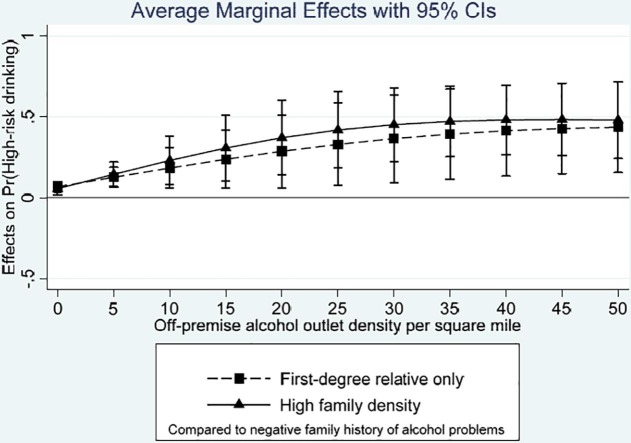
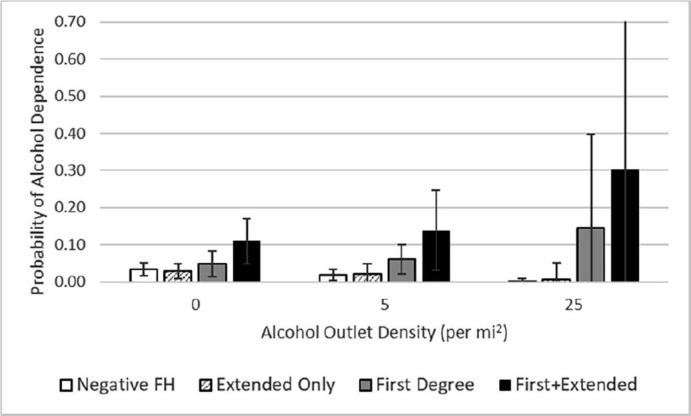
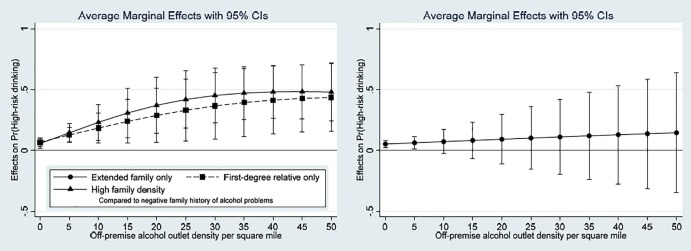
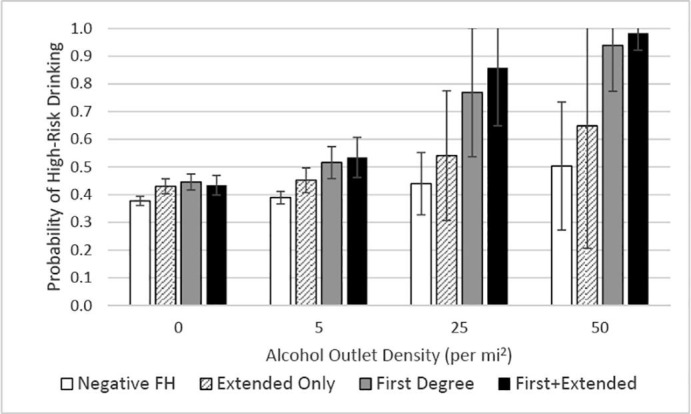
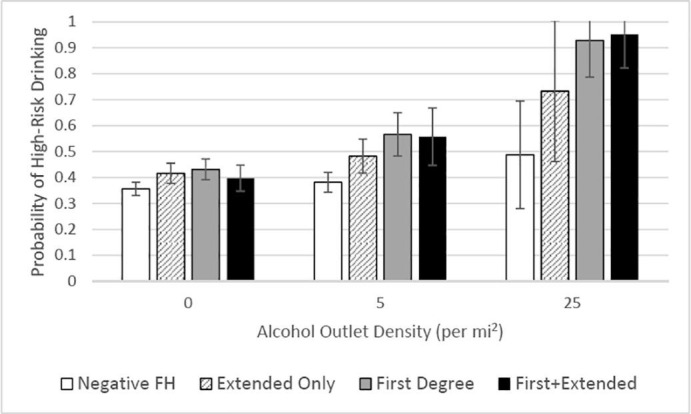
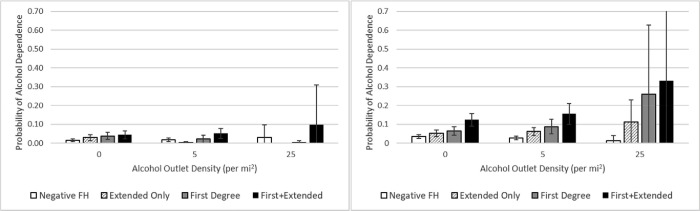
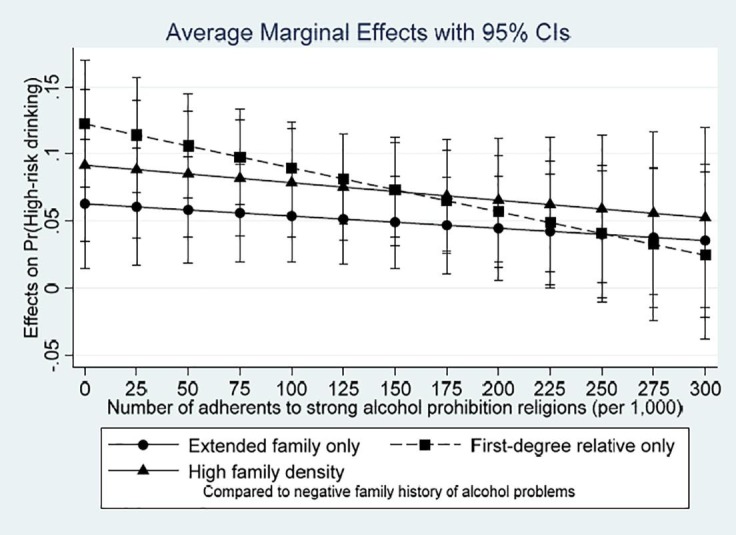
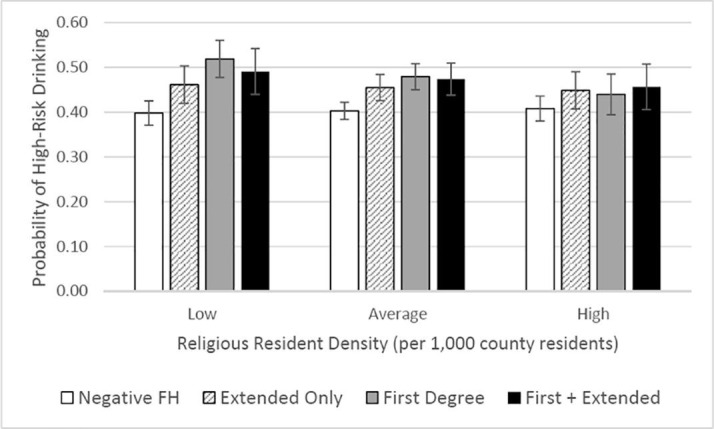
In the full sample, effects of first-degree relatives and high family density on high-risk drinking strengthened as alcohol availability increased. This was replicated in the subsample of women and suggested in relation to dependence among men and Black drinkers. For White drinkers, higher religious social control reduced effects of first-degree relatives on high-risk drinking.
Low social control-in particular, greater density of off-premise alcohol outlets-appears to exacerbate effects of a family history of alcoholism on high-risk drinking. Policy makers should consider differential benefits of decreasing alcohol availability for people from high-risk families to reduce high-risk drinking and alcohol problems.
家族酗酒史的影响可能受到地区社会控制因素的调节。我们检验了邻里间酒精供应的增加(社会控制环境较低)或县内宗教信仰者的增加(社会控制环境较高)是否与家族史相互作用,进而影响酒精相关结果。
从三个美国全国酒精调查中,将加权数据与有关地区层面非场所酒精供应的数据以及对有强烈禁酒规定的宗教信仰者的数据联系起来,共纳入 12686 名成年饮酒者(51%为男性;平均年龄 44 岁;80%为白人,9%为黑人,11%为西班牙裔)。家族史密度分为四个层次(家族史阴性、大家庭、一级亲属、高家族密度)。二项结果为过去一年的高危饮酒和酒精依赖。具有交互项的逻辑回归模型评估了家族史与酒精结果之间的关联是否因地区层面的社会控制而异。分层模型按性别和种族/族裔评估差异。
在全样本中,一级亲属和高家族密度对高危饮酒的影响随着酒精供应的增加而增强。这在女性亚组中得到了复制,并提示男性和黑人饮酒者存在依赖关系。对于白人饮酒者,较高的宗教社会控制减少了一级亲属对高危饮酒的影响。
低社会控制——特别是更多的非场所酒精供应——似乎加剧了家族酗酒史对高危饮酒的影响。政策制定者应考虑减少高危家庭的酒精供应可能会带来的不同益处,以减少高危饮酒和酒精问题。