Department of Clinical Epidemiology, Aarhus University Hospital, Aarhus, Denmark
Department of Clinical Epidemiology, Aarhus University Hospital, Aarhus, Denmark.
BMJ Open. 2020 Oct 12;10(10):e038131. doi: 10.1136/bmjopen-2020-038131.
To examine the long-term outcomes for patients hospitalised with chronic diseases at age 30, 40 or 50 years.
Nationwide, population-based cohort study.
All Danish hospitals, 1979-1989, with follow-up through 2014.
Patients hospitalised during the study period with one, two or three or more chronic diseases and age-matched and sex-matched persons from the general population without chronic disease leading to hospitalisation: age-30 group: 13 857 patients and 69 285 comparators; age-40 group: 24 129 patients and 120 645 comparators; and age-50 group, 37 807 patients and 189 035 comparators.
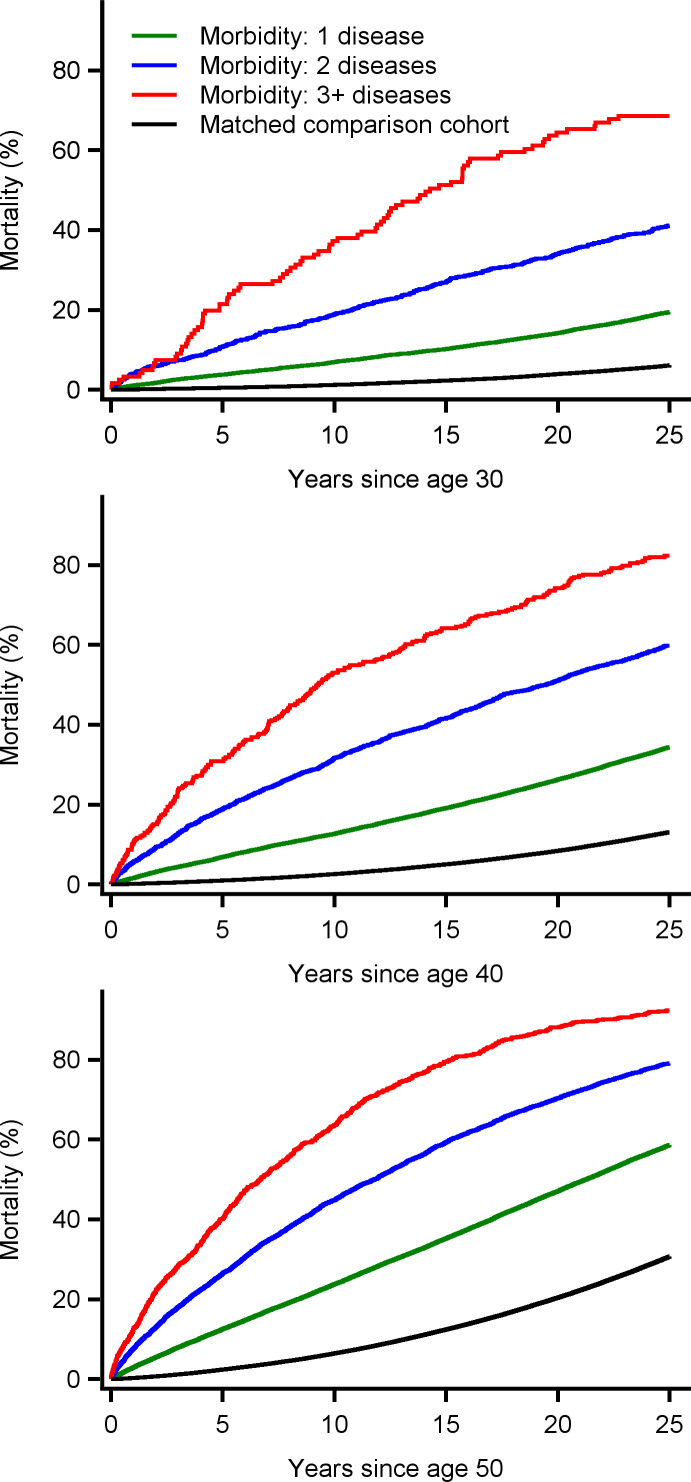
Twenty-five-year mortality risks based on Kaplan-Meier estimates, years-of-life-lost (YLLs) and mortality rate ratios based on Cox regression analysis. YLLs were computed for each morbidity level, as well as in strata of income, employment, education and psychiatric conditions.
Twenty-five-year mortality risks and YLLs increased steadily with increasing number of morbidities leading to hospitalisation and age, but the risk difference with general population comparators remained approximately constant across age cohorts. In the age-30 cohort, the risk differences for patients compared with comparators were 35.0% (95% CI 32.5 to 37.5) with two diseases and 62.5% (54.3% to 70.3%) with three or more diseases. In the age-50 cohort, these differences were, respectively, 48.4% (47.4 to 49.3) and 61.7% (60.1% to 63.0%). Increasing morbidity burden augmented YLLs resulting from low income, unemployment, low education level and psychiatric conditions. In the age-30 cohort, YYLs attributable to low income were 2.4 for patients with one disease, 6.2 for patients with two diseases and 11.5 for patients with three or more diseases.
Among patients with multiple chronic diseases, the risk of death increases steadily with the number of chronic diseases and with age. Multimorbidity augments the already increased mortality among patients with low socioeconomic status.
研究 30 岁、40 岁和 50 岁因慢性病住院患者的长期结局。
全国范围内基于人群的队列研究。
1979 年至 1989 年丹麦所有医院,随访至 2014 年。
研究期间因一种、两种或三种及以上慢性病住院的患者,以及与未因慢性病住院的普通人群中年龄和性别匹配的患者:30 岁组:13857 名患者和 69285 名对照者;40 岁组:24129 名患者和 120645 名对照者;50 岁组:37807 名患者和 189035 名对照者。
基于 Kaplan-Meier 估计的 25 年死亡率风险、寿命损失年(YLLs)和 Cox 回归分析的死亡率比值。为每个发病水平以及收入、就业、教育和精神状况的分层计算了 YLLs。
随着导致住院和年龄的慢性病数量的增加,25 年死亡率风险和 YLLs 呈稳步上升趋势,但与普通人群对照者的风险差异在各年龄组基本保持不变。在 30 岁组中,与对照者相比,患有两种疾病的患者的风险差异为 35.0%(95%CI 32.5%至 37.5%),患有三种或更多疾病的患者为 62.5%(54.3%至 70.3%)。在 50 岁组中,这些差异分别为 48.4%(47.4%至 49.3%)和 61.7%(60.1%至 63.0%)。发病负担的增加增加了低收入、失业、低教育水平和精神状况所致的 YLLs。在 30 岁组中,患有一种疾病的患者归因于低收入的 YYLs 为 2.4,患有两种疾病的患者为 6.2,患有三种或更多疾病的患者为 11.5。
在患有多种慢性病的患者中,死亡风险随慢性病数量和年龄的增加而稳步上升。多发性疾病增加了社会经济地位较低的患者本已增加的死亡率。