Department of Chemistry, University of Liverpool, Crown Street, Liverpool L69 7ZD, United Kingdom.
School of Chemistry and Materials Science, Nanjing Normal University, Nanjing 210023, People's Republic of China.
Nano Lett. 2020 Nov 11;20(11):7980-7986. doi: 10.1021/acs.nanolett.0c02815. Epub 2020 Oct 13.
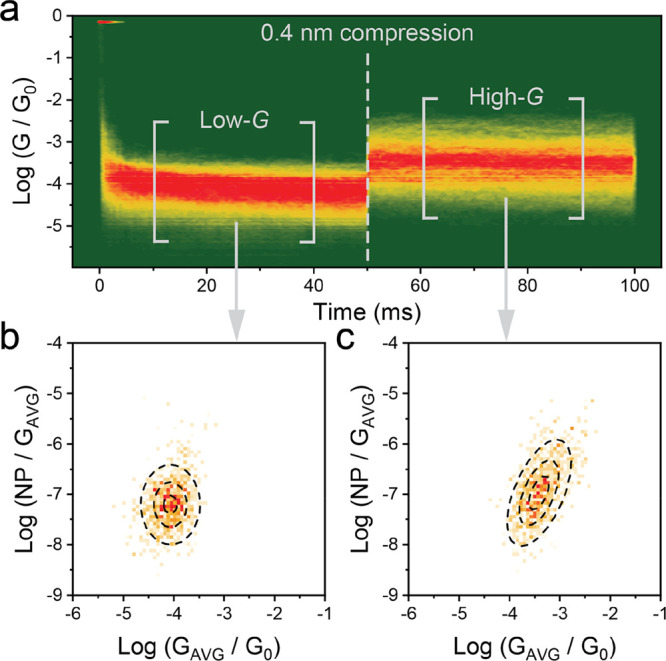
Stimuli-responsive molecular junctions, where the conductance can be altered by an external perturbation, are an important class of nanoelectronic devices. These have recently attracted interest as large effects can be introduced through exploitation of quantum phenomena. We show here that significant changes in conductance can be attained as a molecule is repeatedly compressed and relaxed, resulting in molecular folding along a flexible fragment and cycling between an anti and a syn conformation. Power spectral density analysis and DFT transport calculations show that through-space tunneling between two phenyl fragments is responsible for the conductance increase as the molecule is mechanically folded to the syn conformation. This phenomenon represents a novel class of mechanoresistive molecular devices, where the functional moiety is embedded in the conductive backbone and exploits intramolecular nonbonding interactions, in contrast to most studies where mechanoresistivity arises from changes in the molecule-electrode interface.
刺激响应性分子结,其中电导可以通过外部扰动来改变,是一类重要的纳米电子器件。由于通过利用量子现象可以引入大的效应,这些最近引起了人们的兴趣。我们在这里表明,通过反复压缩和松弛分子,可以实现电导的显著变化,从而导致分子沿着柔性片段折叠,并在反式和顺式构象之间循环。功率谱密度分析和 DFT 输运计算表明,当分子被机械折叠到顺式构象时,两个苯基片段之间的空间隧穿是导致电导增加的原因。这种现象代表了一类新型的机械抗性分子器件,其中功能部分嵌入在导电主链中,并利用分子内非键相互作用,与大多数研究中由于分子-电极界面的变化而引起机械抗性的情况形成对比。