Department of Cardiovascular Medicine, Shanxi Dayi Hospital Affiliated to Shanxi Medical University, Taiyuan, China.
Department of Rheumatology, the Second Hospital of Shanxi Medical University, Taiyuan, China.
J Cell Mol Med. 2020 Nov;24(21):12341-12354. doi: 10.1111/jcmm.15720. Epub 2020 Oct 13.
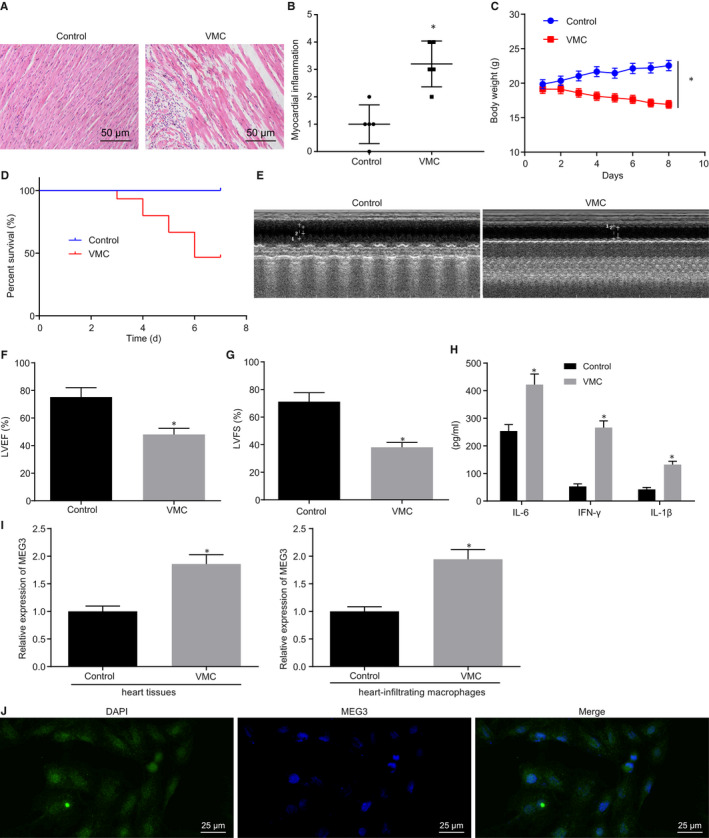
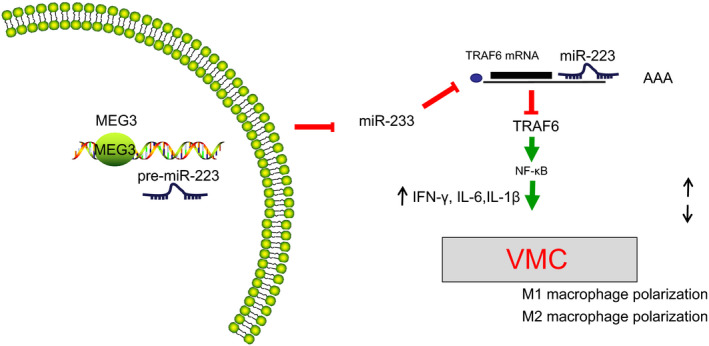
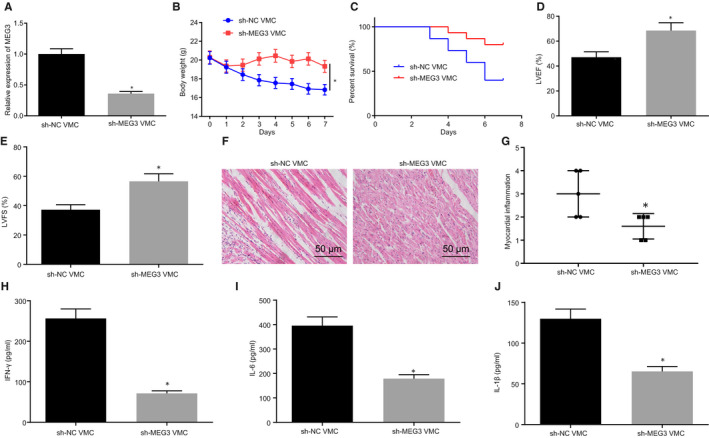
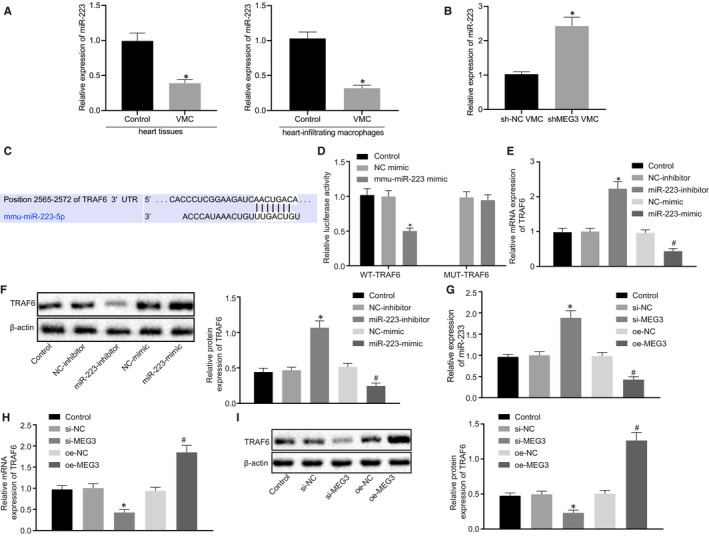
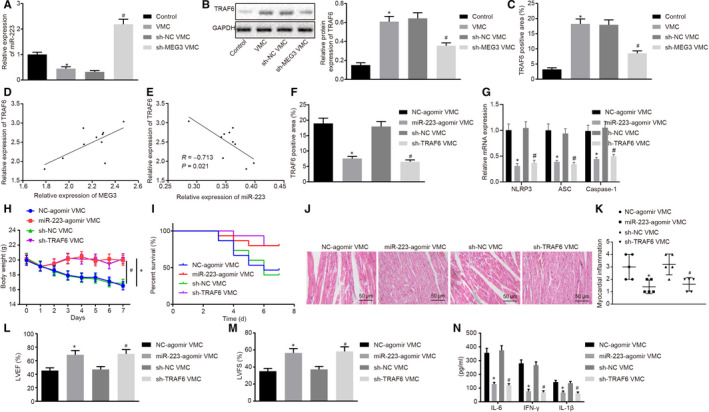
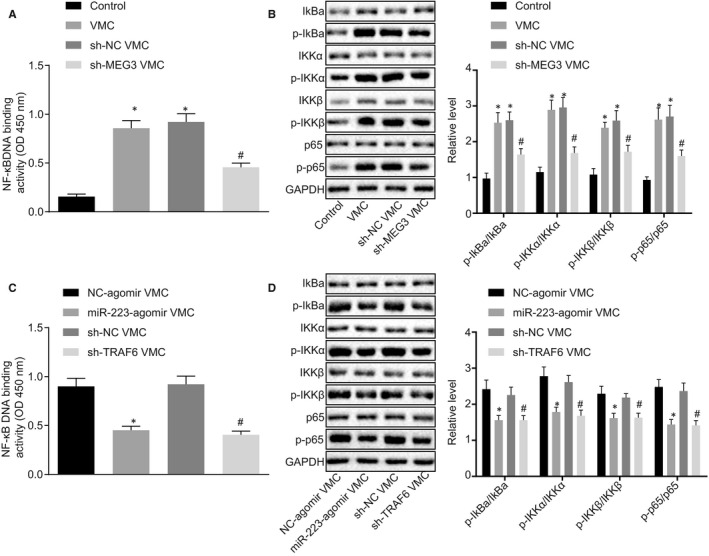
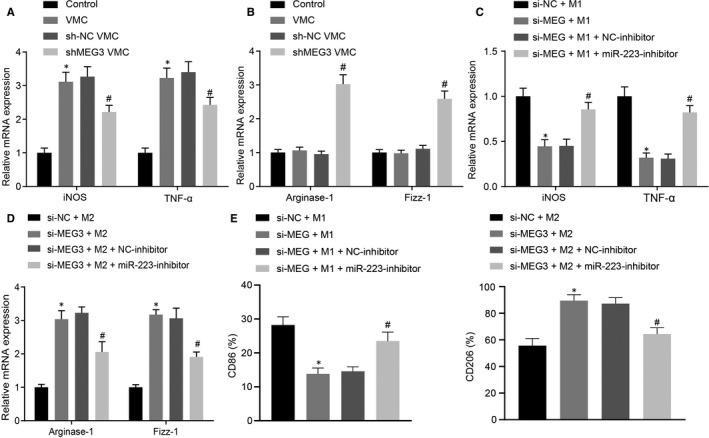
Viral myocarditis (VMC) commonly triggers heart failure, for which no specific treatments are available. This study aims to explore the specific role of long non-coding RNA (lncRNA) maternally expressed 3 (MEG3) in VMC. A VMC mouse model was induced by Coxsackievirus B3 (CVB3). Then, MEG3 and TNF receptor-associated factor 6 (TRAF6) were silenced and microRNA-223 (miR-223) was over-expressed in the VMC mice, followed by determination of ventricular ejection fraction (LVEF) and left ventricular fractional shortening (LVFS). Dual-luciferase reporter assay was introduced to test the interaction among MEG3, TRAF6 and miR-223. Macrophages were isolated from cardiac tissues and bone marrow, and polarization of M1 or M2 macrophages was induced. Then, the expressions of components of NLRP3 inflammatory body (NLRP3, ASC, Caspase-1), M1 markers (CD86, iNOS and TNF-α) and M2 markers (CD206, Arginase-1 and Fizz-1) were measured following MEG3 silencing. In the VMC mouse model, MEG3 and TRAF6 levels were obviously increased, while miR-223 expression was significantly reduced. Down-regulation of MEG3 resulted in the inhibition of TRAF6 by promoting miR-223. TRAF6 was negatively correlated with miR-223, but positively correlated with MEG3 expression. Down-regulations of MEG3 or TRAF6 or up-regulation of miR-223 was observed to increase mouse weight, survival rate, LVEF and LVFS, while inhibiting myocarditis and inflammation via the NF-κB pathway inactivation in VMC mice. Down-regulation of MEG3 decreased M1 macrophage polarization and elevated M2 macrophage polarization by up-regulating miR-223. Collectively, down-regulation of MEG3 leads to the inhibition of inflammation and induces M2 macrophage polarization via miR-223/TRAF6/NF-κB axis, thus alleviating VMC.
病毒性心肌炎(VMC)常引发心力衰竭,目前尚无特效治疗方法。本研究旨在探讨长链非编码 RNA(lncRNA)母系表达基因 3(MEG3)在 VMC 中的具体作用。采用柯萨奇病毒 B3(CVB3)诱导 VMC 小鼠模型,沉默 MEG3 和肿瘤坏死因子受体相关因子 6(TRAF6),并过表达微小 RNA-223(miR-223),检测心室射血分数(LVEF)和左心室短轴缩短率(LVFS)。采用双荧光素酶报告基因检测 MEG3、TRAF6 和 miR-223 之间的相互作用。分离心肌和骨髓来源的巨噬细胞,诱导 M1 或 M2 型巨噬细胞极化,然后检测沉默 MEG3 后 NLRP3 炎性体(NLRP3、ASC、Caspase-1)、M1 标志物(CD86、iNOS 和 TNF-α)和 M2 标志物(CD206、Arg1 和 Fizz-1)的表达。在 VMC 小鼠模型中,MEG3 和 TRAF6 水平明显升高,而 miR-223 表达显著降低。下调 MEG3 通过促进 miR-223 抑制 TRAF6。TRAF6 与 miR-223 呈负相关,与 MEG3 表达呈正相关。下调 MEG3 或 TRAF6 或上调 miR-223 可增加小鼠体重、存活率、LVEF 和 LVFS,同时抑制 VMC 小鼠的心肌炎和炎症,通过 NF-κB 通路失活。下调 MEG3 通过上调 miR-223 减少 M1 型巨噬细胞极化并增加 M2 型巨噬细胞极化。总之,下调 MEG3 通过 miR-223/TRAF6/NF-κB 轴抑制炎症并诱导 M2 型巨噬细胞极化,从而缓解 VMC。