Laboratory of Malaria Immunology and Vaccinology, National Institute of Allergy and Infectious Diseases, NIH, Bethesda, Maryland, USA.
University Children's Hospital Zurich, Zurich, Switzerland.
JCI Insight. 2020 Nov 19;5(22):143471. doi: 10.1172/jci.insight.143471.
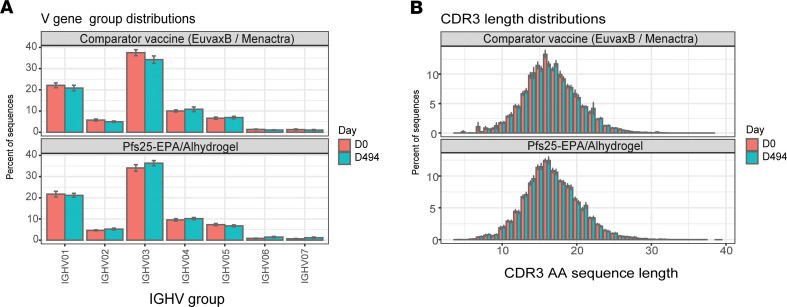
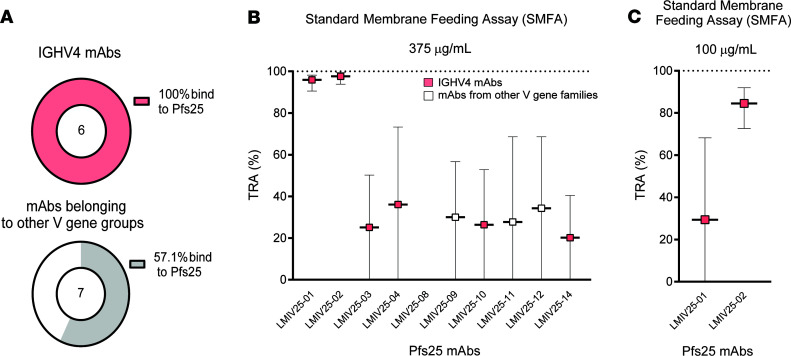
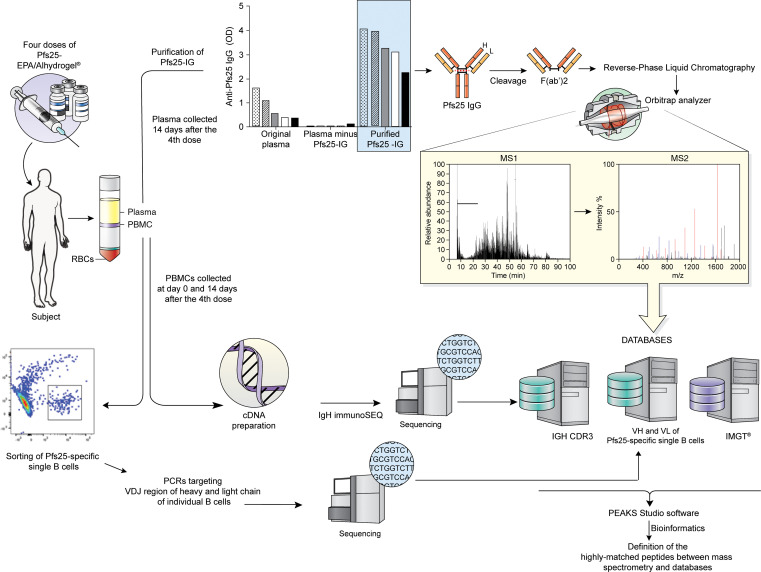
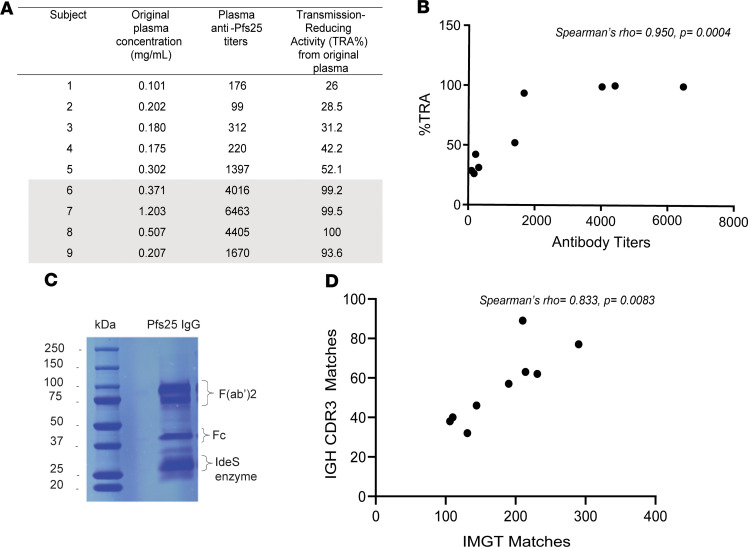
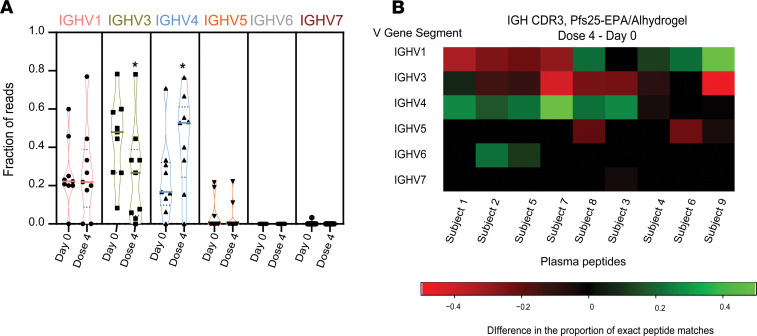
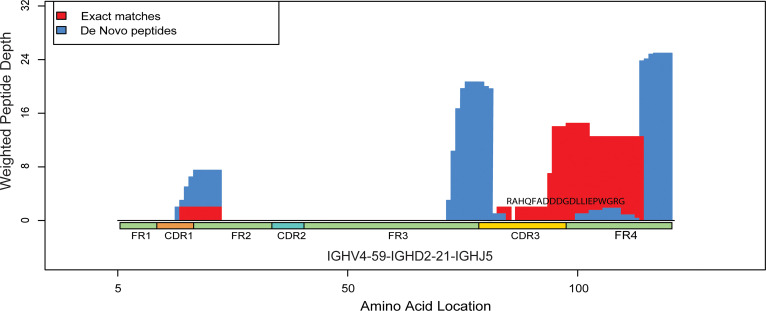
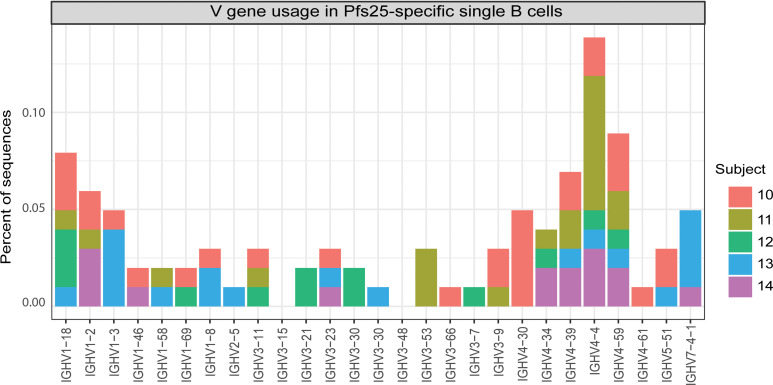
Plasma antimalarial Ab can mediate antiparasite immunity but has not previously been characterized at the molecular level. Here, we develop an innovative strategy to characterize humoral responses by integrating profiles of plasma immunoglobulins (IGs) or Abs with those expressed on B cells as part of the B cell receptor. We applied this strategy to define plasma IG and to determine variable (V) gene usage after vaccination with the Plasmodium falciparum zygote antigen Pfs25. Using proteomic tools coupled with bulk immunosequencing data, we determined human antigen-binding fragment [F(ab')2] peptide sequences from plasma IG of adults who received 4 doses of Pfs25-EPA/Alhydrogel. Specifically, Pfs25 antigen-specific F(ab')2 peptides (Pfs25-IG) were aligned to cDNA sequences of IG heavy (IGH) chain complementarity determining region 3 from a data set generated by total peripheral B cell immunosequencing of the entire vaccinated population. IGHV4 was the most commonly identified IGHV subgroup of Pfs25-IG, a pattern that was corroborated by V heavy/V light chain sequencing of Pfs25-specific single B cells from 5 vaccinees and by matching plasma Pfs25-IG peptides and V-(D)-J sequences of Pfs25-specific single B cells from the same donor. Among 13 recombinant human mAbs generated from IG sequences of Pfs25-specific single B cells, a single IGHV4 mAb displayed strong neutralizing activity, reducing the number of P. falciparum oocysts in infected mosquitoes by more than 80% at 100 μg/mL. Our approach characterizes the human plasma Ab repertoire in response to the Pfs25-EPA/Alhydrogel vaccine and will be useful for studying circulating Abs in response to other vaccines as well as those induced during infections or autoimmune disorders.
血浆抗疟抗体可介导抗寄生虫免疫,但以前尚未在分子水平上进行表征。在这里,我们开发了一种创新策略,通过整合血浆免疫球蛋白(IG)或抗体的图谱与作为 B 细胞受体一部分表达的 B 细胞上的图谱来表征体液反应。我们应用该策略来定义血浆 IG,并确定接种恶性疟原虫合子抗原 Pfs25 后 V 基因的使用情况。使用与批量免疫测序数据相结合的蛋白质组学工具,我们从接受了 4 剂 Pfs25-EPA/Alhydrogel 的成年人的血浆 IG 中确定了人类抗原结合片段[F(ab')2]肽序列。具体来说,将 Pfs25 抗原特异性 F(ab')2 肽(Pfs25-IG)与来自整个接种人群外周血 B 细胞免疫测序数据集的 IG 重链互补决定区 3 的 cDNA 序列进行比对。IGHV4 是 Pfs25-IG 最常见的鉴定 IGHV 亚组,这一模式得到了来自 5 名疫苗接种者的 Pfs25 特异性单 B 细胞的 V 重链/V 轻链测序以及来自同一供体的 Pfs25 特异性单 B 细胞的血浆 Pfs25-IG 肽和 V-(D)-J 序列的证实。在从 Pfs25 特异性单 B 细胞的 IG 序列中产生的 13 种重组人单克隆抗体中,一种 IGHV4 单克隆抗体表现出很强的中和活性,在 100μg/ml 时使感染蚊子中的恶性疟原虫卵囊数量减少了 80%以上。我们的方法对 Pfs25-EPA/Alhydrogel 疫苗的人类血浆 Ab 库进行了特征描述,这将有助于研究针对其他疫苗以及感染或自身免疫性疾病期间诱导的循环 Abs。