Department of Criminology & Criminal Justice, University of Texas at San Antonio, San Antonio, TX 78207, USA.
Department of Population, Family, and Reproductive Health, Johns Hopkins University, Baltimore, MD 21205, USA.
Int J Environ Res Public Health. 2020 Oct 8;17(19):7331. doi: 10.3390/ijerph17197331.
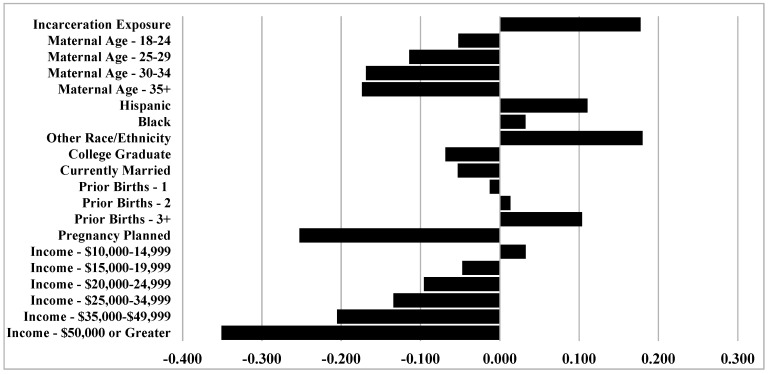
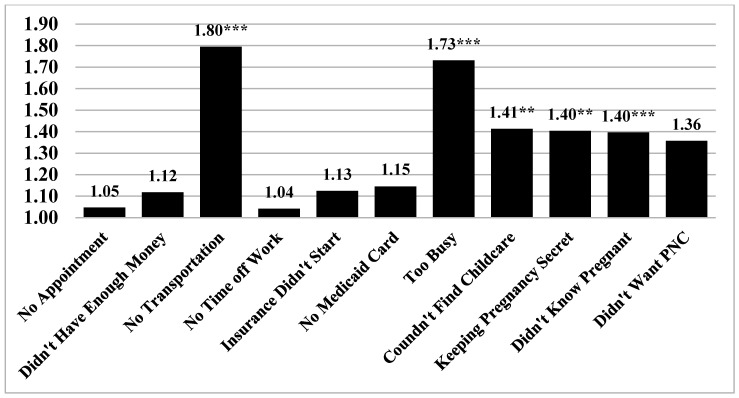
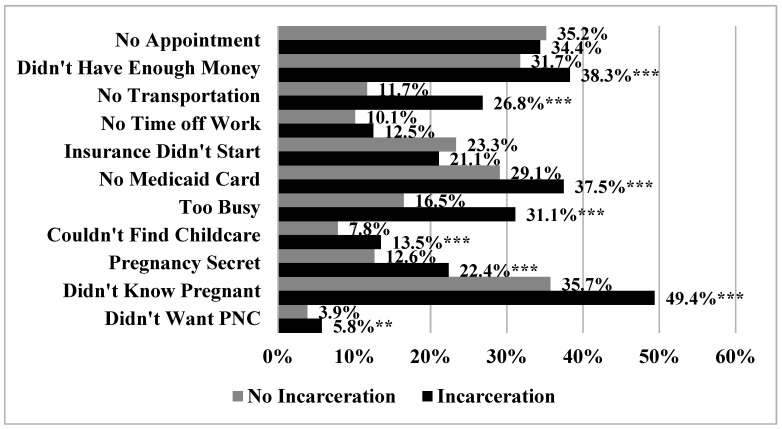
Previous research demonstrates that exposure to incarceration during pregnancy - either personally or vicariously through a partner - worsens parental care. However, little is known about the specific barriers to parental care that are associated with incarceration exposure. Using data from the Pregnancy Risk Assessment Monitoring System (years 2009-2016), the current study examines the relationship between exposure to incarceration during pregnancy and barriers to prenatal care in the United States. Negative binomial and logistic regression models were used to assess the association between the recent incarceration of a woman or her partner (i.e., incarceration that occurred in the 12 months prior to the focal birth) and several barriers to prenatal care. Findings indicate that exposure to incarceration, either personally or vicariously through a partner, increases the overall number of barriers to prenatal care and this association operates through several specific barriers including a lack of transportation to doctor's appointments, having difficulty finding someone to take care of her children, being too busy, keeping pregnancy a secret, and a woman not knowing she was pregnant. Policies designed to help incarceration exposed women overcome these barriers can potentially yield benefits for enhancing access to parental care.
先前的研究表明,怀孕期间(无论是个人经历还是通过伴侣间接经历)入狱会恶化父母的养育状况。然而,人们对与入狱经历相关的具体养育障碍知之甚少。本研究使用 2009 年至 2016 年期间的妊娠风险评估监测系统的数据,考察了美国怀孕期间入狱与产前保健障碍之间的关系。采用负二项式和逻辑回归模型评估了女性或其伴侣(即焦点出生前 12 个月内发生的监禁)最近入狱与产前保健障碍之间的关系。研究结果表明,无论是个人经历还是通过伴侣间接经历,入狱都会增加产前保健障碍的总数,这种关联通过几个具体的障碍运作,包括缺乏去看医生的交通工具、难以找到人照顾她的孩子、太忙、隐瞒怀孕和妇女不知道自己怀孕。旨在帮助经历过监禁的女性克服这些障碍的政策,有可能为改善父母养育的机会带来好处。