Nestarenkaite Ausrine, Fadhil Wakkas, Rasmusson Allan, Susanti Susanti, Hadjimichael Efthymios, Laurinaviciene Aida, Ilyas Mohammad, Laurinavicius Arvydas
National Center of Pathology, Affiliate of Vilnius University Hospital Santaros Klinikos, 08406 Vilnius, Lithuania.
Institute of Biosciences, Life Sciences Center, Vilnius University, 10257 Vilnius, Lithuania.
Cancers (Basel). 2020 Oct 9;12(10):2902. doi: 10.3390/cancers12102902.
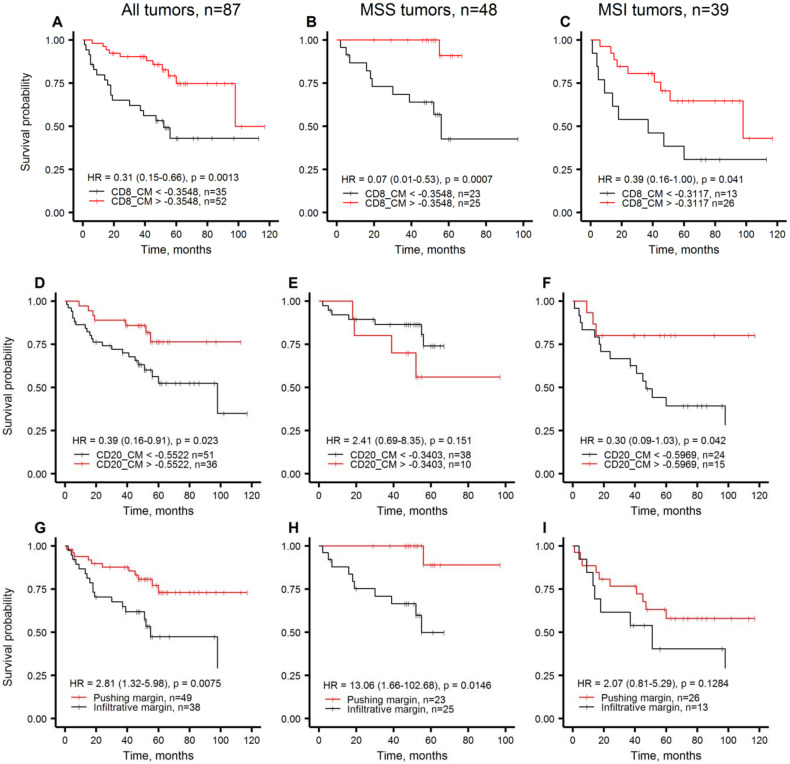
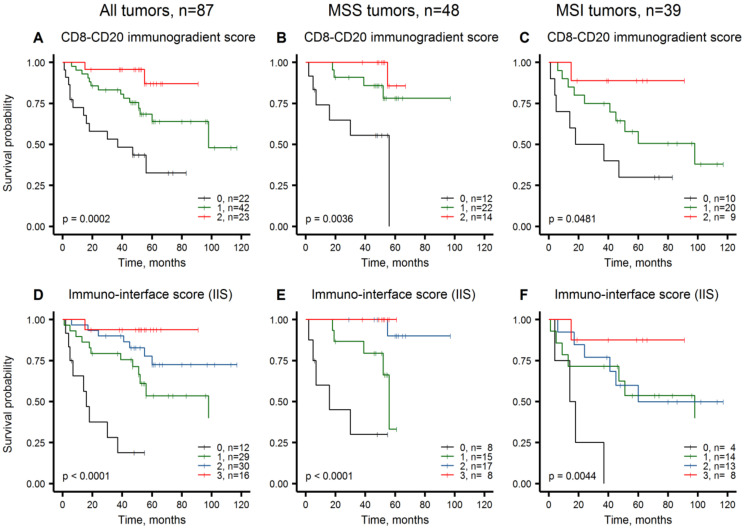
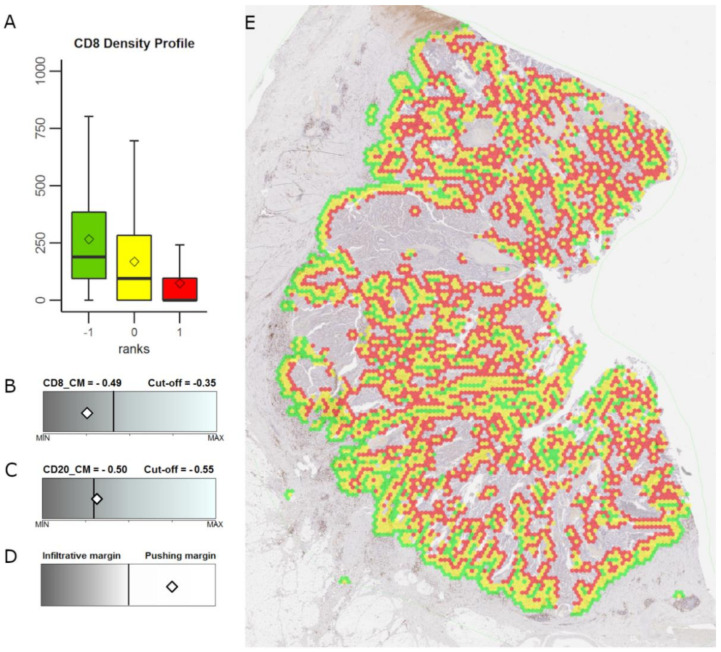
Tumor-associated immune cells have been shown to predict patient outcome in colorectal (CRC) and other cancers. Spatial digital image analysis-based cell quantification increases the informative power delivered by tumor microenvironment features and leads to new prognostic scoring systems. In this study we evaluated the intratumoral density of immunohistochemically stained CD8, CD20 and CD68 cells in 87 cases of CRC (48 were microsatellite stable, MSS, and 39 had microsatellite instability, MSI) in both the intratumoral tumor tissue and within the tumor-stroma interface zone (IZ) which was extracted by a previously developed unbiased hexagonal grid analytics method. Indicators of immune-cell gradients across the extracted IZ were computed and explored along with absolute cell densities, clinicopathological and molecular data, including gene mutation (, , ) and MSI status. Multiple regression modeling identified ( < 0.0001) three independent prognostic factors: CD8+ and CD20+ Immunogradient indicators, that reflect cell migration towards the tumor, were associated with improved patient survival, while the infiltrative tumor growth pattern was linked to worse patient outcome. These features were combined into CD8-CD20 Immunogradient and immuno-interface scores which outperformed both tumor-node-metastasis (TNM) staging and molecular characteristics, and importantly, revealed high prognostic value both in MSS and MSI CRCs.
肿瘤相关免疫细胞已被证明可预测结直肠癌(CRC)和其他癌症患者的预后。基于空间数字图像分析的细胞定量增加了肿瘤微环境特征所提供的信息量,并导致了新的预后评分系统。在本研究中,我们评估了87例CRC(48例微卫星稳定,MSS,39例微卫星不稳定,MSI)肿瘤组织内以及通过先前开发的无偏六边形网格分析方法提取的肿瘤-基质界面区(IZ)中免疫组化染色的CD8、CD20和CD68细胞的瘤内密度。计算并探索了跨提取的IZ的免疫细胞梯度指标以及绝对细胞密度、临床病理和分子数据,包括基因突变(、、)和MSI状态。多元回归模型确定(<0.0001)了三个独立的预后因素:反映细胞向肿瘤迁移的CD8 +和CD20 +免疫梯度指标与患者生存率提高相关,而浸润性肿瘤生长模式与患者预后较差相关。这些特征被整合到CD8 - CD20免疫梯度和免疫界面评分中,其表现优于肿瘤-淋巴结-转移(TNM)分期和分子特征,重要的是,在MSS和MSI CRC中均显示出高预后价值。