B CUBE-Center for Molecular Bioengineering, Technical University Dresden, 01307 Dresden, Germany.
Max Planck Institute of Colloids and Interfaces, Department of Biomaterials, 14424 Potsdam, Germany.
J R Soc Interface. 2020 Oct;17(171):20200474. doi: 10.1098/rsif.2020.0474. Epub 2020 Oct 14.
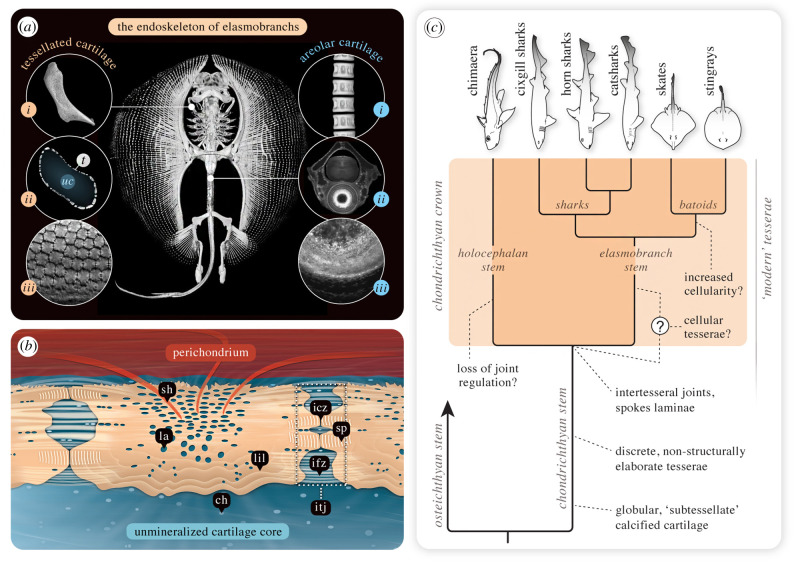
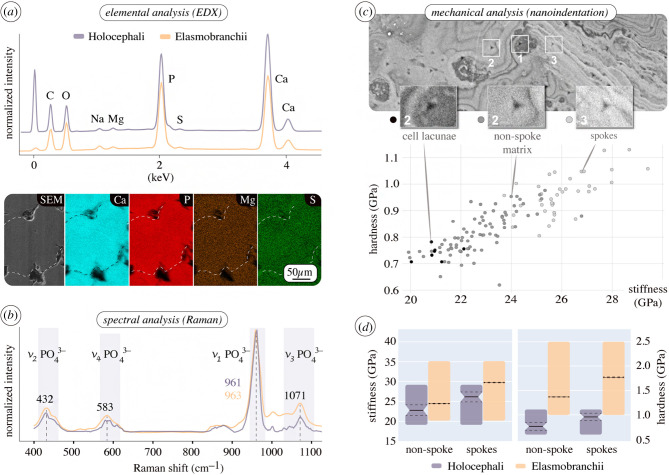
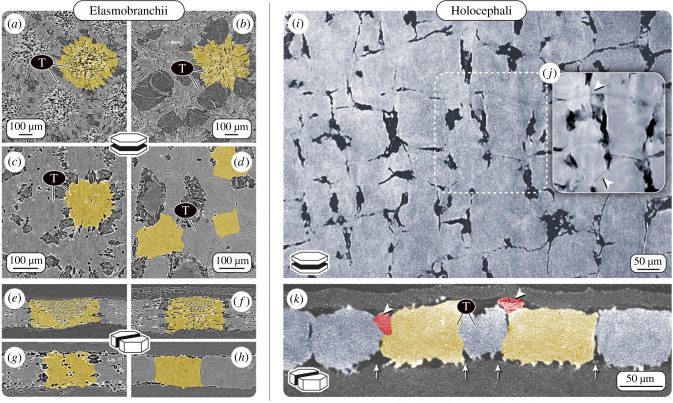
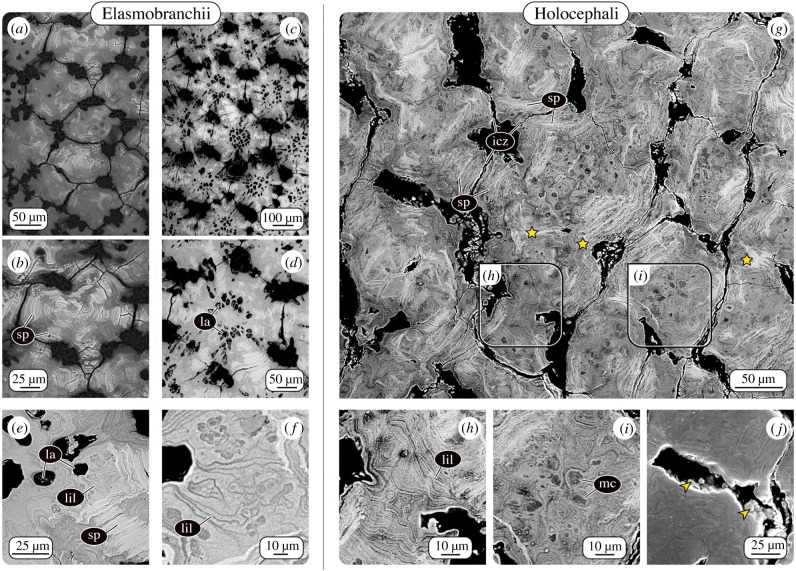
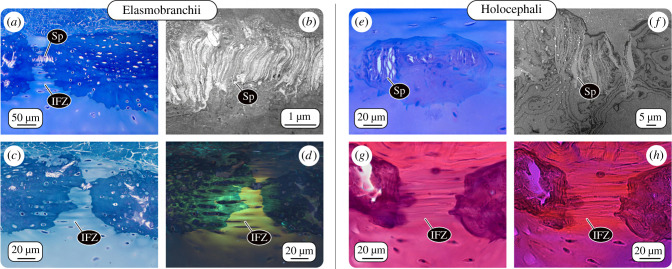
An accepted uniting character of modern cartilaginous fishes (sharks, rays, chimaera) is the presence of a mineralized, skeletal crust, tiled by numerous minute plates called tesserae. Tesserae have, however, never been demonstrated in modern chimaera and it is debated whether the skeleton mineralizes at all. We show for the first time that tessellated cartilage was not lost in chimaera, as has been previously postulated, and is in many ways similar to that of sharks and rays. Tesserae in are less regular in shape and size in comparison to the general scheme of polygonal tesserae in sharks and rays, yet share several features with them. For example, tesserae, like those of elasmobranchs, possess both intertesseral joints (unmineralized regions, where fibrous tissue links adjacent tesserae) and recurring patterns of local mineral density variation (e.g. Liesegang lines, hypermineralized 'spokes'), reflecting periodic accretion of mineral at tesseral edges as tesserae grow. 's tesserae, however, appear to lack the internal cell networks that characterize tesserae in elasmobranchs, indicating fundamental differences among chondrichthyan groups in how calcification is controlled. By compiling and comparing recent ultrastructure data on tesserae, we also provide a synthesized, up-to-date and comparative glossary on tessellated cartilage, as well as a perspective on the current state of research into the topic, offering benchmark context for future research into modern and extinct vertebrate skeletal tissues.
现代软骨鱼类(鲨鱼、鳐鱼、鳐鱼)的一个公认的统一特征是存在矿化的骨骼外壳,由无数称为嵌合体的微小板片覆盖。然而,在现代鳐鱼中从未发现过嵌合体,而且关于骨骼是否完全矿化仍存在争议。我们首次表明,嵌合体的软骨并非如先前假设的那样已经丢失,而且在许多方面与鲨鱼和鳐鱼的软骨相似。与鲨鱼和鳐鱼的多边形嵌合体的一般模式相比,的嵌合体在形状和大小上不太规则,但与它们有几个共同特征。例如,像软骨鱼类的嵌合体一样,具有间质关节(未矿化区域,纤维组织连接相邻的嵌合体)和局部矿物质密度变化的重复模式(例如莱塞格线、超矿化“辐条”),反映了在嵌合体边缘周期性矿化的过程。然而,的嵌体似乎缺乏软骨鱼类中嵌体特有的内部细胞网络,这表明在软骨鱼类的群体中,钙化的控制方式存在根本差异。通过编译和比较最近关于嵌合体的超微结构数据,我们还提供了一个综合的、最新的和比较的软骨镶嵌词汇表,以及对该主题研究现状的展望,为未来对现代和已灭绝的脊椎动物骨骼组织的研究提供基准背景。