Departamento de Medicina Interna, Faculdade de Ciências Médicas, Universidade Estadual de Campinas, Campinas, SP, Brasil.
Instituto Adolfo Lutz, São Paulo, SP, Brasil.
Braz J Med Biol Res. 2020 Oct 9;53(11):e9056. doi: 10.1590/1414-431X20209056. eCollection 2020.
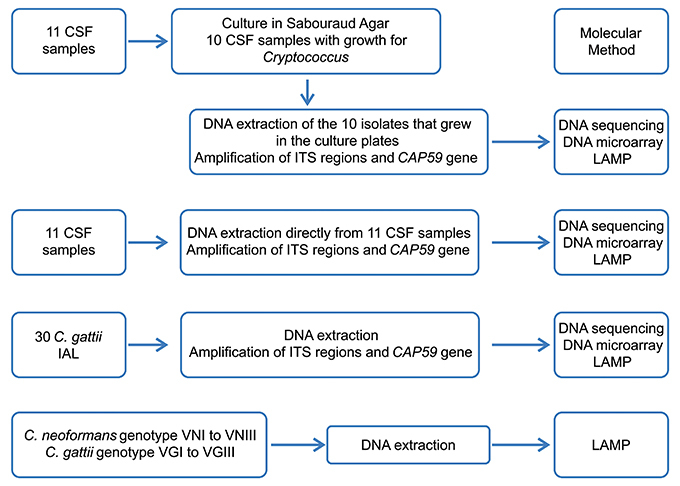
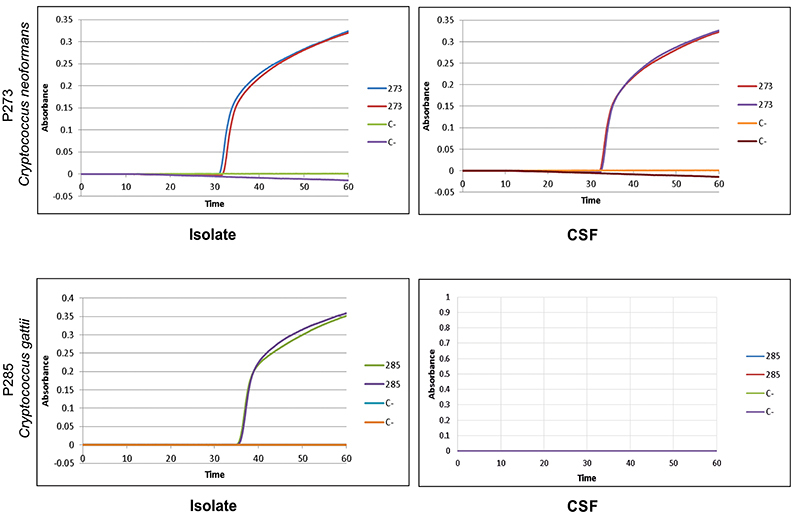
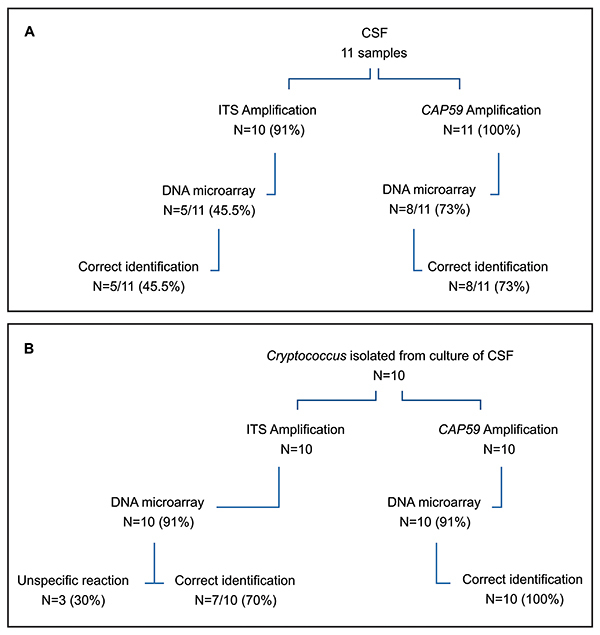
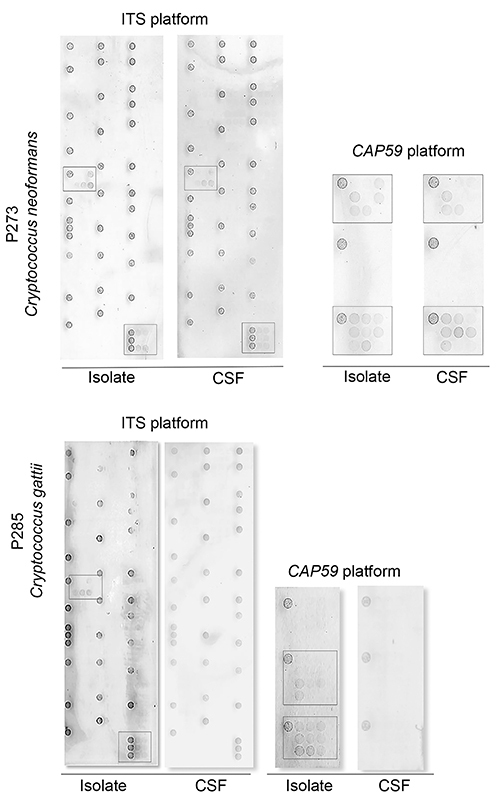
Cryptococcal meningitis affects normal hosts and immunocompromised patients exhibiting high mortality rates. The objective of this study was to design two molecular assays, visible microarray platforms and loop-mediated isothermal amplification (LAMP), to identify Cryptococcus spp. and the species neoformans and gattii from the cerebral spinal fluid (CSF). To identify Cryptococcus and the two species, we designed two microarrays DNA platforms based on the internal transcribed spacer (ITS) region and CAP59 gene and LAMP assays specific for Cryptococcus species. The assays were tested using CSF from patients with cryptococcal meningitis. CSF from patients with cryptococcal meningitis was cultured in Sabouraud culture medium, and the Cryptococcus spp. grown in the culture medium were also tested for LAMP and microarray platforms. The results were compared to DNA sequencing of the same genetic regions. A total of 133 CSF samples were studied. Eleven CSFs were positive for Cryptococcus (9 C. neoformans and 2 C. gattii), 15 were positive for bacteria, and 107 were negative. The CAP59 platform correctly identified 73% of the CSF samples, while the ITS platform identified 45.5%. CAP59 platform correctly identified 100% of the Cryptococcus isolates, and ITS platform identified 70%. The two sets of LAMP primers correctly identified 100% of the Cryptococcus isolates. However, for CSF samples, the amplification occurred only in 55.5% of C. neoformans. The methodologies were reliable in the identification of Cryptococcus species, mainly for isolates from culture medium, and they might be applied as adjunctive tests to identify Cryptococcus species.
隐球菌性脑膜炎影响正常宿主和免疫功能低下的患者,死亡率较高。本研究旨在设计两种分子检测方法,可视化微阵列平台和环介导等温扩增(LAMP),以从脑脊液(CSF)中鉴定出隐球菌属和新型隐球菌及格特隐球菌。为了鉴定隐球菌和两个种,我们设计了两个基于内部转录间隔区(ITS)和 CAP59 基因的 DNA 微阵列平台,以及用于鉴定隐球菌属的 LAMP 检测方法。该检测方法使用隐球菌性脑膜炎患者的 CSF 进行了测试。从隐球菌性脑膜炎患者的 CSF 中培养了萨布罗氏培养基,并且还对培养基中生长的隐球菌进行了 LAMP 和微阵列平台检测。将结果与同一遗传区域的 DNA 测序进行了比较。总共研究了 133 个 CSF 样本。11 个 CSF 对隐球菌呈阳性(9 个为新型隐球菌,2 个为格特隐球菌),15 个为细菌阳性,107 个为阴性。CAP59 平台正确鉴定了 73%的 CSF 样本,而 ITS 平台则鉴定了 45.5%。CAP59 平台正确鉴定了 100%的隐球菌分离株,而 ITS 平台鉴定了 70%。两套 LAMP 引物正确鉴定了 100%的隐球菌分离株。然而,对于 CSF 样本,仅在 55.5%的新型隐球菌中发生了扩增。这些方法在鉴定隐球菌属方面是可靠的,主要适用于来自培养基的分离株,并且它们可以作为辅助测试来鉴定隐球菌属。