
ZFP57 和其他 KRAB 锌指蛋白在维持人类印记甲基化和多位点印记紊乱中的作用。
The role of ZFP57 and additional KRAB-zinc finger proteins in the maintenance of human imprinted methylation and multi-locus imprinting disturbances.
机构信息
Imprinting and Cancer group, Bellvitge Institute for Biomedical Research, Gran via, L'Hospitalet de Llobregat, Barcelona, Spain.
Department of Obstetrics and Gynecology, Valencia University and INCLIVA, Valencia, Spain.
出版信息
Nucleic Acids Res. 2020 Nov 18;48(20):11394-11407. doi: 10.1093/nar/gkaa837.
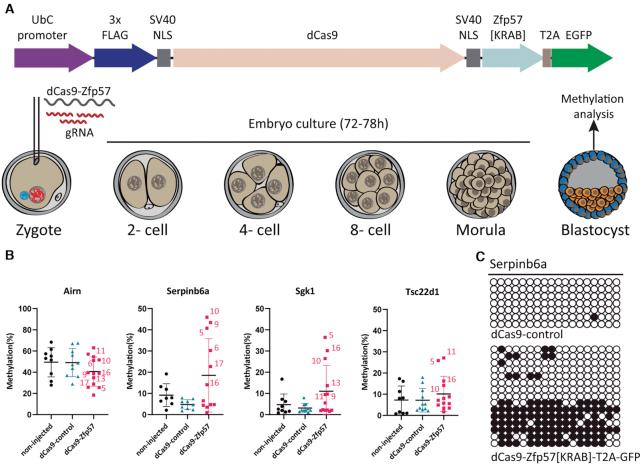
Genomic imprinting is an epigenetic process regulated by germline-derived DNA methylation that is resistant to embryonic reprogramming, resulting in parental origin-specific monoallelic gene expression. A subset of individuals affected by imprinting disorders (IDs) displays multi-locus imprinting disturbances (MLID), which may result from aberrant establishment of imprinted differentially methylated regions (DMRs) in gametes or their maintenance in early embryogenesis. Here we investigated the extent of MLID in a family harbouring a ZFP57 truncating variant and characterize the interactions between human ZFP57 and the KAP1 co-repressor complex. By ectopically targeting ZFP57 to reprogrammed loci in mouse embryos using a dCas9 approach, we confirm that ZFP57 recruitment is sufficient to protect oocyte-derived methylation from reprogramming. Expression profiling in human pre-implantation embryos and oocytes reveals that unlike in mice, ZFP57 is only expressed following embryonic-genome activation, implying that other KRAB-zinc finger proteins (KZNFs) recruit KAP1 prior to blastocyst formation. Furthermore, we uncover ZNF202 and ZNF445 as additional KZNFs likely to recruit KAP1 to imprinted loci during reprogramming in the absence of ZFP57. Together, these data confirm the perplexing link between KZFPs and imprint maintenance and highlight the differences between mouse and humans in this respect.
基因组印记是一种由生殖细胞衍生的 DNA 甲基化调控的表观遗传过程,它能抵抗胚胎重编程,导致亲本来源特异性单等位基因表达。一部分受印记障碍 (IDs) 影响的个体表现出多基因座印记紊乱 (MLID),这可能是由于配子中印记差异甲基化区域 (DMRs) 的异常建立或其在早期胚胎发生中的维持所致。在这里,我们研究了一个携带 ZFP57 截断变异体的家庭中 MLID 的程度,并描述了人类 ZFP57 与 KAP1 共抑制复合物之间的相互作用。通过使用 dCas9 方法将 ZFP57 靶向重编程的小鼠胚胎中的靶基因,我们证实 ZFP57 的募集足以保护卵母细胞衍生的甲基化免受重编程。在人类着床前胚胎和卵母细胞中的表达谱分析表明,与在小鼠中不同,ZFP57 仅在胚胎基因组激活后表达,这意味着在囊胚形成之前,其他 KRAB-锌指蛋白 (KZNFs) 募集 KAP1。此外,我们发现 ZNF202 和 ZNF445 是另外的 KZNFs,它们可能在没有 ZFP57 的情况下,在重编程过程中募集 KAP1 到印记基因座。总之,这些数据证实了 KZFPs 与印记维持之间令人费解的联系,并强调了在这方面小鼠和人类之间的差异。



 Zotero 插件