Mazur-Bialy Agnieszka Irena, Kołomańska-Bogucka Daria, Opławski Marcin, Tim Sabina
Department of Biomechanics and Kinesiology, Faculty of Health Science, Jagiellonian University Medical College, Grzegorzecka 20, 31-531 Krakow, Poland.
Department of Gynecology and Obstetrics with Gynecologic Oncology, Ludwik Rydygier Memorial Specialized Hospital, Zlotej Jesieni 1, 31-826 Kraków, Poland.
J Clin Med. 2020 Oct 12;9(10):3255. doi: 10.3390/jcm9103255.
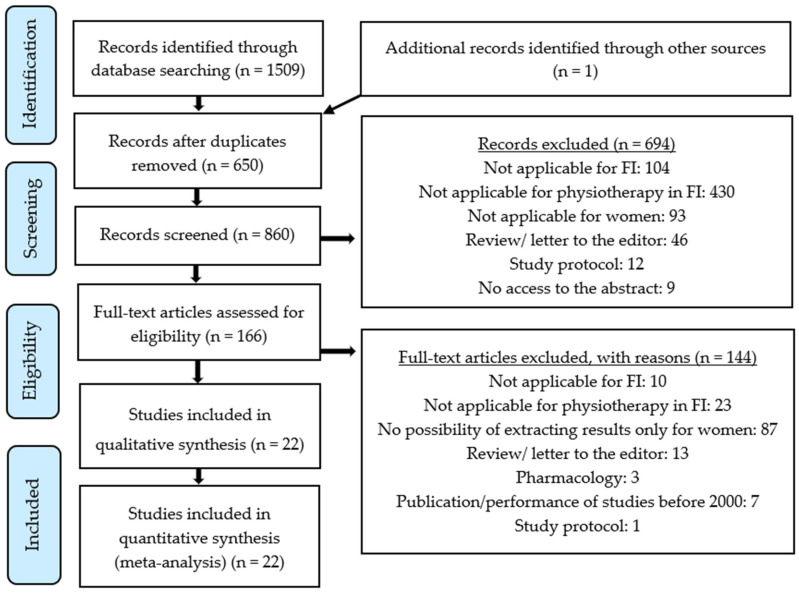
Fecal incontinence (FI) affects approximately 0.25-6% of the population, both men and women. The most common causes of FI are damage to/weakness of the anal sphincter muscle and/or pelvic floor muscles, as well as neurological changes in the central or peripheral nervous system. The purpose of this study is to report the results of a systematic review of the possibilities and effectiveness of physiotherapy techniques for the prevention and treatment of FI in women. For this purpose, the PubMed, Embase, and Web of Science databases were searched for 2000-2020. A total of 22 publications qualified for detailed analysis. The studies showed that biofeedback (BF), anal sphincter muscle exercises, pelvic floor muscle training (PFMT), and electrostimulation (ES) are effective in relieving FI symptoms, as reflected in the International Continence Society recommendations (BF: level A; PFMT and ES: level B). Research has confirmed that physiotherapy, by improving muscle strength, endurance, and anal sensation, is beneficial in the prevention of FI, both as an independent method of conservative treatment or in pre/post-surgery treatment. Moreover, it can significantly improve the quality of life of patients. In conclusion, physiotherapy (in particular, BF, PFMT, or ES, as effective methods) should be one of the key elements in the comprehensive therapy of patients with FI.
大便失禁(FI)影响着约0.25%-6%的人群,无论男女。FI最常见的原因是肛门括约肌和/或盆底肌肉受损/无力,以及中枢或周围神经系统的神经变化。本研究的目的是报告对物理治疗技术预防和治疗女性FI的可能性和有效性进行系统评价的结果。为此,检索了2000年至2020年的PubMed、Embase和科学网数据库。共有22篇出版物符合详细分析的条件。研究表明,生物反馈(BF)、肛门括约肌锻炼、盆底肌肉训练(PFMT)和电刺激(ES)在缓解FI症状方面是有效的,这在国际尿失禁学会的建议中得到了体现(BF:A级;PFMT和ES:B级)。研究证实,物理治疗通过提高肌肉力量、耐力和肛门感觉,无论是作为一种独立的保守治疗方法还是在手术前/后治疗中,对预防FI都是有益的。此外,它可以显著提高患者的生活质量。总之,物理治疗(特别是BF、PFMT或ES,作为有效的方法)应是FI患者综合治疗的关键要素之一。