Department of Pharmaceutical Sciences, Jerry H. Hodge School of Pharmacy, Texas Tech University Health Sciences Center, Amarillo, TX, 79106, USA.
Center for Blood-Brain Barrier Research, School of Pharmacy, Texas Tech University Health Sciences Center, Amarillo, TX, 79106, USA.
Fluids Barriers CNS. 2020 Oct 14;17(1):61. doi: 10.1186/s12987-020-00224-1.
Understanding the pathophysiology of the blood brain-barrier (BBB) plays a critical role in diagnosis and treatment of disease conditions. Applying a sensitive and specific LC-MS/MS technique for the measurement of BBB integrity with high precision, we have recently introduced non-radioactive [C]sucrose as a superior marker substance. Comparison of permeability markers with different molecular weight, but otherwise similar physicochemical properties, can provide insights into the uptake mechanism at the BBB. Mannitol is a small hydrophilic, uncharged molecule that is half the size of sucrose. Previously only radioactive [H]mannitol or [C]mannitol has been used to measure BBB integrity.
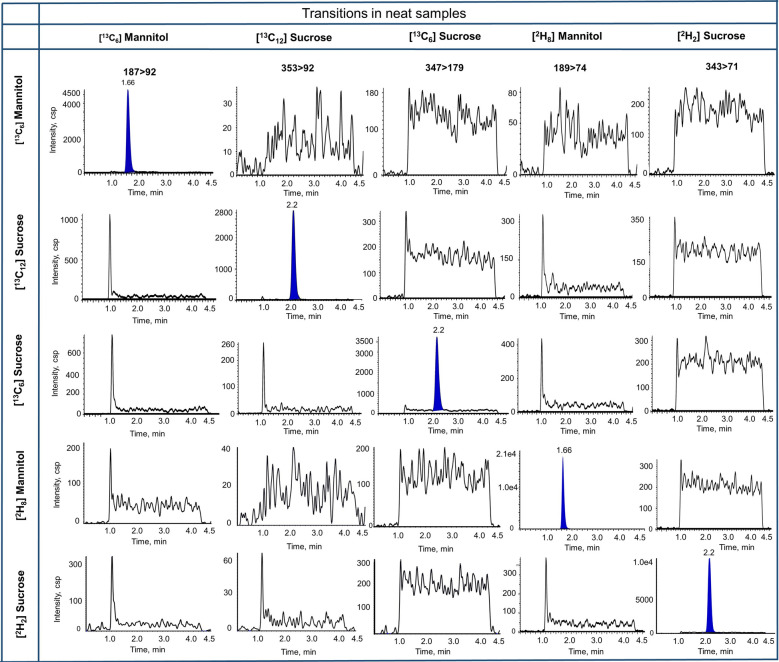
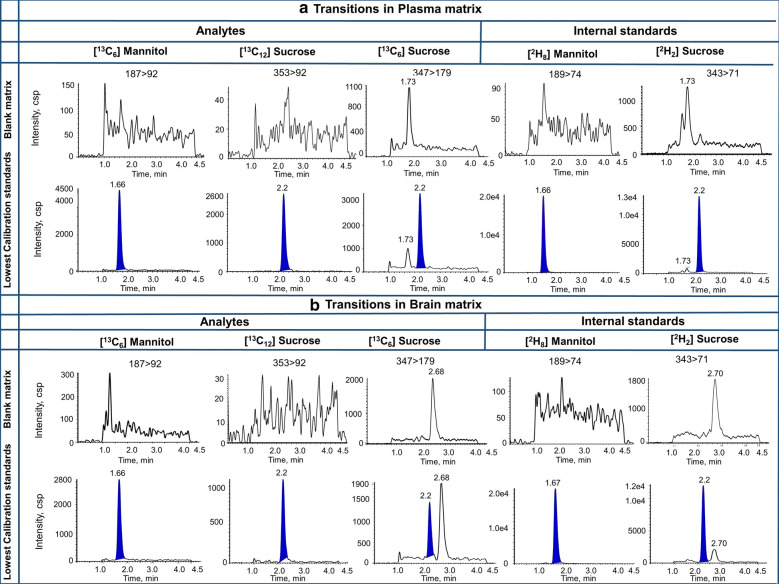
We developed a UPLC-MS/MS method for simultaneous analysis of stable isotope-labeled sucrose and mannitol. The in vivo BBB permeability of [C]mannitol and [C]sucrose was measured in mice, using [C]sucrose as a vascular marker to correct for brain intravascular content. Moreover, a Transwell model with induced pluripotent stem cell-derived brain endothelial cells was used to measure the permeability coefficient of sucrose and mannitol in vitro both under control and compromised (in the presence of IL-1β) conditions.
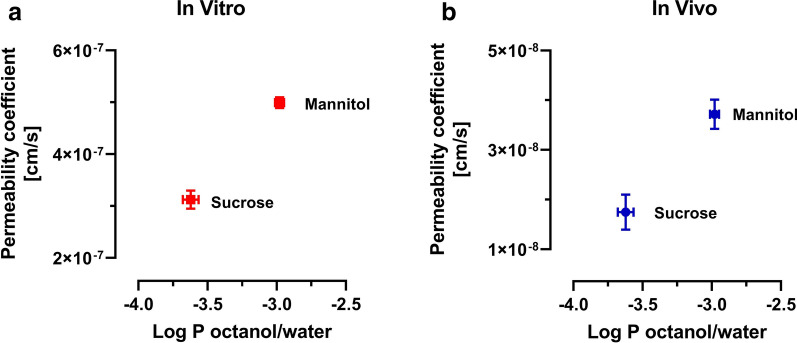
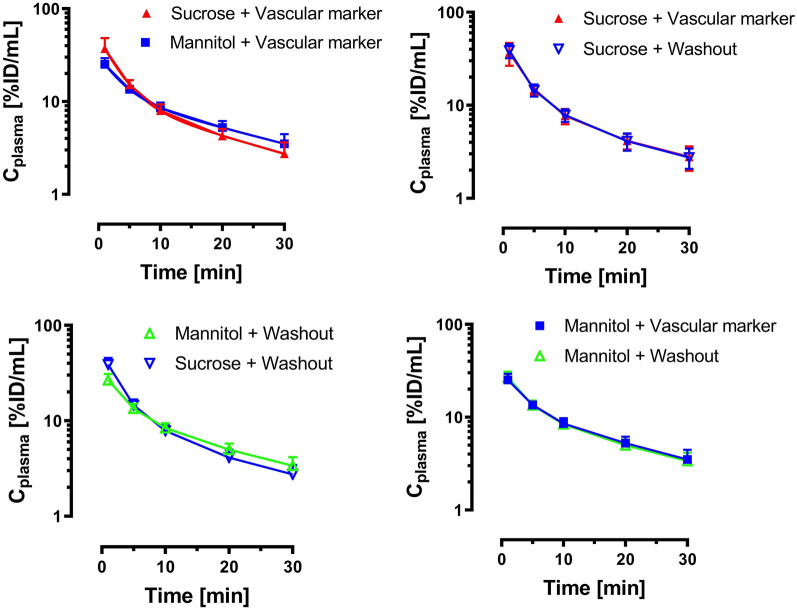
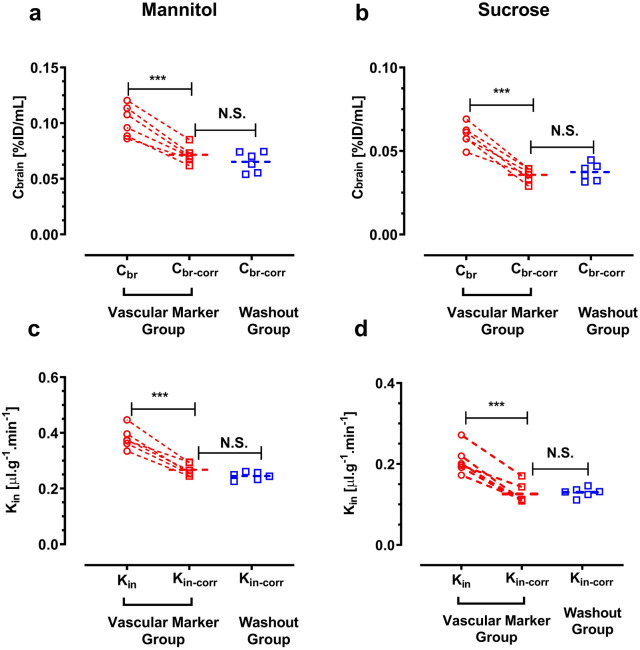
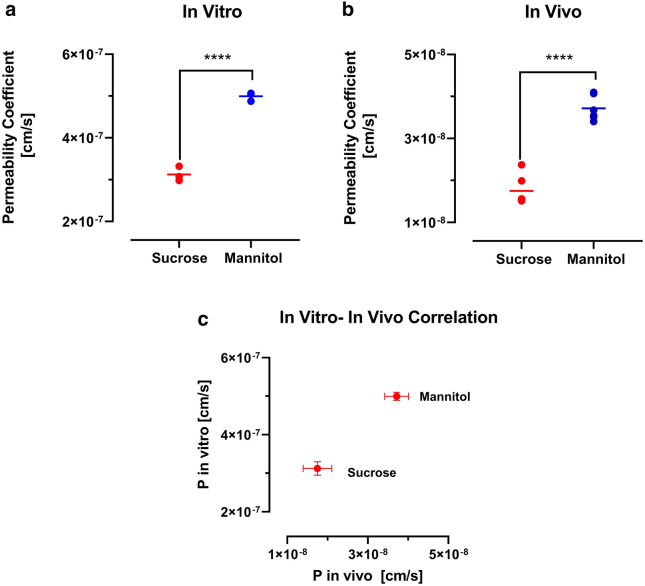
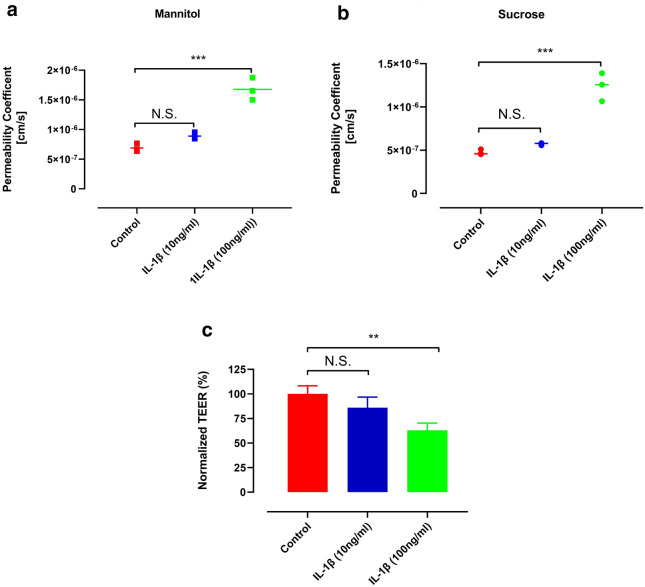
We found low permeability values for both mannitol and sucrose in vitro (permeability coefficients of 4.99 ± 0.152 × 10 and 3.12 ± 0.176 × 10 cm/s, respectively) and in vivo (PS products of 0.267 ± 0.021 and 0.126 ± 0.025 µl g min, respectively). Further, the in vitro permeability of both markers substantially increased in the presence of IL-1β. Corrected brain concentrations (C), obtained by washout vs. vascular marker correction, were not significantly different for either mannitol (0.071 ± 0.007 and 0.065 ± 0.009 percent injected dose per g) or sucrose (0.035 ± 0.003 and 0.037 ± 0.005 percent injected dose per g). These data also indicate that C and PS product values of mannitol were about twice the corresponding values of sucrose.
We established a highly sensitive, specific and reproducible approach to simultaneously measure the BBB permeability of two classical low molecular weight, hydrophilic markers in a stable isotope labeled format. This method is now available as a tool to quantify BBB permeability in vitro and in vivo in different disease models, as well as for monitoring treatment outcomes.
理解血脑屏障(BBB)的病理生理学在疾病的诊断和治疗中起着至关重要的作用。我们最近应用一种灵敏且特异的、可高精度测量 BBB 完整性的 LC-MS/MS 技术,引入了非放射性[C]蔗糖作为一种优越的标记物。对具有不同分子量但其他理化性质相似的通透性标记物进行比较,可以深入了解 BBB 摄取机制。甘露醇是一种小的亲水性、不带电荷的分子,大小为蔗糖的一半。以前,只有放射性[H]甘露醇或[C]甘露醇被用于测量 BBB 完整性。
我们开发了一种 UPLC-MS/MS 方法,用于同时分析稳定同位素标记的蔗糖和甘露醇。在小鼠体内,我们使用[C]蔗糖作为血管标记物来校正脑内血管内容物,测量[C]甘露醇和[C]蔗糖的 BBB 通透性。此外,我们还使用诱导多能干细胞衍生的脑内皮细胞的 Transwell 模型,在对照和受损(存在 IL-1β的情况下)条件下,分别测量蔗糖和甘露醇的体外通透性系数。
我们发现甘露醇和蔗糖在体外(渗透率分别为 4.99±0.152×10 和 3.12±0.176×10 cm/s)和体内(PS 产物分别为 0.267±0.021 和 0.126±0.025 µl g min)的通透性值均较低。此外,两种标记物的体外通透性在存在 IL-1β的情况下均显著增加。通过洗脱与血管标记物校正相比,获得的脑校正浓度(C),甘露醇(0.071±0.007 和 0.065±0.009 注射剂量的百分比每克)或蔗糖(0.035±0.003 和 0.037±0.005 注射剂量的百分比每克)之间没有显著差异。这些数据还表明,甘露醇的 C 和 PS 产物值约为蔗糖相应值的两倍。
我们建立了一种高度灵敏、特异和可重复的方法,可同时以稳定同位素标记格式测量两种经典低分子量亲水性标记物的 BBB 通透性。该方法现已作为一种工具,可用于在不同疾病模型中体外和体内定量 BBB 通透性,以及监测治疗效果。