
基于自噬相关基因的甲状腺癌生存模型的建立与验证
Development and validation of a survival model for thyroid carcinoma based on autophagy-associated genes.
作者信息
Han Baoai, Yang Xiuping, Hosseini Davood K, Luo Pan, Liu Mengzhi, Xu Xiaoxiang, Zhang Ya, Su Hongguo, Zhou Tao, Sun Haiying, Chen Xiong
机构信息
Public Laboratory, Key Laboratory of Breast Cancer Prevention and Therapy, Ministry of Education, Tianjin Medical University Cancer Institute and Hospital, National Clinical Research Center for Cancer, Tianjin Medical University, Tianjin 30000, China.
Department of Otorhinolaryngology, Head and Neck Surgery, Zhongnan Hospital of Wuhan University, Wuhan 430071, China.
出版信息
Aging (Albany NY). 2020 Oct 14;12(19):19129-19146. doi: 10.18632/aging.103715.
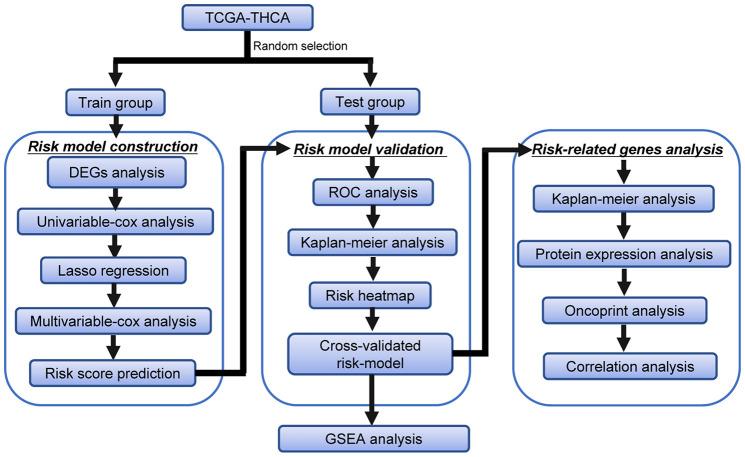
Abnormalities in autophagy-related genes (ARGs) are closely related to the occurrence and development of thyroid carcinoma (THCA). However, the effect of ARGs on the prognosis of THCA remains unclear. Here, by analyzing data from TCGA, 26 differentially expressed ARGs were screened. Cox regression and Lasso regression were utilized to analyze the prognosis of the training group, and a risk model was constructed. Our results show that low-risk patients had better overall survival (OS) than high-risk patients, and the area under the ROC curve in the training and testing groups was significant (3-year AUC, 0.735 vs 0.796; 5-year AUC, 0.821 vs 0.804). In addition, a comprehensive analysis of the 5 identified ARGs demonstrated that most of them were related to OS in THCA patients, and two of them (CX3CL1 and CDKN2A) were differentially expressed in THCA and normal thyroid tissues at the protein level. GSEA suggested that the inactivation of the cell defense system and the activation of some classical tumor signaling pathways are important driving forces for the progression of THCA. This study demonstrated that the 5 ARGs in the survival model are promising multidimensional biomarkers for the diagnosis, prognosis, and treatment of THCA.
自噬相关基因(ARGs)异常与甲状腺癌(THCA)的发生发展密切相关。然而,ARGs对THCA预后的影响仍不清楚。在此,通过分析来自TCGA的数据,筛选出26个差异表达的ARGs。利用Cox回归和Lasso回归分析训练组的预后,并构建风险模型。我们的结果表明,低风险患者的总生存期(OS)优于高风险患者,训练组和测试组的ROC曲线下面积具有显著性(3年AUC,0.735对0.796;5年AUC,0.821对0.804)。此外,对5个鉴定出的ARGs进行综合分析表明,它们中的大多数与THCA患者的OS相关,其中两个(CX3CL1和CDKN2A)在THCA和正常甲状腺组织中的蛋白水平存在差异表达。基因集富集分析(GSEA)表明,细胞防御系统的失活和一些经典肿瘤信号通路的激活是THCA进展的重要驱动力。本研究表明,生存模型中的5个ARGs是THCA诊断、预后和治疗有前景的多维度生物标志物。

 Zotero 插件