Yale School of the Environment, Yale University, New Haven, CT, 06511, USA.
School of Environmental Sciences, Jawaharlal Nehru University, New Mehrauli Road, Delhi, New Delhi, 110067, India.
Sci Rep. 2020 Oct 14;10(1):17241. doi: 10.1038/s41598-020-73313-8.
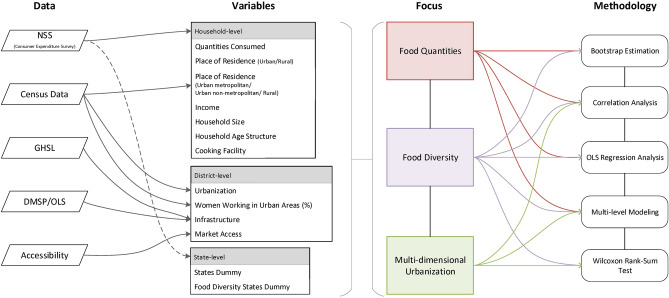
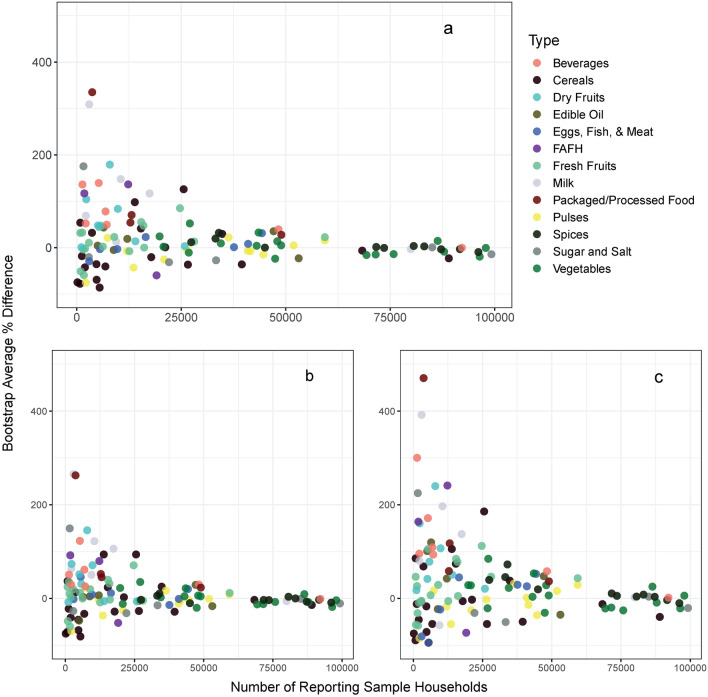
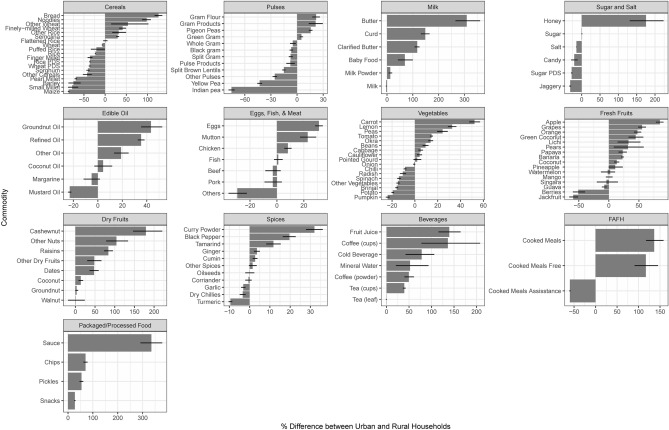
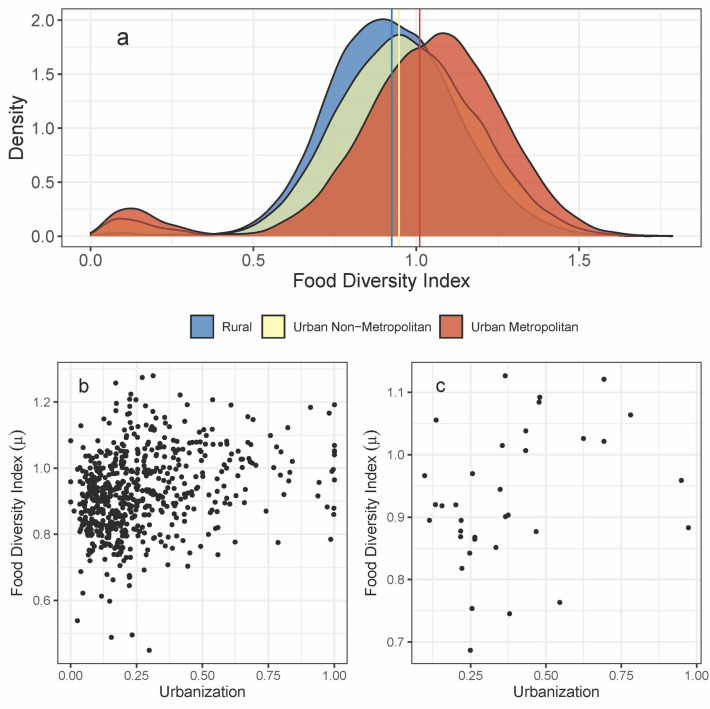
The shift towards urban living is changing food demand. Past studies on India show significant urban-rural differences in food consumption. However, a scientific understanding of the underlying relationships between urbanization and food consumption is limited. This study provides the first detailed analysis of how urbanization influences both quantity and diversity of food consumption in India by harnessing the strength of multiple datasets, including consumer expenditure surveys, satellite imagery, and census data. Our statistical analysis shows three main findings. First, in contrast to existing studies, we find that much of the variation in food consumption quantity is due to income and not urbanization. After controlling for income and state-level differences, our results show that average consumption is higher in urban than rural areas for fewer than 10% of all commodities. That is, there is nearly no difference in average consumption between urban and rural residents. Second, we find the influence of urbanization as a population share on food consumption diversity to be statistically insignificant (p-value > 0.1). Instead, the results show that infrastructure, market access, percentage working women in urban areas, and norms and institutions have a statistically significant influence. Third, all covariates of food consumption diversity we tested were found to be associated with urbanization. This suggests that urbanization influences on food consumption are both indirect and multidimensional. These results show that increases in the urban population size alone do not explain changes in food consumption in India. If we are to understand how food consumption may change in the future due to urbanization, the study points to the need for a more complex and multidimensional understanding of the urbanization process that goes beyond demographic shifts.
向城市生活的转变正在改变食物需求。过去对印度的研究表明,食物消费在城乡之间存在显著差异。然而,对于城市化与食物消费之间潜在关系的科学理解是有限的。本研究通过利用多个数据集(包括消费者支出调查、卫星图像和人口普查数据)的优势,首次详细分析了城市化如何影响印度食物消费的数量和多样性。我们的统计分析显示了三个主要发现。首先,与现有研究不同,我们发现食物消费数量的大部分变化是由于收入而不是城市化。在控制收入和州级差异后,我们的结果表明,在不到 10%的所有商品中,城市地区的平均消费高于农村地区。也就是说,城市和农村居民的平均消费几乎没有差异。其次,我们发现城市化作为人口份额对食物消费多样性的影响在统计学上并不显著(p 值>0.1)。相反,结果表明基础设施、市场准入、城市地区女性劳动力的百分比以及规范和制度具有统计学上的显著影响。第三,我们测试的所有食物消费多样性的协变量都被发现与城市化有关。这表明城市化对食物消费的影响是间接的和多方面的。这些结果表明,仅增加城市人口规模并不能解释印度食物消费的变化。如果我们要了解未来城市化可能如何影响食物消费,该研究表明,需要对城市化进程有一个更复杂和多维度的理解,超越人口结构的转变。