Advanced Fruit Research Center, Agronomic Institute (IAC), Jundiaí, SP, Brazil.
Molecular Biology and Genetic Engineering Center (CBMEG), University of Campinas (UNICAMP), Campinas, SP, Brazil.
PLoS One. 2020 Oct 15;15(10):e0240665. doi: 10.1371/journal.pone.0240665. eCollection 2020.
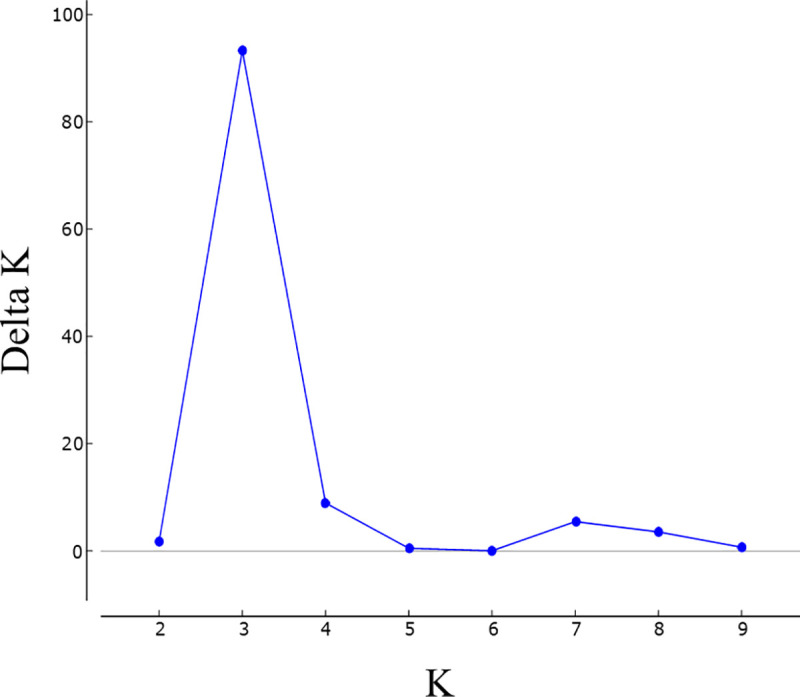
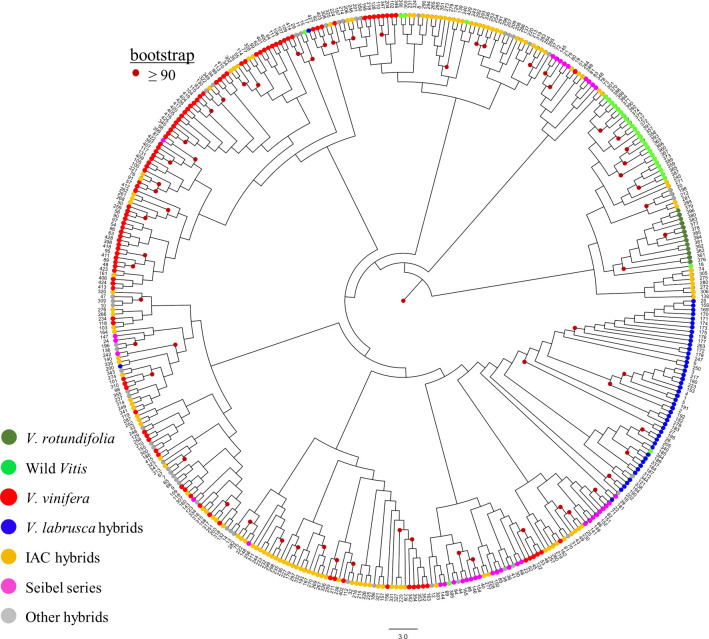
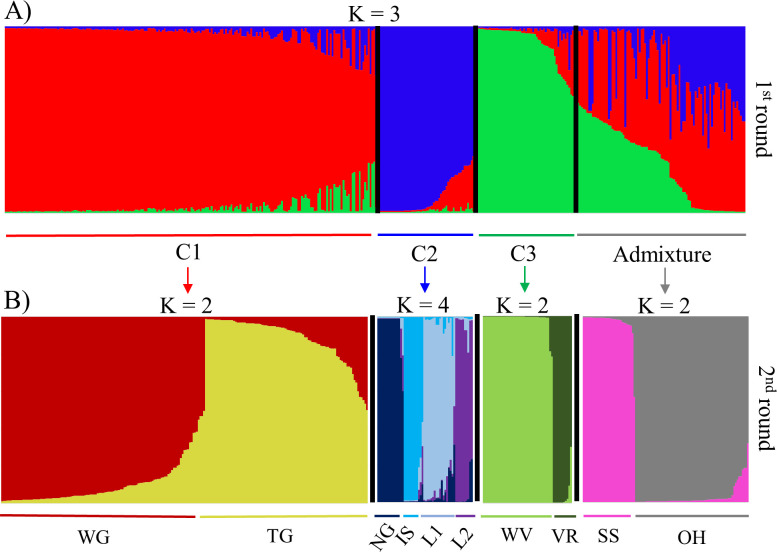
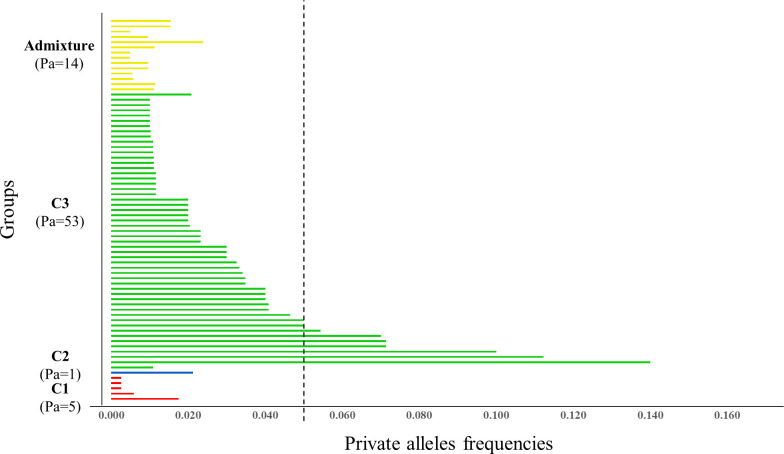
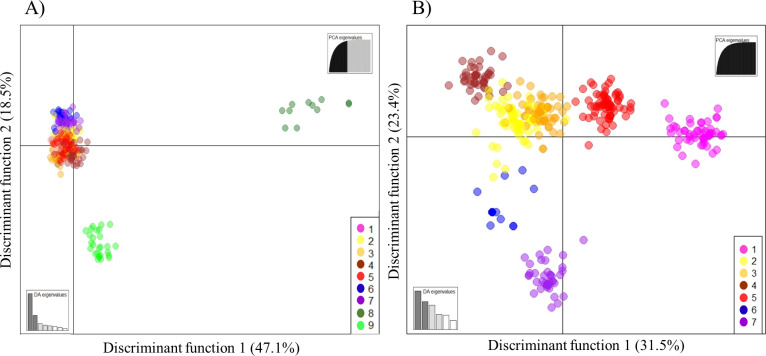
The management of germplasm banks is complex, especially when many accessions are involved. Microsatellite markers are an efficient tool for assessing the genetic diversity of germplasm collections, optimizing their use in breeding programs. This study genetically characterizes a large collection of 410 grapevine accessions maintained at the Agronomic Institute of Campinas (IAC) (Brazil). The accessions were genotyped with 17 highly polymorphic microsatellite markers. Genetic data were analyzed to determine the genetic structure of the germplasm, quantify its allelic diversity, suggest the composition of a core collection, and discover cases of synonymy, duplication, and misnaming. A total of 304 alleles were obtained, and 334 unique genotypes were identified. The molecular profiles of 145 accessions were confirmed according to the literature and databases, and the molecular profiles of more than 100 genotypes were reported for the first time. The analysis of the genetic structure revealed different levels of stratification. The primary division was between accessions related to Vitis vinifera and V. labrusca, followed by their separation from wild grapevine. A core collection of 120 genotypes captured 100% of all detected alleles. The accessions selected for the core collection may be used in future phenotyping efforts, in genome association studies, and for conservation purposes. Genetic divergence among accessions has practical applications in grape breeding programs, as the choice of relatively divergent parents will maximize the frequency of progeny with superior characteristics. Together, our results can enhance the management of grapevine germplasm and guide the efficient exploitation of genetic diversity to facilitate the development of new grape cultivars for fresh fruits, wine, and rootstock.
种质库管理较为复杂,特别是当涉及多个样本时。微卫星标记是评估种质资源遗传多样性的有效工具,可以优化其在育种计划中的应用。本研究对保存在巴西坎皮纳斯农业研究所(IAC)的 410 个葡萄品种进行了遗传特征分析。利用 17 个高度多态性的微卫星标记对这些品种进行了基因分型。对遗传数据进行分析,以确定种质资源的遗传结构,量化其等位基因多样性,建议核心种质组成,并发现同义、重复和命名错误的情况。共获得 304 个等位基因,鉴定出 334 个独特基因型。根据文献和数据库对 145 个样本的分子图谱进行了确认,首次报道了 100 多个基因型的分子图谱。遗传结构分析显示出不同层次的分层。主要的分类是与 Vitis vinifera 和 V. labrusca 相关的样本,其次是与野生葡萄的分离。一个包含 120 个基因型的核心种质库捕获了所有检测到的等位基因的 100%。所选核心种质库的样本可用于未来的表型分析、基因组关联研究和保护目的。样本之间的遗传差异在葡萄育种计划中具有实际应用价值,因为选择相对分化的亲本将最大限度地提高具有优良特性的后代的频率。综上所述,我们的研究结果可以提高葡萄种质资源的管理水平,并指导对遗传多样性的有效利用,以促进开发用于鲜食、酿酒和砧木的新型葡萄品种。