Department of Gastrointestinal and Hepato-Biliary-Pancreatic Surgery, Faculty of Medicine, University of Tsukuba, Tsukuba, Japan.
Biotechnology Research Institute for Drug Discovery, National Institute of Advanced Industrial Science and Technology, Tsukuba, Japan.
Cancer Sci. 2020 Dec;111(12):4548-4557. doi: 10.1111/cas.14687. Epub 2020 Nov 2.
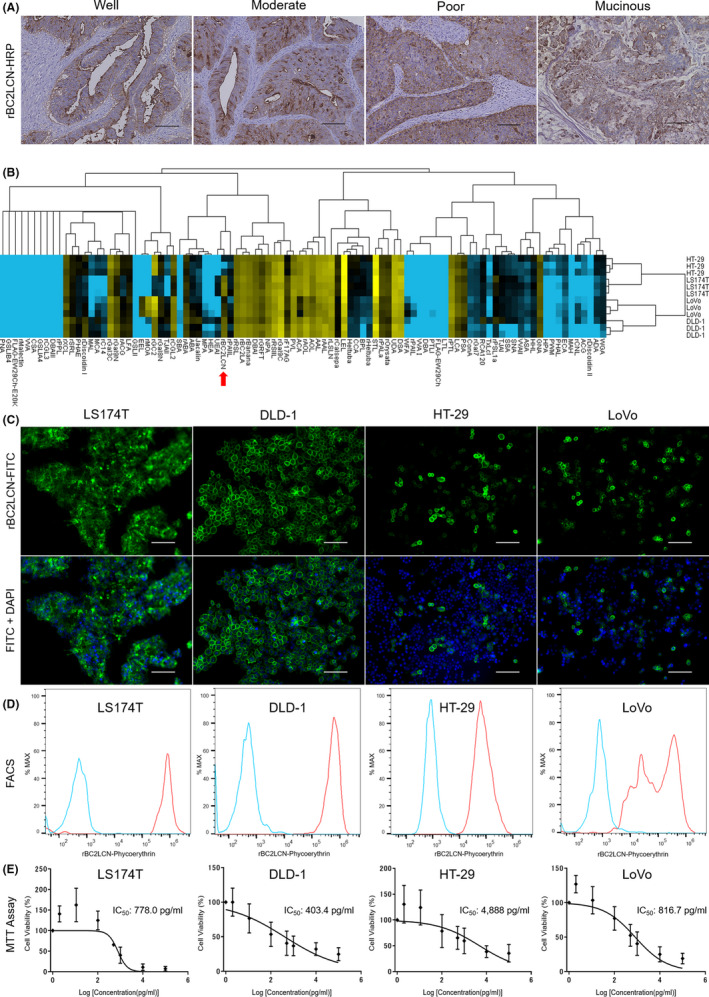
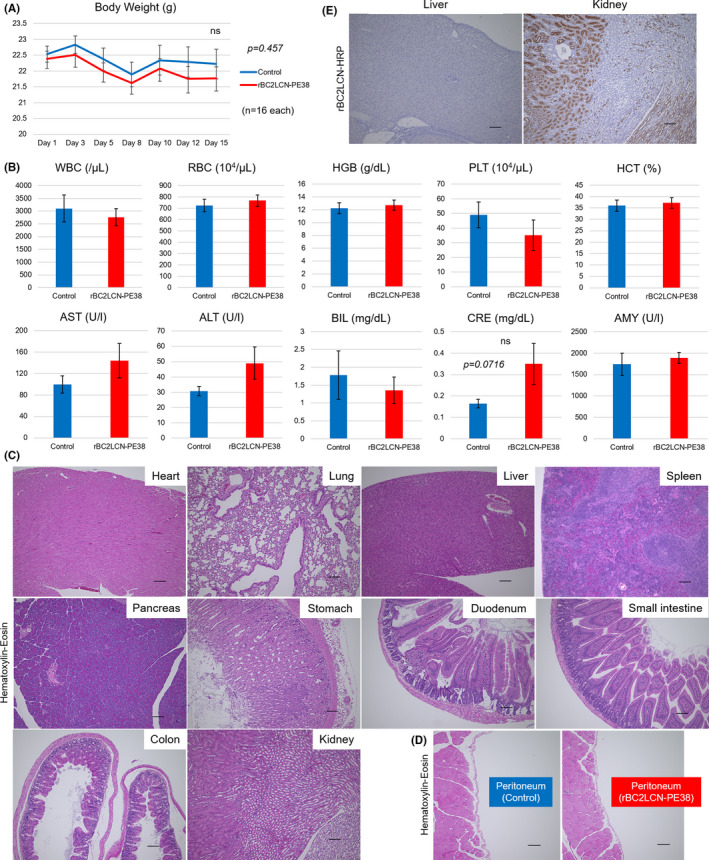
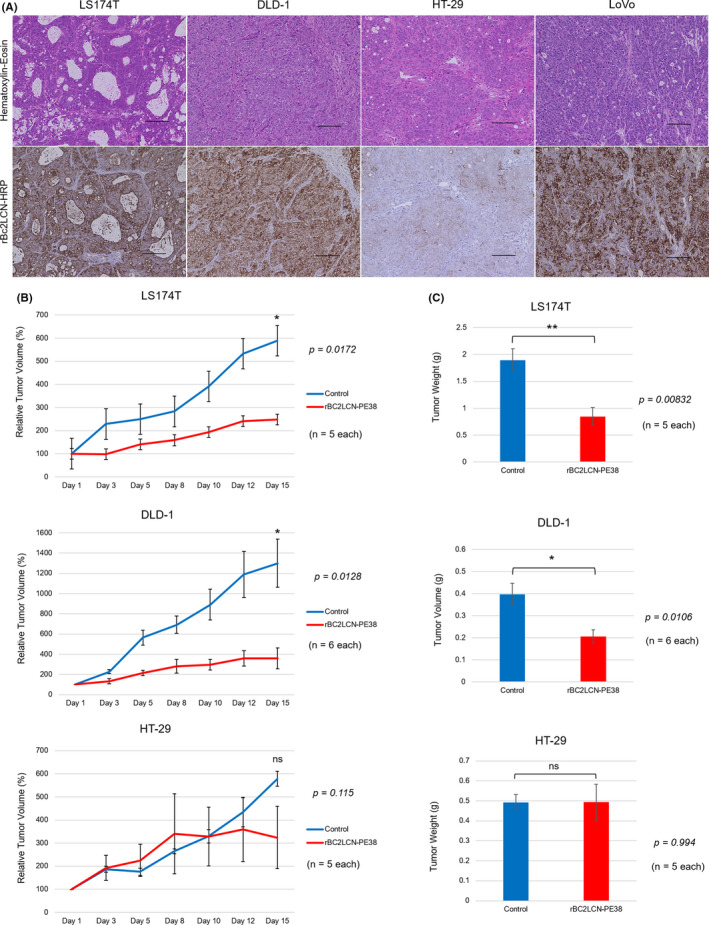
Drug resistance represents an obstacle in colorectal cancer (CRC) treatment because of its association with poor prognosis. rBC2LCN is a lectin isolated from Burkholderia that binds cell surface glycans that have fucose moieties. Because fucosylation is enhanced in many types of cancers, this lectin could be an efficient drug carrier if CRC cells specifically present such glycans. Therefore, we examined the therapeutic efficacy and toxicity of lectin drug conjugate therapy in CRC mouse xenograft models. The affinity of rBC2LCN for human CRC cell lines HT-29, LoVo, LS174T, and DLD-1 was assessed in vitro. The cytocidal efficacy of a lectin drug conjugate, rBC2LCN-38 kDa domain of pseudomonas exotoxin A (PE38) was evaluated by MTT assay. The therapeutic effects and toxicity for each CRC cell line-derived mouse xenograft model were compared between the intervention and control groups. LS174T and DLD-1 cell lines showed a strong affinity for rBC2LCN. In the xenograft model, the tumor volume in the rBC2LCN-PE38 group was significantly reduced compared with that using control treatment alone. However, the HT-29 cell line showed weak affinity and poor therapeutic efficacy. No significant toxicities or adverse responses were observed. In conclusion, we demonstrated that rBC2LCN lectin binds CRC cells and that rBC2LCN-PE38 significantly suppresses tumor growth in vivo. In addition, the efficacy of the drug conjugate correlated with its binding affinity for each CRC cell line. These results suggest that lectin drug conjugate therapy has potential as a novel targeted therapy for CRC cell surface glycans.
耐药性是结直肠癌 (CRC) 治疗的一个障碍,因为它与预后不良有关。rBC2LCN 是一种从伯克霍尔德菌中分离出来的凝集素,它可以与带有岩藻糖基的细胞表面聚糖结合。由于岩藻糖基在许多类型的癌症中增强,这种凝集素如果 CRC 细胞特异性地呈现这种聚糖,就可以成为一种有效的药物载体。因此,我们在 CRC 小鼠异种移植模型中研究了凝集素药物偶联物治疗的疗效和毒性。在体外评估了 rBC2LCN 对人 CRC 细胞系 HT-29、LoVo、LS174T 和 DLD-1 的亲和力。通过 MTT 测定评估了凝集素药物偶联物 rBC2LCN-38 kDa 域假单胞菌外毒素 A (PE38) 的细胞毒性作用。比较了干预组和对照组每种 CRC 细胞系来源的小鼠异种移植模型的治疗效果和毒性。LS174T 和 DLD-1 细胞系对 rBC2LCN 表现出强烈的亲和力。在异种移植模型中,与单独使用对照治疗相比,rBC2LCN-PE38 组的肿瘤体积显著减小。然而,HT-29 细胞系表现出较弱的亲和力和较差的治疗效果。没有观察到明显的毒性或不良反应。总之,我们证明 rBC2LCN 凝集素与 CRC 细胞结合,rBC2LCN-PE38 显著抑制体内肿瘤生长。此外,药物偶联物的疗效与其与每种 CRC 细胞系的结合亲和力相关。这些结果表明,凝集素药物偶联物治疗具有作为 CRC 细胞表面糖的新型靶向治疗的潜力。