Department of Medical Laboratory Science, College of Medicine and Health Sciences, Arba Minch University, Arba Minch, Ethiopia.
Global Health Institute, Antwerp University, Antwerp, Belgium.
Malar J. 2020 Oct 15;19(1):369. doi: 10.1186/s12936-020-03437-9.
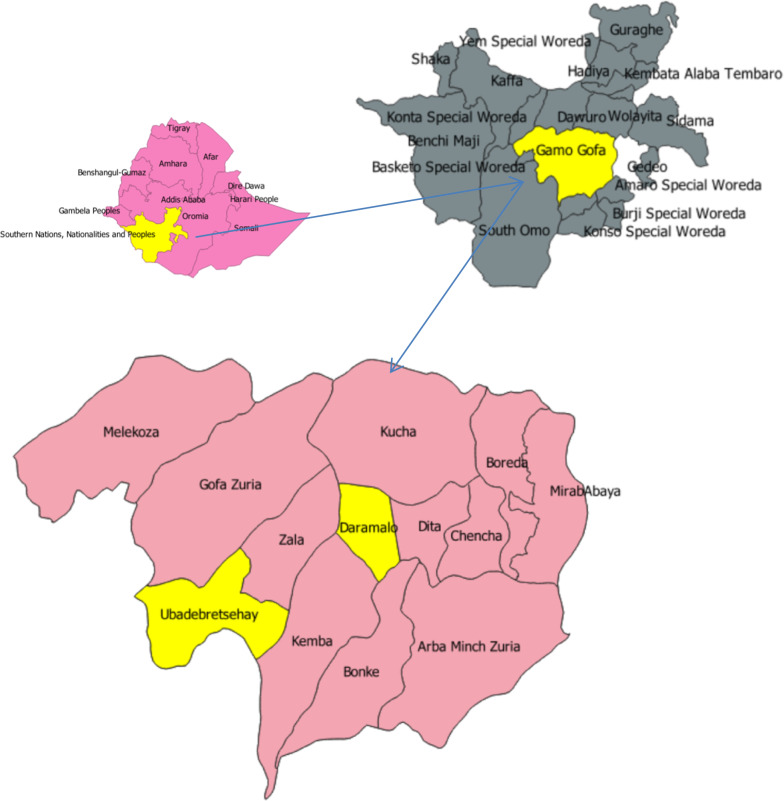
Malaria is one of the major causes of morbidity and mortality among school-age children (SAC) in sub-Saharan Africa. SAC account for more than 60% of the reservoir of malaria transmission, but they are given less emphasis in prioritizing malaria prevention interventions. This study was aimed at assessing the ownership of long-lasting insecticide treated bed nets (LLINs), its utilization and factors associated with ownership of LLINs by households and LLINs utilization among SAC in malaria-prone areas of Dara Mallo and Uba Debretsehay districts in Southern Ethiopia, October to December 2019.
This study is part of a baseline assessment in a cluster-randomized controlled trial. The data was collected through interview and observation, following a structured questionnaire, of 2261 SAC households. Univariable and multivariable multilevel logistic regressions were used to assess the association between LLINs ownership and utilization and potential predictor variables. Odds ratio (OR) and corresponding 95% confidence interval (CI) were used to determine the strength and statistical significance of association.
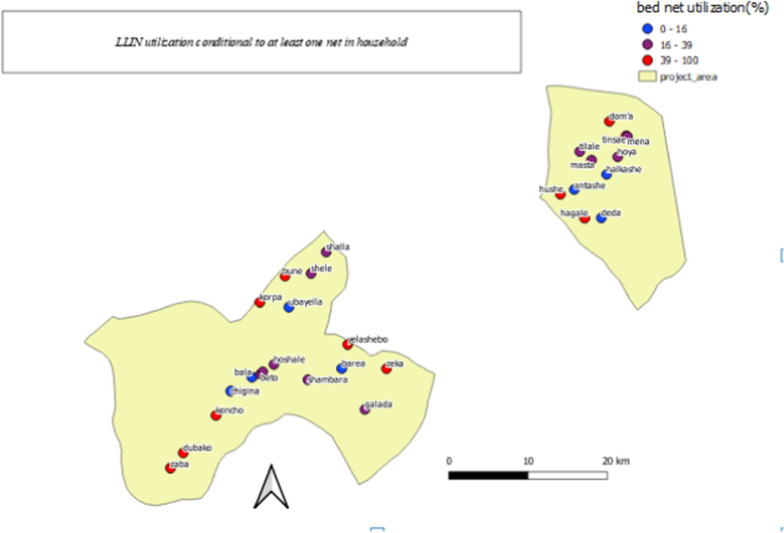
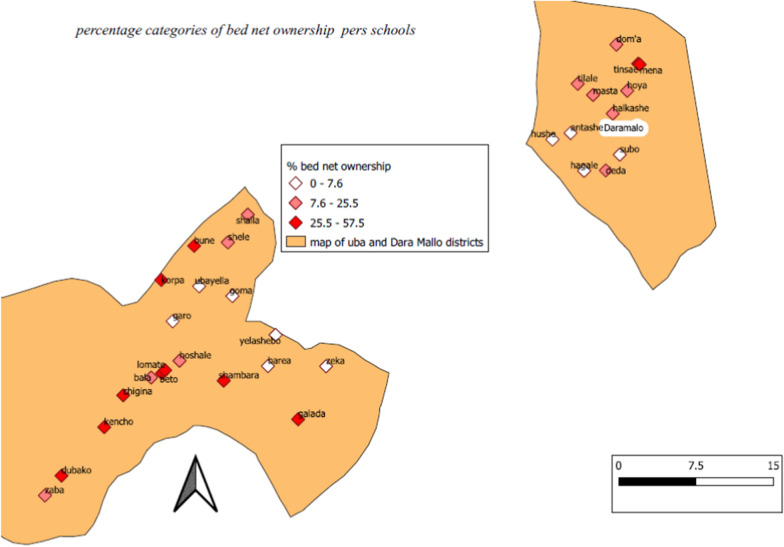
The ownership of at least one LLIN by households of SAC was about 19.3% (95% CI 17.7-21.0%) but only 10.3% % (95% CI 7.7-13.7%) of these households had adequate access of bed nets to the household members. Ownership of bed net was marginally affected by living in semi-urban area (adjusted OR = 2.6; 95% CI 1.0-6.9) and occupational status of the household head being a civil servant (adjusted OR = 2.7; 95% CI 0.9-7.9). About 7.8% (95% CI 6.7-10.0%) of all SAC participated in the study and 40.4% (95% CI 57.4-66.7%) of children in households owning at least one LLIN passed the previous night under LLIN. LLIN utilization by SAC conditional to presence of at least one net in the household was significantly correlated with education level of mother above grade 6 (adjusted OR = 3.4; 95% CI 1.3-9.3) and the household size to bed net ratio less than or equal to 2 (adjusted OR = 20.7; 95% CI 4.7-132.5).
Ownership of bed net was lower than universal coverage of at least one bed net for two individuals. It is important to monitor replacement needs and educate mothers with low education level with their SAC on the benefit of consistent utilization of bed nets.
疟疾是撒哈拉以南非洲学龄儿童(SAC)发病率和死亡率的主要原因之一。SAC 占疟疾传播储库的 60%以上,但在优先考虑疟疾预防干预措施时,他们的重视程度较低。本研究旨在评估在埃塞俄比亚南部达拉马洛和乌巴德布雷特谢海地区疟疾流行地区,家庭拥有长效驱虫处理蚊帐(LLINs)及其利用率以及与家庭拥有 LLINs 相关的因素,以及 SAC 对 LLINs 的利用情况,2019 年 10 月至 12 月。
这是一项集群随机对照试验的基线评估的一部分。通过对 2261 个 SAC 家庭进行访谈和观察,采用结构化问卷收集数据。使用单变量和多变量多层逻辑回归评估 LLINs 拥有率和利用率与潜在预测变量之间的关联。使用优势比(OR)和相应的 95%置信区间(CI)来确定关联的强度和统计学意义。
SAC 家庭至少拥有一个 LLIN 的比例约为 19.3%(95%CI 17.7-21.0%),但只有 10.3%的家庭(95%CI 7.7-13.7%)能够充分获得床上用品。蚊帐的拥有率受居住在半城市地区的影响(调整后的 OR=2.6;95%CI 1.0-6.9)和家庭户主的职业状况为公务员(调整后的 OR=2.7;95%CI 0.9-7.9)。约有 7.8%(95%CI 6.7-10.0%)的所有 SAC 参加了研究,在拥有至少一个 LLIN 的家庭中,40.4%(95%CI 57.4-66.7%)的儿童在前一晚在 LLIN 下度过。SAC 对至少有一个蚊帐的家庭的 LLIN 利用率与母亲受教育程度高于 6 年级(调整后的 OR=3.4;95%CI 1.3-9.3)和家庭大小与蚊帐比例小于或等于 2(调整后的 OR=20.7;95%CI 4.7-132.5)显著相关。
拥有蚊帐的比例低于至少两个人的普遍覆盖蚊帐。重要的是要监测更换需求,并教育教育程度较低的母亲及其 SAC 一致使用蚊帐的好处。