Neutron Scattering Division, Oak Ridge National Laboratory, Oak Ridge, Tennessee, USA; National Virtual Biotechnology Laboratory, United States Department of Energy, Washington, DC, USA.
Neutron Scattering Division, Oak Ridge National Laboratory, Oak Ridge, Tennessee, USA; National Virtual Biotechnology Laboratory, United States Department of Energy, Washington, DC, USA; Second Target Station, Oak Ridge National Laboratory, Oak Ridge, Tennessee, USA.
J Biol Chem. 2020 Dec 11;295(50):17365-17373. doi: 10.1074/jbc.AC120.016154. Epub 2020 Oct 15.
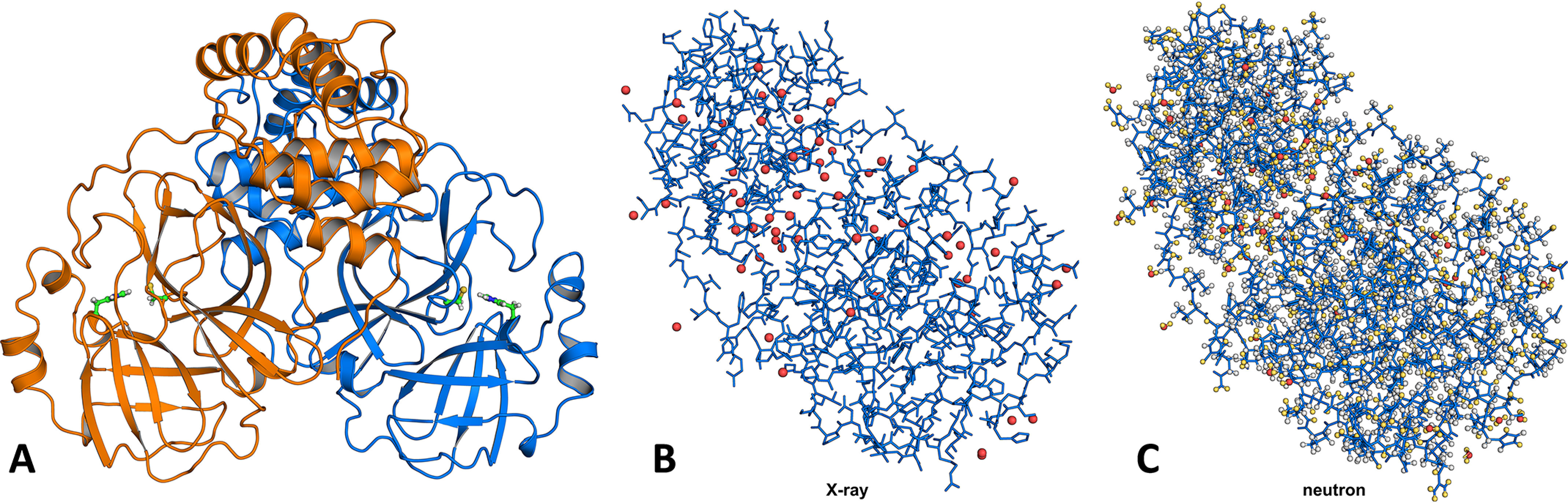
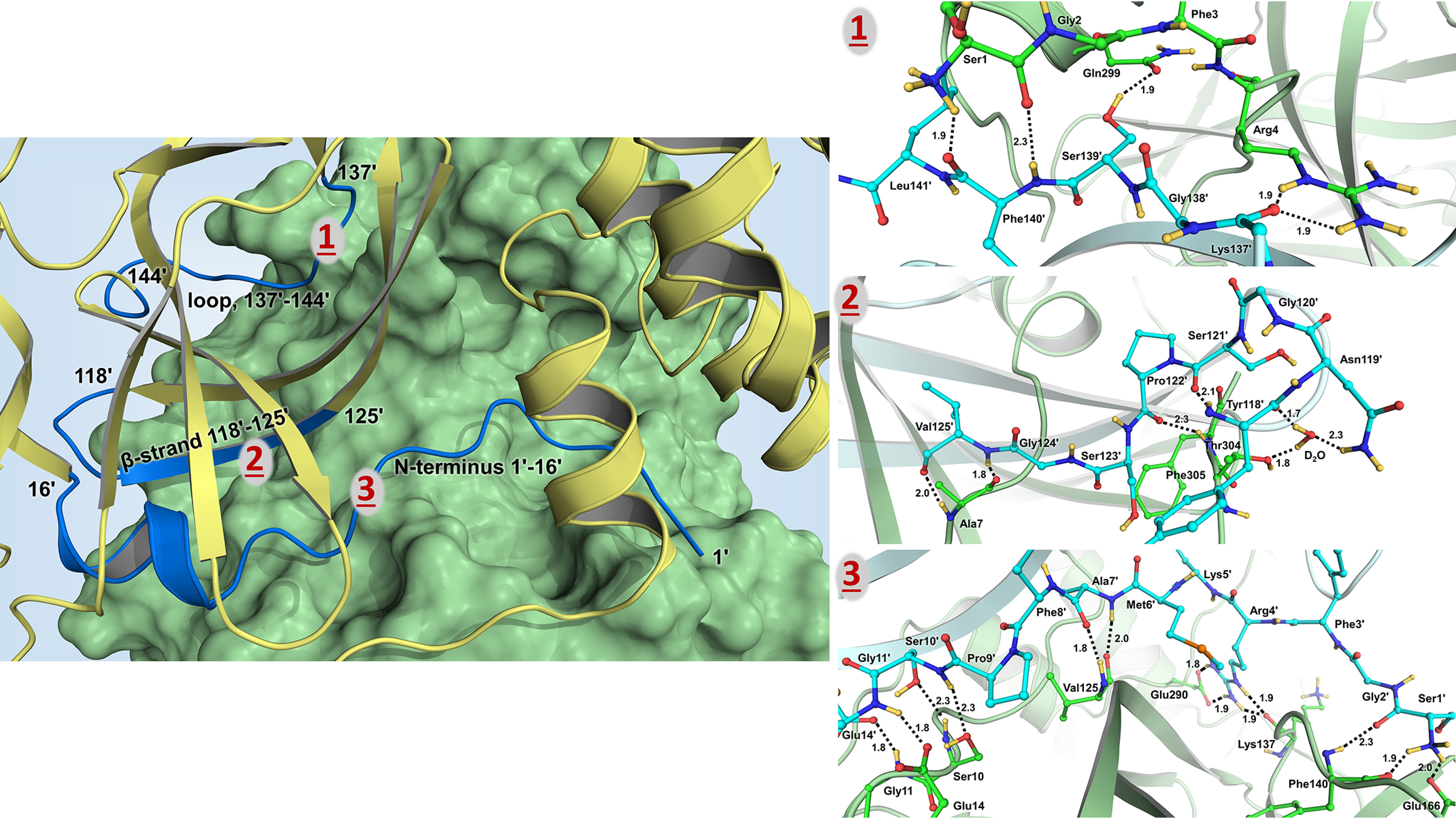
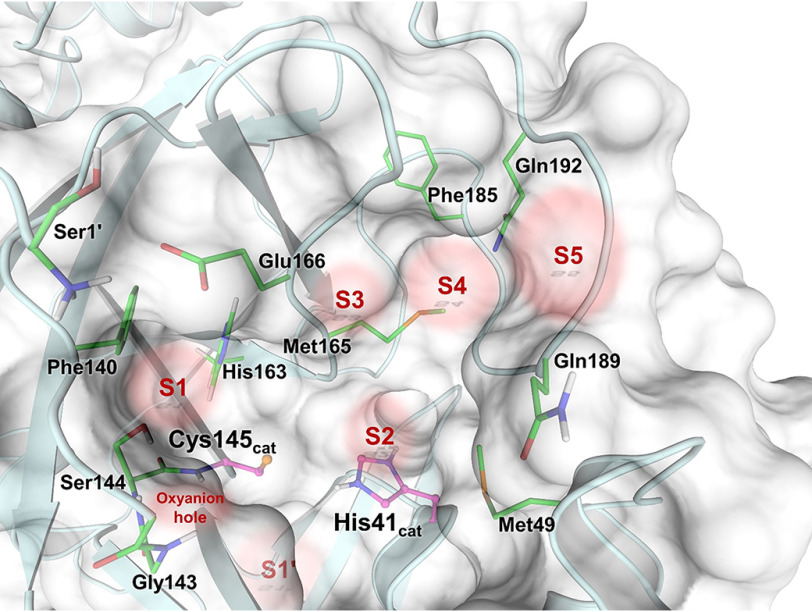
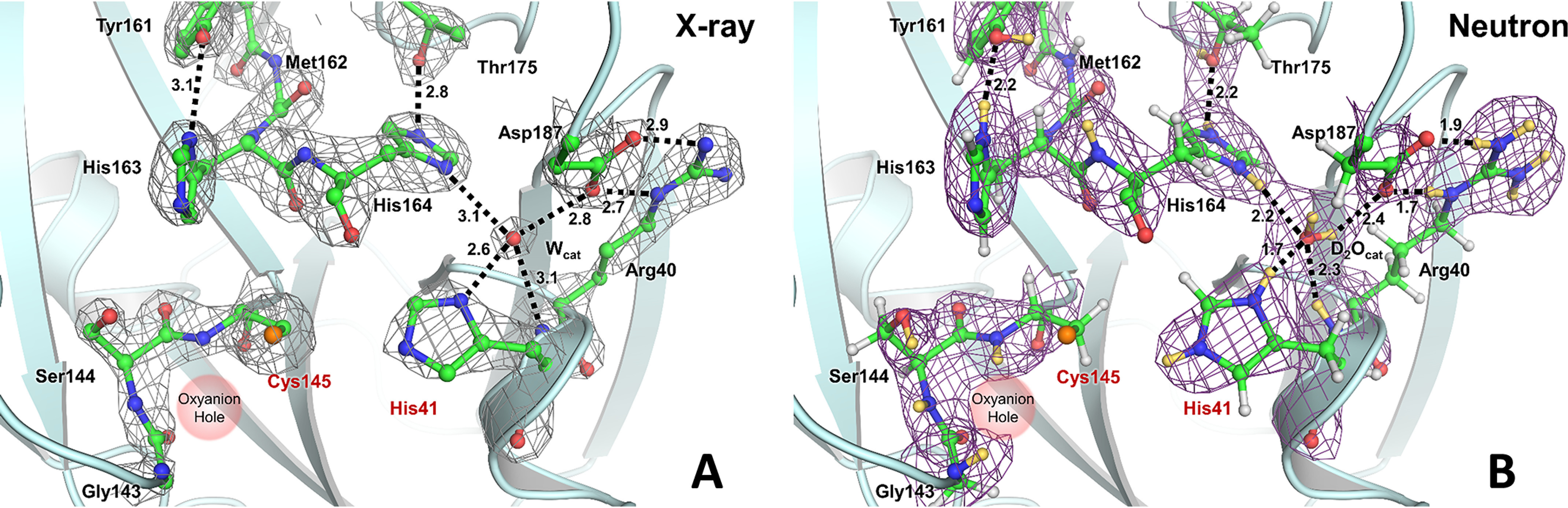
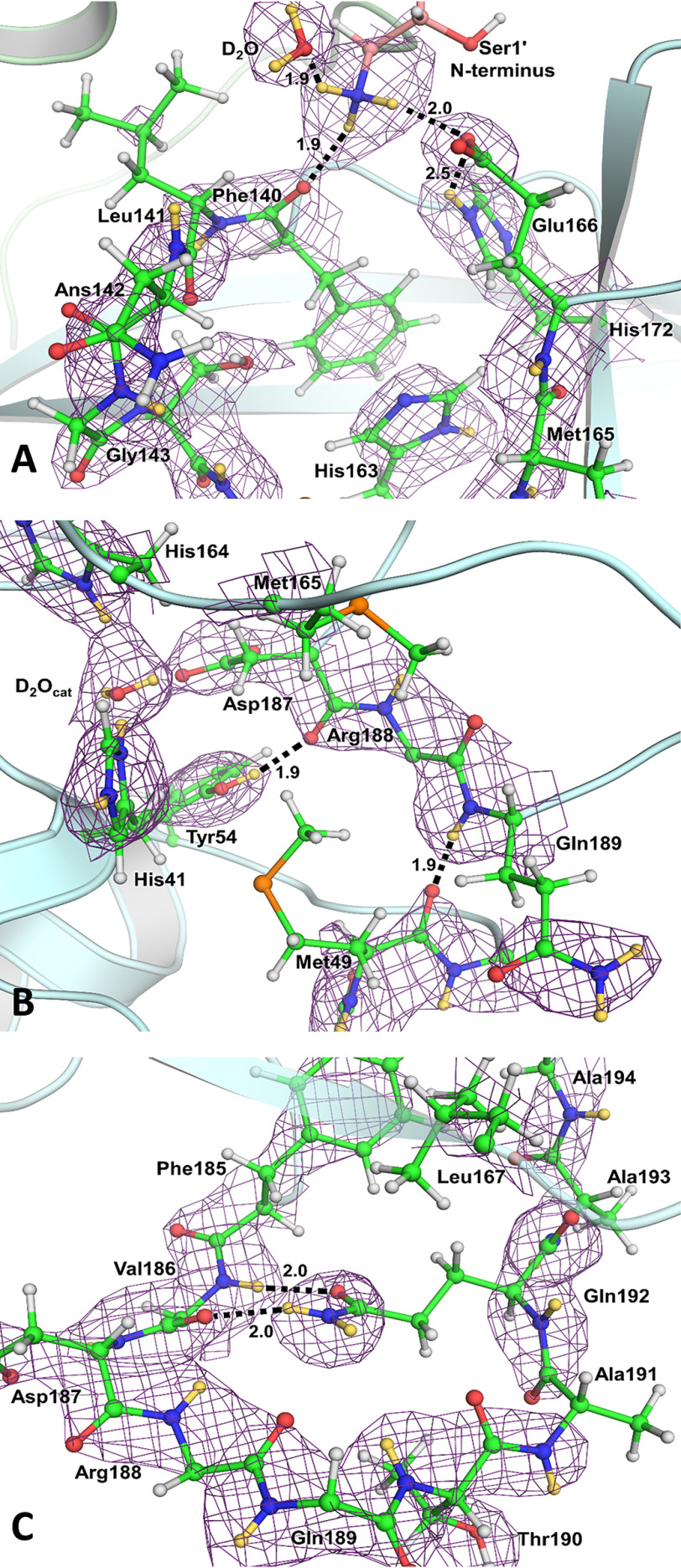
The main protease (3CL M) from SARS-CoV-2, the etiological agent of COVID-19, is an essential enzyme for viral replication. 3CL M possesses an unusual catalytic dyad composed of Cys and His residues. A critical question in the field has been what the protonation states of the ionizable residues in the substrate-binding active-site cavity are; resolving this point would help understand the catalytic details of the enzyme and inform rational drug development against this pernicious virus. Here, we present the room-temperature neutron structure of 3CL M, which allowed direct determination of hydrogen atom positions and, hence, protonation states in the protease. We observe that the catalytic site natively adopts a zwitterionic reactive form in which Cys is in the negatively charged thiolate state and His is doubly protonated and positively charged, instead of the neutral unreactive state usually envisaged. The neutron structure also identified the protonation states, and thus electrical charges, of all other amino acid residues and revealed intricate hydrogen-bonding networks in the active-site cavity and at the dimer interface. The fine atomic details present in this structure were made possible by the unique scattering properties of the neutron, which is an ideal probe for locating hydrogen positions and experimentally determining protonation states at near-physiological temperature. Our observations provide critical information for structure-assisted and computational drug design, allowing precise tailoring of inhibitors to the enzyme's electrostatic environment.
新型冠状病毒(SARS-CoV-2)的主要蛋白酶(3CL M)是病毒复制所必需的酶,也是引发 COVID-19 的病原体。3CL M 具有一个不寻常的催化双功能基,由半胱氨酸(Cys)和组氨酸(His)残基组成。该领域的一个关键问题是底物结合活性位点腔中可离子化残基的质子化状态是什么;解决这一问题将有助于了解酶的催化细节,并为针对这种恶性病毒的合理药物开发提供信息。在这里,我们呈现了 3CL M 的室温中子结构,该结构允许直接确定蛋白酶中活性位点的氢原子位置,从而确定质子化状态。我们观察到,催化位点天然采用两性离子反应形式,其中半胱氨酸呈带负电荷的硫醇盐状态,组氨酸呈双质子化和正电荷状态,而不是通常设想的中性非反应状态。中子结构还确定了所有其他氨基酸残基的质子化状态(因此是电荷状态),并揭示了活性位点腔中和二聚体界面处复杂的氢键网络。该结构中存在的精细原子细节是通过中子独特的散射特性实现的,中子是在接近生理温度下定位氢原子位置和实验确定质子化状态的理想探针。我们的观察结果为基于结构的和计算药物设计提供了关键信息,允许针对酶的静电环境精确调整抑制剂。