Kim Hwi Young, Baik Su Jung, Lee Hye Ah, Lee Byoung Kwon, Lee Hye Sun, Kim Tae Hun, Yoo Kwon
Department of Internal Medicine, College of Medicine, Ewha Womans University, 1071, Anyangcheon-ro, Yangcheon-gu, Seoul, 07985, Republic of Korea.
Healthcare Research Team, Health Promotion Center, Gangnam Severance Hospital, Seoul, Republic of Korea.
Sci Rep. 2020 Oct 15;10(1):17491. doi: 10.1038/s41598-020-74659-9.
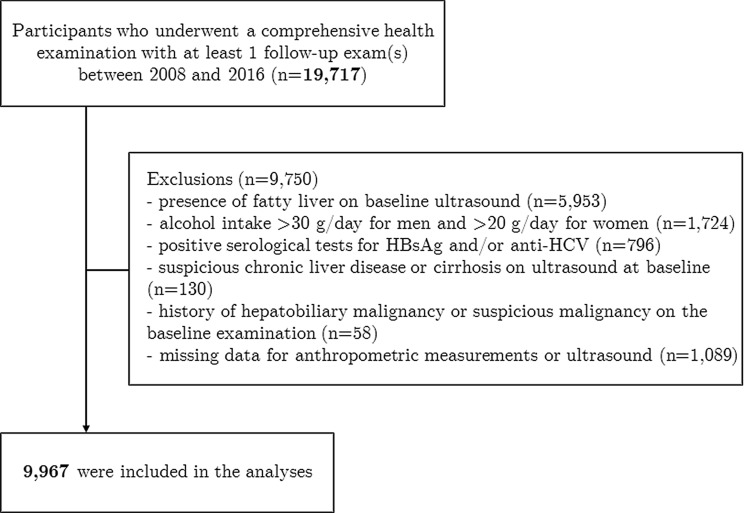
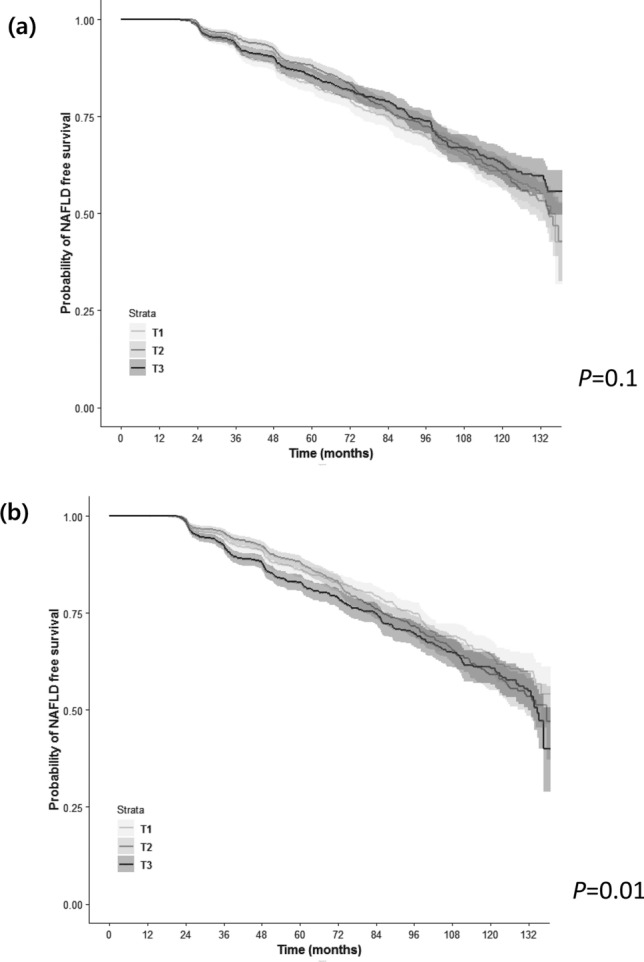
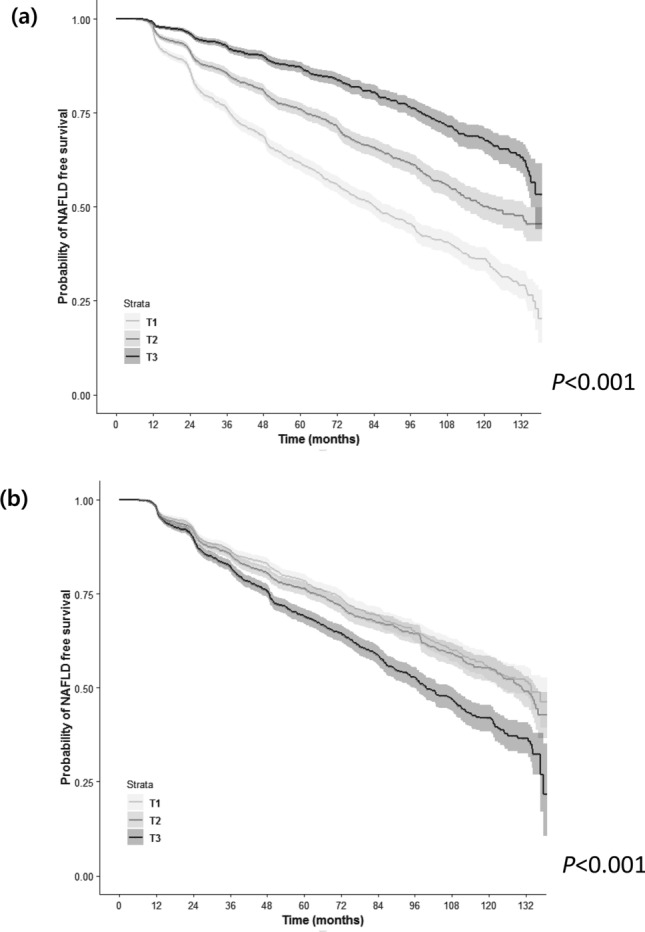
The relationship between changes in body components and the risk of nonalcoholic fatty liver disease (NAFLD) is not fully understood. We investigated the effects of body components and subsequent changes on incident NAFLD at follow-up ultrasound scanning in a longitudinal cohort. We included 9967 participants without NAFLD at baseline who underwent serial health examinations. Sex-specific, weight-adjusted skeletal muscle index (SMI) was used. Mean follow-up duration was 48.5 ± 33.5 months. NAFLD developed in 2395 participants (24.0%). Body composition was measured using bioelectrical impedance analysis. The following baseline body components were significantly associated with incident NAFLD: the lowest and middle SMI tertiles in the normal-weight group (adjusted hazard ratio [aHR] = 2.20 and 1.54, respectively), and fat percentage in the normal-weight (aHR = 1.12), overweight (aHR = 1.05), and obese groups (aHR = 1.03) (all P < 0.05). Among 5,033 participants who underwent ≥ 3 health examinations, SMI increase between the first and second examinations was an independent protective factor against incident NAFLD in non-obese groups (P < 0.05). Increased fat percentage was an independent risk factor for incident NAFLD in all weight categories (P < 0.05). High fat mass at baseline may be a better predictor of incident NAFLD than muscle mass. Reciprocal changes in fat and muscle mass during the first year of follow-up predicted incident NAFLD in non-obese groups.
身体成分变化与非酒精性脂肪性肝病(NAFLD)风险之间的关系尚未完全明确。我们在一个纵向队列中,通过随访超声扫描研究了身体成分及其后续变化对新发NAFLD的影响。我们纳入了9967名基线时无NAFLD且接受了系列健康检查的参与者。使用了按性别和体重调整的骨骼肌指数(SMI)。平均随访时间为48.5±33.5个月。2395名参与者(24.0%)发生了NAFLD。使用生物电阻抗分析测量身体成分。以下基线身体成分与新发NAFLD显著相关:正常体重组中最低和中间SMI三分位数(调整后风险比[aHR]分别为2.20和1.54),以及正常体重组(aHR = 1.12)、超重组(aHR = 1.05)和肥胖组(aHR = 1.03)的脂肪百分比(均P < 0.05)。在接受≥3次健康检查的5033名参与者中,非肥胖组第一次和第二次检查之间SMI的增加是预防新发NAFLD的独立保护因素(P < 0.05)。脂肪百分比增加是所有体重类别中新发NAFLD的独立危险因素(P < 0.05)。基线时高脂肪量可能比肌肉量更能预测新发NAFLD。随访第一年脂肪和肌肉量的相互变化可预测非肥胖组的新发NAFLD。