Cai Guoxin, Yu Jinming, Meng Xue
Department of Radiation Oncology, Cheeloo College of Medicine, Shandong University, Jinan, Shandong, People's Republic of China.
Department of Radiation Oncology, Shandong Cancer Hospital and Institute, Shandong First Medical University and Shandong Academy of Medical Sciences, Jinan, Shandong, People's Republic of China.
Cancer Manag Res. 2020 Sep 15;12:8497-8507. doi: 10.2147/CMAR.S257058. eCollection 2020.
Our purpose was to evaluate the association between hematologic markers and mortality and adverse events in patients with esophageal squamous cell carcinoma (ESCC) treated with neoadjuvant chemoradiotherapy (nCRT).
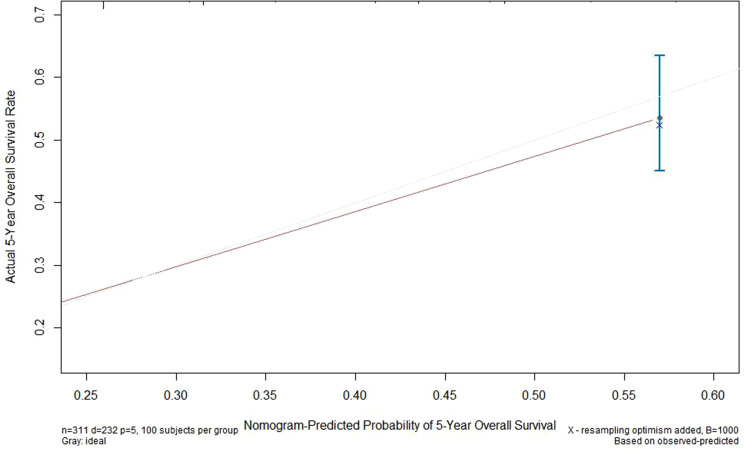
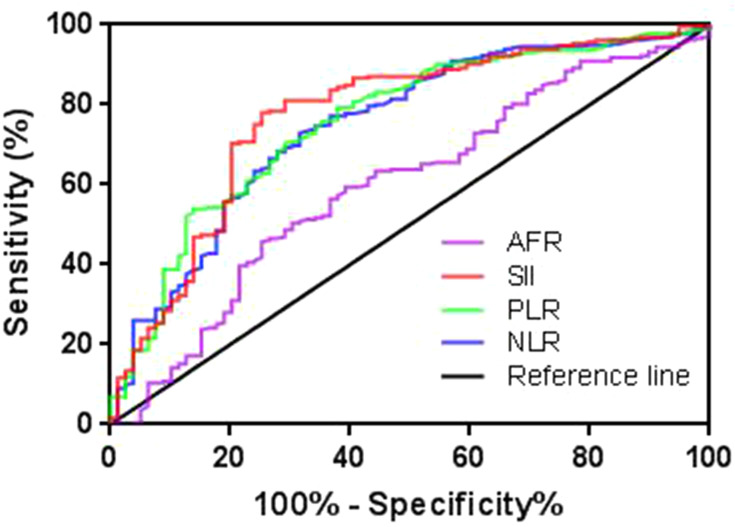
A total of 311 patients with ESCC treated with nCRT from 2012 to 2014 were enrolled retrospectively. The Kaplan-Meier method with a Log rank test was used to calculate five-year overall survival (OS). Receiver operating characteristic (ROC) curves were plotted to determine the cut-off values for hematologic markers. Multivariate analysis was performed using Cox regression analysis model. Model performance was evaluated by predicted nomogram, concordance index (C-index) and calibration curve.
Median follow-up was 22 months. High pretreatment platelet to lymphocyte ratio (PLR, p = 0.047) and systemic immune-inflammation index (SII, p = 0.027) were significantly associated with pathologic complete response (pCR). In multivariate analysis, smoking history, Eastern Cooperative Oncology Group (ECOG) performance status, invasion depth, lymph node metastasis, PLR, and SII were independent factors to predict five-year OS. Multivariate analysis showed a lower neutrophil to lymphocyte ratio (NLR) at baseline (p = 0.007) was significantly associated with development of grade ≥3 hematologic toxicity, and none of inflammatory biomarkers could predict grade ≥3 non-hematologic toxicity or radiation pneumonitis (RP).
SII and PLR were independent indicators to predict prognosis in patients with ESCC treated with nCRT, and a lower NLR at baseline was an independent indicator to predict grade ≥3 hematologic toxicity.
我们的目的是评估血液学标志物与接受新辅助放化疗(nCRT)的食管鳞状细胞癌(ESCC)患者的死亡率和不良事件之间的关联。
回顾性纳入了2012年至2014年期间接受nCRT治疗的311例ESCC患者。采用Kaplan-Meier法和Log秩检验计算五年总生存率(OS)。绘制受试者工作特征(ROC)曲线以确定血液学标志物的临界值。使用Cox回归分析模型进行多因素分析。通过预测列线图、一致性指数(C-index)和校准曲线评估模型性能。
中位随访时间为22个月。治疗前血小板与淋巴细胞比值(PLR,p = 0.047)和全身免疫炎症指数(SII,p = 0.027)与病理完全缓解(pCR)显著相关。在多因素分析中,吸烟史、东部肿瘤协作组(ECOG)体能状态、浸润深度、淋巴结转移、PLR和SII是预测五年OS的独立因素。多因素分析显示,基线时较低的中性粒细胞与淋巴细胞比值(NLR,p = 0.007)与≥3级血液学毒性的发生显著相关,且没有炎症生物标志物能够预测≥3级非血液学毒性或放射性肺炎(RP)。
SII和PLR是接受nCRT治疗的ESCC患者预后的独立预测指标,基线时较低的NLR是预测≥3级血液学毒性的独立指标。