Dessie Gashaw, Tadesse Yewondwossen, Demelash Birhanu, Genet Solomon
Department of Biochemistry, School of Medicine, College of Medicine and Health Sciences, University of Gondar, Gondar, Ethiopia.
Department of Internal Medicine, School of Medicine, Addis Ababa University, Addis Ababa, Ethiopia.
Open Access Rheumatol. 2020 Sep 23;12:223-232. doi: 10.2147/OARRR.S264466. eCollection 2020.
Rheumatoid arthritis (RA) is a chronic inflammatory disease characterized by severe joint pain, swelling, damage, and disability which leads to joint destruction and loss of function. The complication of RA is associated with cardiovascular diseases, particularly due to systemic inflammation and dyslipidemia. The purpose of this study was to assess the development of atherosclerosis, which acts as a major risk factor for cardiovascular complications in RA patients.
A hospital-based cross-sectional study was conducted at the Rheumatology Clinic of Tikur Anbessa Specialized Hospital. The study made a comparison of risk factors (dyslipidemia and inflammatory status) between individuals having RA as a case group and apparently healthy individuals as a control group. Simple descriptive statistics, one-way ANOVA, independent sample -test and multivariate analysis were utilized for statistical analysis. p-value of <0.05 at the 95% confidence level was considered as statistically significant.
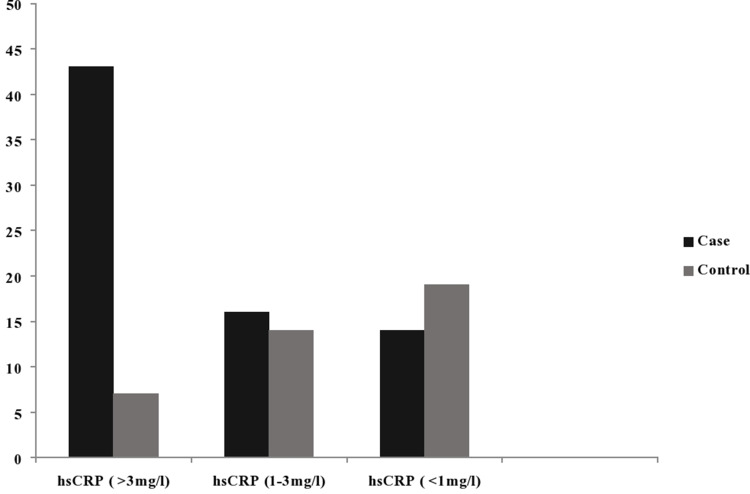
The result of this study demonstrated that there was a significant elevation of mean ±SD of TC, TC/HDL, LDL/HDL, and lowered value of HDL-C was seen among RA patients than controls (-value <0.05). The mean ±SD of inflammatory marker, high-sensitivity C-reactive protein (hsCRP), was significantly higher among RA patients compared to controls (<0.05). HDL-C had a significant negative correlation with a hsCRP whereas TC/HDL-C and LDL/HDL-C had a significant positive correlation with hsCRP (<0.05).
In this study, RA patients had lipid abnormalities and elevated systemic inflammation than controls. An increase in hsCRP and dyslipidemia status among RA patients indicates the possible development of an atherosclerotic event. Therefore, assessment of lipid profiles and hsCRP in early RA patients may be helpful to assess the possible development of cardiovascular complications.
类风湿关节炎(RA)是一种慢性炎症性疾病,其特征为严重的关节疼痛、肿胀、损伤和残疾,可导致关节破坏和功能丧失。RA的并发症与心血管疾病相关,尤其是由于全身炎症和血脂异常。本研究的目的是评估动脉粥样硬化的发展情况,动脉粥样硬化是RA患者心血管并发症的主要危险因素。
在提库尔·安贝萨专科医院风湿病诊所进行了一项基于医院的横断面研究。该研究比较了作为病例组的RA患者和作为对照组的明显健康个体之间的危险因素(血脂异常和炎症状态)。采用简单描述性统计、单因素方差分析、独立样本t检验和多变量分析进行统计分析。在95%置信水平下p值<0.05被认为具有统计学意义。
本研究结果表明,RA患者的总胆固醇(TC)、TC/高密度脂蛋白(HDL)、低密度脂蛋白(LDL)/HDL的均值±标准差显著升高,且与对照组相比HDL-C值降低(p值<0.05)。与对照组相比,RA患者炎症标志物高敏C反应蛋白(hsCRP)的均值±标准差显著更高(p<0.05)。HDL-C与hsCRP呈显著负相关,而TC/HDL-C和LDL/HDL-C与hsCRP呈显著正相关(p<0.05)。
在本研究中,RA患者比对照组存在脂质异常和全身炎症升高。RA患者hsCRP升高和血脂异常状态表明可能发生动脉粥样硬化事件。因此,评估早期RA患者的血脂谱和hsCRP可能有助于评估心血管并发症的可能发展情况。